
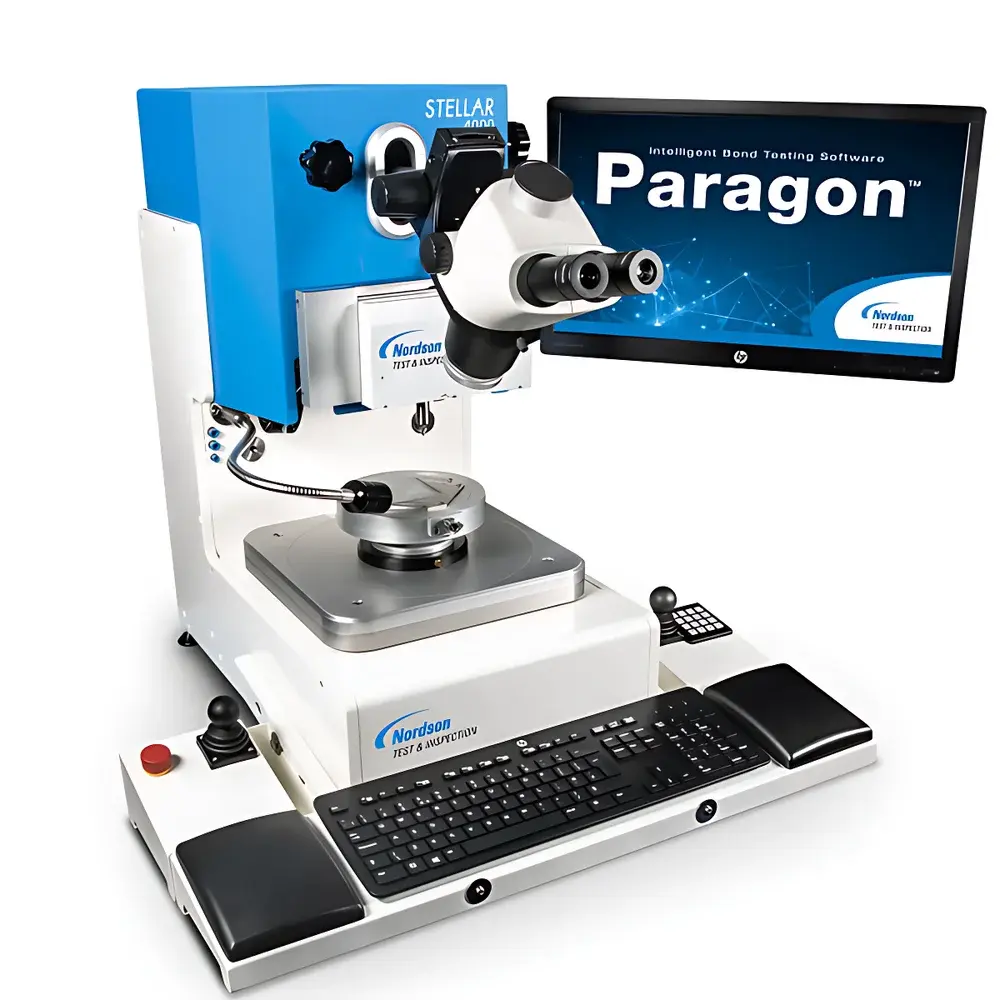
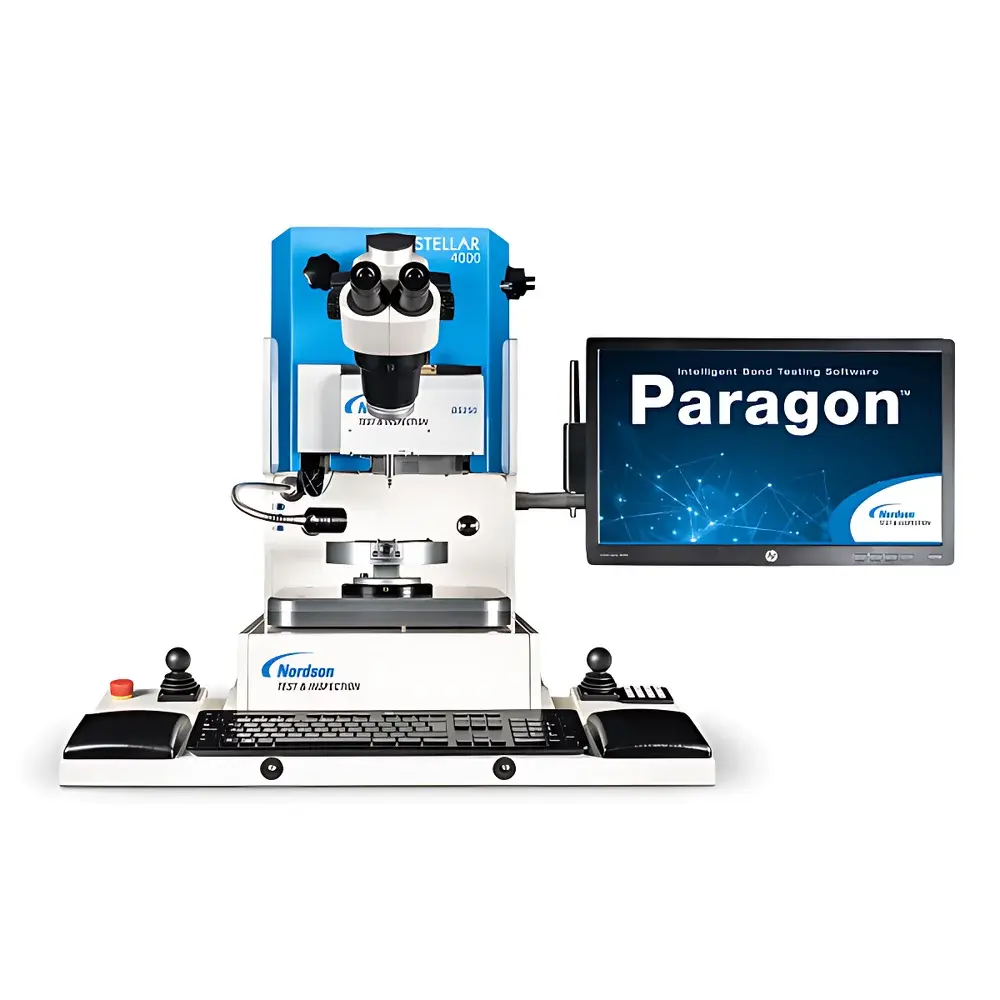
Nordson Dage STELLAR 4000 Bond Strength Tester
| Brand | Nordson Dage |
|---|---|
| Origin | United Kingdom |
| Model | STELLAR 4000 |
| System Accuracy | ±0.25 % F.S.L. |
| Positional Resolution (XY) | 500 nm |
| Z-Axis Travel | 65 mm |
| XY Travel Range | 100 mm × 100 mm |
| XY Speed | up to 2 mm/s |
| Force Measurement Technology | Frictionless Load Cell |
| Power Supply | 100–240 VAC, Single Phase |
| Pneumatic Supply | ≥4.0 bar |
| Dimensions (W×D×H) | 705 mm × 562 mm × 675 mm |
| Weight | 86 kg |
Overview
The Nordson Dage STELLAR 4000 Bond Strength Tester is a manually operated, high-precision mechanical test platform engineered for quantitative bond integrity verification in semiconductor packaging and microelectronics manufacturing. It operates on fundamental principles of mechanical force transduction—applying controlled tensile, shear, or peel loads to interconnect structures (e.g., wire bonds, solder bumps, die attach interfaces) and measuring the resulting force-displacement response with metrological traceability. Designed specifically for production-floor deployment, the STELLAR 4000 integrates calibrated load measurement, sub-micron positional control, and real-time data acquisition to support process validation, incoming material qualification, and failure mode analysis in accordance with industry-standard test methods including MIL-STD-883 Method 2011 (Wire Bond Pull Test), JEDEC JESD22-B116 (Die Shear), and ASTM F459 (Bond Strength of Microelectronic Devices). Its modular architecture enables configuration as a dedicated wire pull tester or expansion into multi-mode operation—including ball shear, chip shear, ball lift (ball pull), and tweezer pull—without compromising mechanical stability or measurement fidelity.
Key Features
- Frictionless electromagnetic load cell technology delivering high linearity, repeatability, and long-term drift stability—critical for pass/fail decisions under ISO/IEC 17025-accredited quality systems.
- Sub-micron positional resolution (500 nm XY) and ±1 µm repeatability, enabling precise alignment of test tools to bond pads, solder balls, or die edges under optical guidance.
- Ergonomic workstation design: height-adjustable microscope stage, padded armrests, anti-vibration optical baseplate, and fully adjustable coaxial LED illumination—reducing operator fatigue during extended shift operations.
- Paragon™ Lite software suite providing intuitive test method setup, real-time force–displacement curve visualization, automated pass/fail logic based on user-defined thresholds, and export-ready CSV/PDF reporting.
- Robust cast-aluminum frame with reinforced kinematic mounting points ensures mechanical rigidity across thermal and vibrational environments typical of cleanroom and factory-floor settings.
- Datasync™ integration capability supports bidirectional data exchange with MES and QMS platforms, facilitating audit-ready electronic records compliant with FDA 21 CFR Part 11 and GLP/GMP documentation requirements.
Sample Compatibility & Compliance
The STELLAR 4000 accommodates a broad range of substrate formats—from bare dies and leadframes to fully packaged QFN, BGA, and wafer-level CSP devices—via interchangeable tooling fixtures and customizable sample holders. Standard tooling includes tungsten carbide-tipped shear blades (100–500 µm), gold wire pull hooks (1–5 mil), and precision tweezers for flip-chip bump evaluation. All mechanical test procedures align with recognized international standards: JEDEC JESD22-B116 for die shear strength, JESD22-B117 for solder bump shear, MIL-STD-883 Method 2011.1 for wire bond pull, and IPC-9701A for interconnect reliability assessment. The system’s calibration certificate is traceable to UKAS-accredited national standards, supporting compliance with ISO 9001, IATF 16949, and AS9100 quality management frameworks.
Software & Data Management
Paragon™ Lite provides an intuitive, role-based interface optimized for production technicians and QA engineers. It supports pre-configured test templates, configurable pass/fail limits per bond type (e.g., Au wire 25 µm vs. Cu wire 30 µm), real-time statistical process monitoring (SPC) charts (X̄–R, Cpk), and automatic generation of test logs with timestamps, operator ID, and instrument metadata. All raw force–displacement data are stored in binary format with checksum validation; export options include CSV (for Excel analysis), XML (for LIMS ingestion), and PDF (with embedded signature fields for electronic approval). Audit trails record every parameter change, test execution, and report generation event—enabling full forensic reconstruction during regulatory inspections.
Applications
- Wire bond pull testing post-wedge/wedge or ball/wedge bonding for automotive and aerospace ICs.
- Die shear strength evaluation of epoxy and solder die-attach processes in power modules and SiC/GaN devices.
- Solder bump shear and lift testing for 2.5D/3D stacked packages and fan-out wafer-level packaging (FOWLP).
- Tweezer pull testing of micro-bumps in flip-chip assemblies to assess underfill adhesion and intermetallic compound (IMC) integrity.
- Qualification of new bond materials (e.g., palladium-coated Cu wire, low-temperature solders) against legacy specifications.
- Root cause analysis of bond failures via synchronized video capture (optional) and force–displacement curve morphology interpretation.
FAQ
Is the STELLAR 4000 suitable for automated inline integration?
No—it is designed as a manual, operator-guided platform optimized for flexibility and rapid method switching. For fully automated solutions, Nordson Dage offers the AUTOVISION™ series.
Does the system support calibration verification using NIST-traceable reference standards?
Yes—calibration kits with certified force standards (e.g., 10 g, 100 g, 1 kg) are available and documented per ISO/IEC 17025 requirements.
Can Paragon™ Lite generate SPC-compliant control charts directly?
Yes—built-in X̄–R and Cpk calculation engines enable real-time charting without third-party software.
What pneumatic interface standard does the STELLAR 4000 use?
It accepts standard ISO 15407-1 (¼” NPT) quick-connect fittings with regulated supply pressure ≥4.0 bar (58 psi).
Is the microscope integrated or optional?
A high-resolution stereo zoom microscope (10×–40× magnification, 100 mm working distance) is included as standard equipment.



