
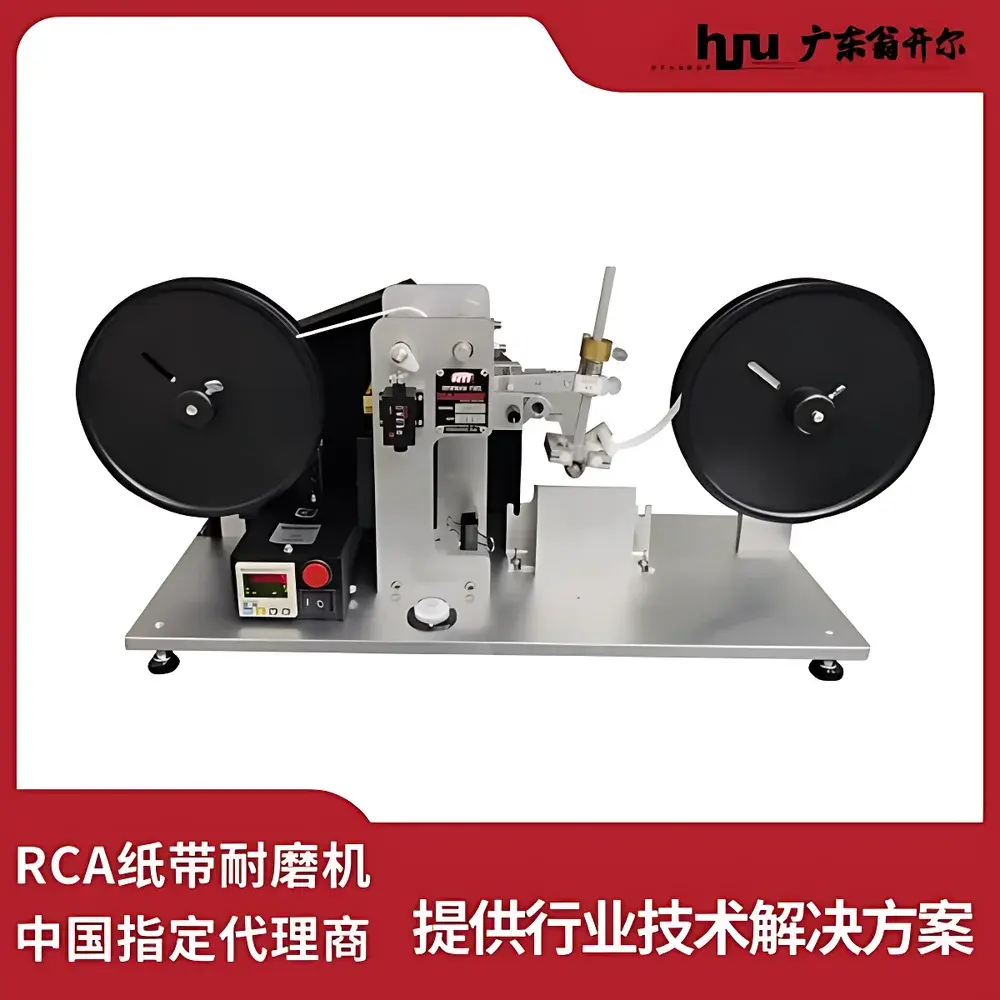
Norman Tool RCA 7-IBB-CC Paper Tape Abrasion Tester
| Brand | Norman Tool |
|---|---|
| Origin | USA |
| Model | RCA 7-IBB-CC |
| Load Options | 55 g / 175 g / 275 g |
| Counter Type | Digital LCD (0–999,999 cycles) |
| Sample Mounting | Flat & 3D fixtures |
| Compliance | ASTM F2357-04 |
| Power Supply | 220 V, 50/60 Hz, 5 A |
| Weight | ~17 kg |
| Accessories | Calibration plate (certified), surface flatness gauge, hex key set, LED magnifier, two counterweights (55 g & 175 g), three O-rings, 3D sample holder |
Overview
The Norman Tool RCA 7-IBB-CC Paper Tape Abrasion Tester is an electromechanical precision instrument engineered for quantitative evaluation of surface wear resistance in thin organic coatings and decorative finishes applied to rigid substrates. It operates on the standardized RCA (Rubbing Cloth Abrasion) principle—utilizing a rotating paper tape as the abrasive medium under controlled normal force and defined oscillatory motion. Unlike rotary or linear reciprocating abrasion methods, the RCA test simulates repetitive tangential contact with a flexible, conformable abrasive surface, making it particularly suitable for assessing durability of printed legends, UV-cured inks, vacuum metallized layers, and hard-coat polycarbonate surfaces used in consumer electronics housings. The instrument conforms strictly to ASTM F2357-04, “Standard Test Method for Measuring Abrasion Resistance of Printed Inks and Coatings on Plastic Substrates Using the RCA Abrasion Test,” and supports comparative analysis aligned with Taber abrasion (ASTM D4060) and DIN 53778 washability protocols where surface integrity under mechanical stress is critical.
Key Features
- Digitally programmable cycle counter (LCD display, range 0–999,999) with presettable endpoint triggering—enabling precise termination at user-defined abrasion thresholds.
- Three calibrated load options (55 g, 175 g, 275 g) achieved via lever-arm counterweight system; standard test load is 275 g (no additional weights); reduction to 175 g or 55 g accomplished using supplied certified counterweights.
- Dual-mode operation: continuous contact mode (constant pressure application) and intermittent contact mode (1.5 s down / 2.0 s up duty cycle), both mechanically governed by cam-driven rocker arm mechanism.
- Universal sample fixture design accommodates both planar specimens (e.g., flat PC/ABS panels) and three-dimensional components (e.g., mobile phone casings, PDA bezels) without reconfiguration.
- Integrated LED magnifier (10×) mounted on adjustable arm for real-time visual assessment of coating failure—defined as exposure of substrate material or irreversible loss of legibility in printed characters.
- Robust cast-aluminum chassis with vibration-damped base ensures mechanical stability during extended testing sessions and minimizes operator-induced variability.
Sample Compatibility & Compliance
The RCA 7-IBB-CC is validated for use across thermoplastic and thermoset substrates including polycarbonate (PC), acrylonitrile butadiene styrene (ABS), polypropylene (PP), and glass-filled composites. It is routinely deployed in QC laboratories supporting ISO 9001-certified manufacturing lines for consumer electronics, medical device enclosures, and automotive HMI interfaces. Test data generated meets documentation requirements for internal quality audits and external regulatory submissions where surface durability must be demonstrated per customer specifications or industry benchmarks. While not inherently GLP/GMP-compliant, the instrument supports traceability when operated with documented SOPs, calibrated weights, certified reference plates, and audit-ready logbooks—particularly relevant for FDA-regulated Class II device manufacturers evaluating label adhesion and tactile overlay longevity.
Software & Data Management
The RCA 7-IBB-CC operates as a standalone electromechanical system with no embedded firmware or connectivity interfaces. All operational parameters—including total cycles, selected load, mode (continuous/intermittent), and elapsed time—are manually recorded. To ensure data integrity and process repeatability, users are advised to maintain a controlled test log referencing ASTM F2357-04 Annex A1 procedures. Optional integration with laboratory information management systems (LIMS) is achievable via external digital logging devices synchronized to the motor’s pulse output (TTL-compatible signal available upon request). Calibration verification is performed using the supplied NIST-traceable calibration plate, with annual recalibration recommended per ISO/IEC 17025 guidelines.
Applications
- Evaluation of ink adhesion and abrasion resistance on smartphone keypad legends and touch panel overlays.
- Validation of anti-scratch hard coat performance on laptop lids and tablet backplates.
- Comparative screening of UV-curable acrylic and silicone-based topcoats for automotive interior trim.
- Quality gate testing for electroplated ABS housings subjected to repeated handling and cleaning cycles.
- Pre-release durability assessment of medical device control panel graphics exposed to alcohol-based disinfectants and wiping actions.
FAQ
What type of abrasive media is required for this tester?
Only certified RCA-grade paper tape (e.g., Normantool Part No. RCA-TAPE-100) must be used; generic kraft or sandpaper substitutes invalidate ASTM F2357-04 compliance and introduce unacceptable inter-lot variability.
Can the same test result be directly compared between 7-IBB (mechanical counter) and 7-IBB-CC (digital counter)?
Yes—both models share identical mechanical architecture, load train, and cam timing; only the counting mechanism differs. Calibration verification using the certified plate confirms equivalence of cycle registration accuracy.
Is environmental conditioning required prior to testing?
Per ASTM F2357-04, specimens shall be conditioned at 23 ± 2 °C and 50 ± 5 % RH for minimum 48 hours prior to cleaning and abrasion testing to stabilize hygroscopic coating behavior.
How often should the O-rings and cam followers be replaced?
Inspect before each test series; replace O-rings every 6 months or after 50,000 cycles, whichever occurs first. Cam follower lubrication with light machine oil is recommended every 10,000 cycles to maintain timing fidelity.
Does the instrument support automated pass/fail reporting?
No—pass/fail determination is based on visual inspection per ASTM criteria (substrate exposure or contrast loss ≥20% vs. baseline). Automated image analysis requires external vision systems integrated downstream of the tester.




