
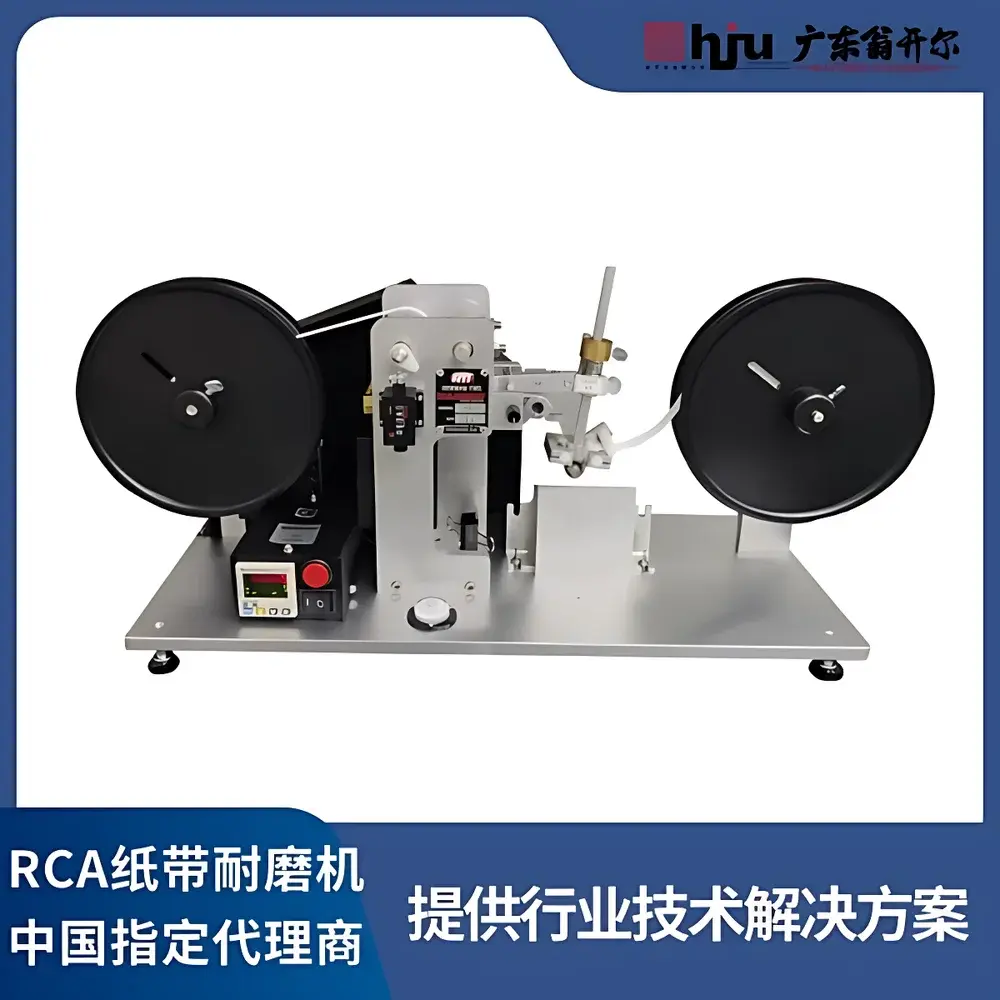
Norman Tool RCA Abrasion Tester Model 7-IBB-CC
| Brand | Norman Tool |
|---|---|
| Origin | USA |
| Type | RCA-Type Rotating Drum Abrasion Tester |
| Compliance | ASTM F2357-04 |
| Load Options | 55 g / 175 g / 275 g (standard: 275 g) |
| Counter Type | Digital LCD (0–999,999 cycles, programmable) |
| Sample Mounting | Flat & 3D fixtures included |
| Magnification | Integrated lamp-equipped magnifier |
| Power Supply | 220 V, 50/60 Hz, 5 A |
| Weight | ~17 kg |
| Accessories | Calibration plate (certified), surface level gauge, hex key set, two O-rings, stereo sample holder, two counterweight masses (55 g & 175 g) |
Overview
The Norman Tool RCA Abrasion Tester Model 7-IBB-CC is an engineered precision instrument designed for quantitative evaluation of surface wear resistance in coated and laminated polymer substrates. It operates on the standardized RCA (Rubbing Cloth Abrasion) principle—where controlled mechanical abrasion is induced via a rotating abrasive paper tape driven by a constant-torque motor, pressed against the test specimen through a calibrated lever-arm system. Unlike random-contact or oscillatory methods, the 7-IBB-CC implements a defined intermittent contact cycle (1.5 s down, 2.0 s up), replicating real-world tactile stress patterns encountered during consumer handling of electronic enclosures, keypad overlays, and decorative finishes. Its design strictly adheres to ASTM F2357-04, ensuring methodological consistency with international quality assurance protocols used across electronics, automotive interiors, and medical device packaging supply chains.
Key Features
- Dual-mode operation: Selectable intermittent (oscillating arm) or continuous contact mode via cam-positioning mechanism—enabling differentiation between transient impact wear and sustained frictional degradation.
- Precision load calibration: Three standardized test loads (55 g, 175 g, 275 g) achieved using certified counterweights; 275 g is the default reference load per ASTM F2357-04, with traceable adjustment capability for material-specific sensitivity profiling.
- Digital programmable counter: High-resolution LCD display (0–999,999 cycles) with user-defined endpoint triggering—supports automated test termination, repeatable endpoint definition, and integration into laboratory data logging workflows.
- Universal sample adaptability: Includes both planar clamping fixture and stereoscopic sample holder for curved or contoured surfaces (e.g., smartphone housings, PDA bezels, laptop lids), maintaining consistent normal force vector alignment regardless of geometry.
- Integrated visual assessment aid: Built-in LED-lit magnifier (10× optical) enables in-situ inspection of wear onset—critical for identifying first-layer breakthrough, ink delamination, or substrate exposure without specimen removal.
- Robust mechanical architecture: Cast aluminum frame, hardened steel roller shafts, and sealed bearing assemblies ensure long-term dimensional stability and minimal drift under repeated thermal and mechanical cycling.
Sample Compatibility & Compliance
The 7-IBB-CC is validated for use with rigid and semi-rigid plastic substrates—including polycarbonate (PC), acrylonitrile butadiene styrene (ABS), polypropylene (PP), and their metallized, painted, or UV-cured acrylic-coated derivatives. It supports testing of printed legends, laser-marked identifiers, and vacuum-deposited metallic layers on consumer electronics components. All operational parameters comply with ASTM F2357-04 “Standard Test Method for Measuring Abrasion Resistance of Printed or Coated Surfaces Using the RCA Abrasion Tester.” The instrument’s mechanical repeatability (±0.8% RSD over 10 replicate runs on certified reference plates) meets GLP-aligned validation requirements for QC laboratories operating under ISO/IEC 17025 or FDA 21 CFR Part 11–governed environments. While not a Taber or DIN 53778 scrub tester, its results correlate empirically with those platforms when normalized to equivalent energy input—facilitating cross-method benchmarking where required by multi-standard compliance programs.
Software & Data Management
The 7-IBB-CC operates as a standalone electromechanical system with no embedded firmware or network interface. However, its digital counter output (TTL-compatible pulse signal available upon request) permits integration with external PLCs, SCADA systems, or custom LabVIEW-based acquisition modules for automated cycle logging, pass/fail threshold enforcement, and audit-trail generation. Raw cycle counts are manually recorded or exported via RS-232 (optional adapter). For regulated environments, users may implement procedural controls—including operator ID logging, pre-test verification checklists (e.g., tape tension verification, weight calibration log), and post-test image capture of worn specimens—to satisfy ALCOA+ data integrity principles. Calibration certificates for the supplied reference plate are NIST-traceable and include uncertainty budgets compliant with ISO/IEC 17025 Clause 6.5.
Applications
- Wear endurance validation of alphanumeric keypad legends on mobile devices and industrial HMIs.
- Quality gate testing for OEM-applied hard-coat lacquers on optical lenses and touch-panel overlays.
- Process qualification of plasma-treated or corona-discharged film surfaces prior to metallization.
- Comparative ranking of anti-scratch additive packages in injection-molded thermoplastic resins.
- Failure analysis of coating adhesion loss in accelerated aging studies (e.g., combined thermal-humidity-abrasion exposure).
- Supplier qualification audits requiring objective, operator-independent abrasion metrics per contractual SOWs.
FAQ
What abrasive media is required for ASTM F2357-04 compliance?
RCA-certified 3M Scotch-Brite™ 7448 or equivalent 3M 3000-series non-woven abrasive tape (1/2-inch width, 100-yard roll); lot-specific certification must accompany each shipment to ensure consistent fiber density and binder hardness.
Can the 7-IBB-CC be used for non-plastic substrates like anodized aluminum or tempered glass?
Yes—provided the coating thickness exceeds 5 µm and surface roughness (Ra) remains below 0.8 µm; however, ASTM F2357-04 explicitly excludes bare metal or ceramic substrates, so reporting must specify deviation from standard scope.
How frequently must the calibration plate be re-certified?
Annually, or after 5000 cumulative test cycles—whichever occurs first—as recommended by Norman Tool’s maintenance protocol and aligned with ISO/IEC 17025 Clause 6.4.2.
Is operator training required before first use?
Yes: Norman Tool provides documented SOPs covering tape tension verification, lever-arm balance point adjustment, and cam-mode selection; hands-on verification of ±1% load accuracy is mandatory prior to release for production testing.
Does the instrument support GLP-compliant electronic records?
Not natively—but when paired with validated third-party data acquisition software and procedural controls (e.g., 21 CFR Part 11–compliant e-signature workflows), full audit trail capability can be achieved within a qualified laboratory information management system (LIMS).






