
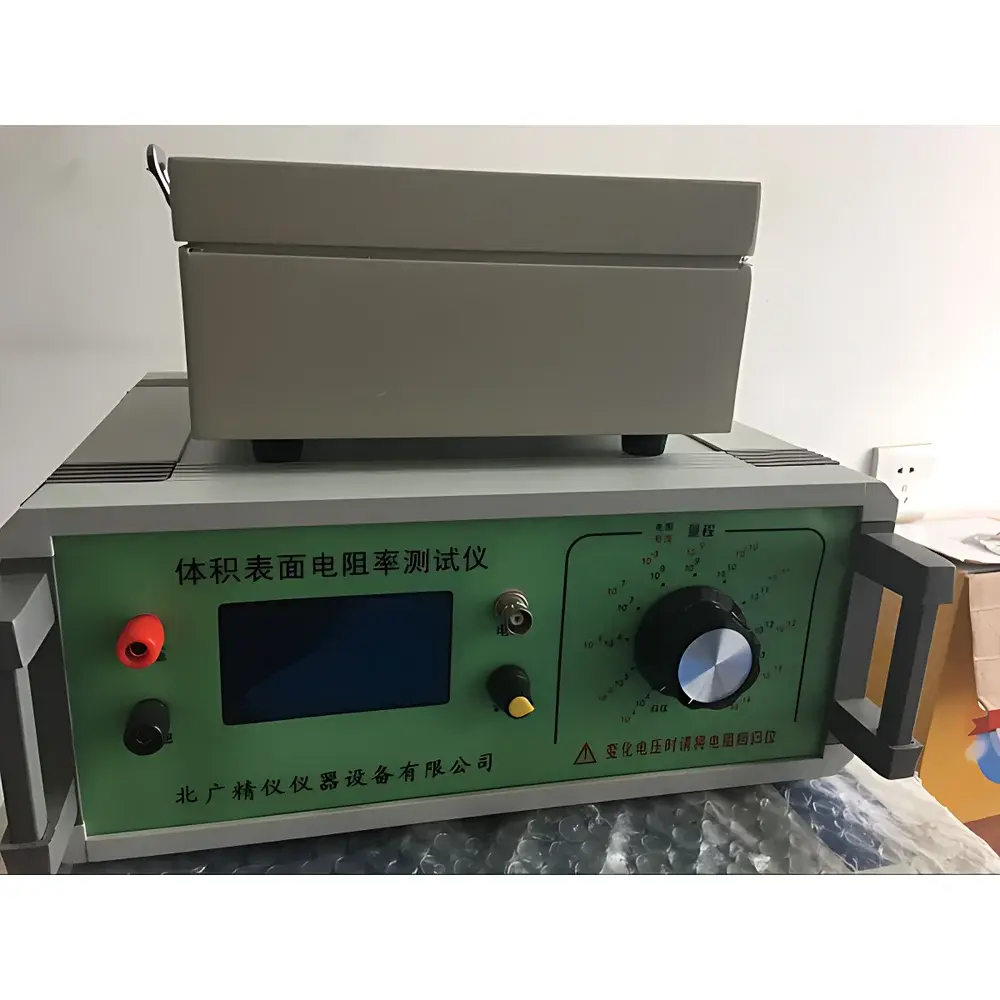
North Guang BEST-121 Surface & Volume Resistivity Tester for Epoxy Resin Boards and Polymer Insulating Materials
| Brand | North Guang Precision Instrument |
|---|---|
| Origin | Beijing, China |
| Manufacturer Type | Direct Manufacturer |
| Country of Origin | China |
| Model | BEST-121 |
| Measuring Range | 1×10⁴ Ω to 1×10¹⁸ Ω |
| Current Range | 2×10⁻⁴ A to 1×10⁻¹⁶ A |
| Test Voltages | 10 V / 50 V / 100 V / 250 V / 500 V / 1000 V (adjustable) |
| Accuracy | ±2% |
| Display | Dual 3.5-digit LED (resistance & current) |
| Compliance | GB/T 1410–2006, ASTM D257–99 |
| Electrode Method | Three-electrode configuration |
| Operating Temperature | 0–40 °C, RH <80% |
| Power Supply | AC 220 V, 50 Hz, ~5 W |
| Dimensions | 285 × 245 × 120 mm |
| Weight | 2.5 kg |
Overview
The North Guang BEST-121 Surface & Volume Resistivity Tester is a precision digital high-resistance meter engineered for accurate, stable measurement of surface and volume resistivity in solid insulating materials—including epoxy resin boards, polymer films, rubber compounds, and antistatic composites. It operates on the fundamental principle of Ohm’s Law (R = V/I), but distinguishes itself from conventional electrometers by simultaneously digitizing both applied test voltage and resulting current via integrated high-impedance analog front-end circuitry and real-time A/D conversion. Unlike legacy analog or single-parameter high-resistance meters—whose nonlinear scale and voltage drift compromise resolution at ultra-high impedances—the BEST-121 delivers linear, traceable resistance values across its full 14-decade range (10⁴ Ω to 10¹⁸ Ω) with minimal dependence on source stability or environmental fluctuation. Its dual-channel display presents both resistance and current readings concurrently, enabling direct evaluation of leakage behavior and material polarization response under controlled DC bias.
Key Features
- Simultaneous high-precision measurement of resistance (1×10⁴ Ω – 1×10¹⁸ Ω) and current (2×10⁻⁴ A – 1×10⁻¹⁶ A) using synchronized voltage/current sampling architecture
- Adjustable DC test voltages (10 V, 50 V, 100 V, 250 V, 500 V, 1000 V) compliant with ASTM D257 and GB/T 1410–2006 test protocols
- Three-electrode configuration per IEC 60093 and ASTM D257 Annex A2, ensuring separation of surface and volume conduction paths for unambiguous resistivity calculation
- Dual 3.5-digit LED display with independent readouts for resistance and current—eliminating manual unit conversion or external ammeter dependency
- Low-power, compact design (285 × 245 × 120 mm; 2.5 kg) suitable for benchtop use in QC labs, R&D facilities, and production line verification stations
- Internal voltage regulation and guard-driven input stage minimize noise coupling and stray capacitance effects—critical for sub-picoampere current fidelity
Sample Compatibility & Compliance
The BEST-121 is validated for use with rigid and semi-rigid dielectric substrates including epoxy resin laminates (e.g., FR-4, G10), polyimide films, silicone rubber sheets, conductive/antistatic plastics (e.g., carbon-filled PE/PP), and elastomeric flooring materials. Its three-electrode fixture supports standardized sample geometries per GB/T 1410 (circular electrodes, defined guard ring width) and ASTM D257 (electrode diameter ≥ 50 mm, guard gap ≤ 2 mm). The instrument meets essential electrical safety requirements for Class II portable measuring equipment (IEC 61010-1) and supports GLP-compliant documentation when paired with external data loggers. While not FDA 21 CFR Part 11–certified out-of-the-box, its deterministic analog-to-digital signal path and non-volatile parameter storage enable audit-ready operation under ISO/IEC 17025-accredited quality systems.
Software & Data Management
The BEST-121 operates as a standalone instrument with no embedded firmware-based data logging or USB connectivity. However, its stable analog outputs (0–2 V proportional to log₁₀(R) and I) are compatible with third-party DAQ systems (e.g., National Instruments USB-6009, Keysight 34972A) for time-stamped resistivity trending, statistical process control (SPC), and automated pass/fail reporting. When integrated into laboratory information management systems (LIMS), raw resistance and current values can be exported via RS-232 (optional adapter) or analog output for traceability. All test parameters—including selected voltage, electrode configuration, and ambient conditions—are manually recorded per GLP practice; the instrument’s ±2% basic accuracy and temperature-stable reference design ensure repeatability across shifts and operators.
Applications
- Quality control of epoxy resin PCB substrates for aerospace and high-reliability electronics—verifying surface resistivity >1×10¹² Ω/sq to prevent electrostatic discharge (ESD) damage
- Volume resistivity validation of insulating rubber gaskets used in high-voltage transformer housings (per IEEE Std 930)
- Antistatic performance verification of cleanroom flooring and footwear per ANSI/ESD S20.20 and IEC 61340-4-1
- Research-grade characterization of nanocomposite polymers containing carbon black, graphene, or metal oxides—quantifying percolation thresholds
- Dark current measurement of photodetector encapsulants and optical isolator housings where leakage below 10 fA must be confirmed
- Material qualification for medical device packaging per ISO 11607–1, where surface resistivity governs particulate adhesion and sterilization efficacy
FAQ
What standard test methods does the BEST-121 support?
It fully complies with GB/T 1410–2006 and ASTM D257–99 for surface and volume resistivity measurements, including mandatory three-electrode geometry, voltage selection, and dwell time requirements.
Can it measure both surface and volume resistivity on the same sample?
Yes—by reconfiguring electrode placement per GB/T 1410 Section 6.2 (surface) and Section 7.2 (volume), and applying the appropriate geometric correction factors during post-test calculation.
Is calibration traceable to national standards?
The instrument accepts external calibration using NIST-traceable high-value resistors (e.g., IET Labs SR1012 series) and picoammeter standards; factory calibration certificates include uncertainty budgets per ISO/IEC 17025 guidelines.
Does it meet requirements for regulated industries like pharmaceuticals or medical devices?
While the hardware itself requires user-established SOPs for 21 CFR Part 11 compliance, its measurement stability, documented accuracy, and repeatable test setup make it suitable for IQ/OQ/PQ validation within GMP environments.
How is electrode contact resistance minimized during high-resistance measurement?
The three-electrode system incorporates a guarded guard ring that actively nullifies surface leakage paths; combined with gold-plated contacts and low-noise triaxial cabling, contact resistance contributes <0.1% error even at 10¹⁷ Ω.




