
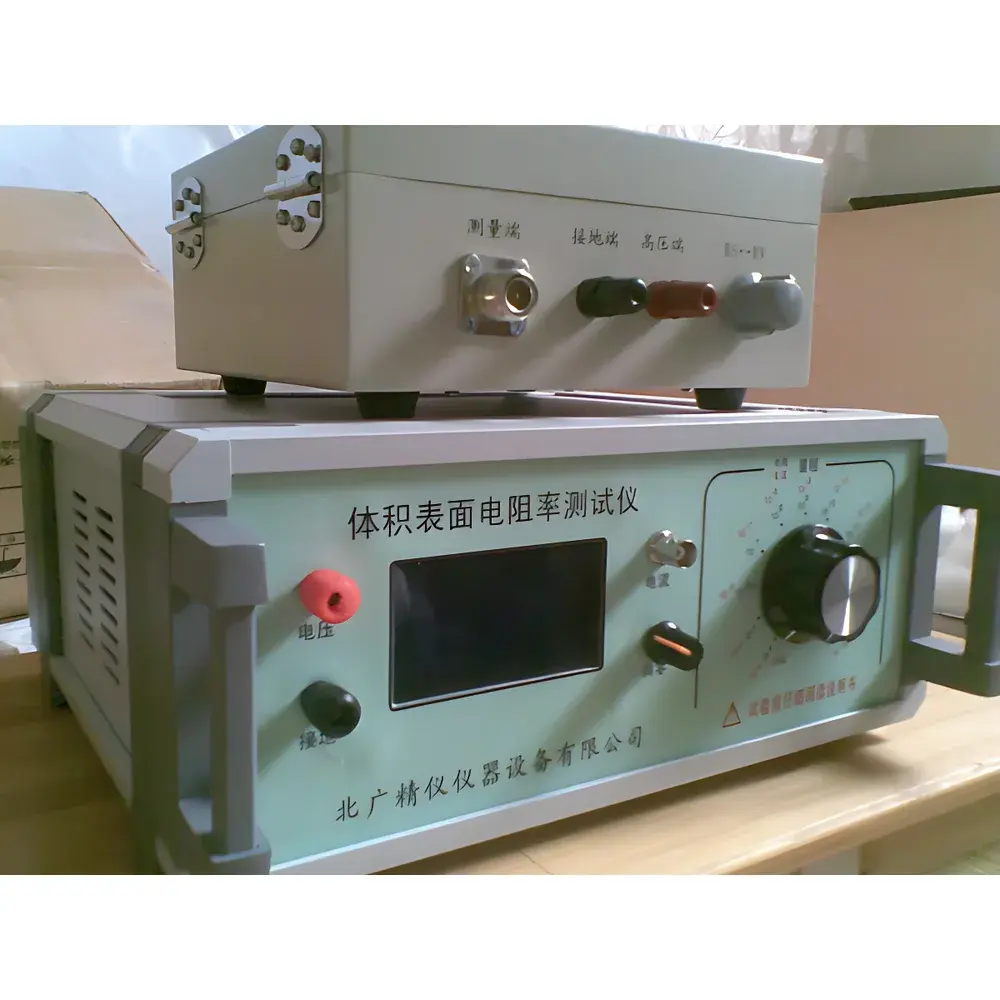
North Guang BEST-121 Volume & Surface Resistivity Tester
| Brand | North Guang / All Precision Instrument |
|---|---|
| Origin | Beijing, China |
| Manufacturer Type | Direct Manufacturer |
| Model | BEST-121 |
| Test Voltage Range | DC 10 V, 50 V, 100 V, 250 V, 500 V, 1000 V |
| Resistance Measurement Range | 1×10⁴ Ω to 1×10¹⁸ Ω |
| Current Measurement Range | 2×10⁻⁴ A to 1×10⁻¹⁶ A |
| Input Impedance | >10¹⁵ Ω |
| Display | Full-digit LCD |
| Operating Temperature | −10 °C to 50 °C |
| Relative Humidity | <90% RH |
| Power Supply | AC 220 V ±10%, 50 Hz |
| Power Consumption | ~10 W |
| Dimensions (L×W×D) | 300 mm × 280 mm × 150 mm |
| Weight | ~3.0 kg |
| Compliance | GB/T 1410–2006 (Three-Electrode Method), Q/TPGG 7–2008 |
Overview
The North Guang BEST-121 Volume & Surface Resistivity Tester is an engineered precision instrument designed for quantitative electrical resistivity characterization of solid, powder, liquid, and semi-solid insulating materials. It operates on the principle of direct-current (DC) high-voltage resistance measurement using a three-electrode configuration—compliant with GB/T 1410–2006, the Chinese national standard equivalent to IEC 60093 and ASTM D257. This method isolates volume conduction from surface leakage paths by incorporating a guarded electrode system, enabling independent determination of volume resistivity (ρv, in Ω·m) and surface resistivity (ρs, in Ω/square). The instrument delivers stable, low-noise DC test voltages up to 1000 V across six selectable ranges (10 V to 1000 V), paired with a high-input-impedance (>10¹⁵ Ω) electrometer amplifier stage to ensure minimal loading error during ultra-high-resistance measurements. Its architecture supports reproducible evaluation of insulating performance under controlled environmental conditions, making it suitable for R&D laboratories, QC/QA departments in polymer, cable, and electronics manufacturing, and academic material science facilities.
Key Features
- Triple-range DC voltage output (10 V – 1000 V) with fine-grained selection for optimal signal-to-noise ratio across diverse sample resistivities
- Ultra-wide resistance measurement range: 1×10⁴ Ω to 1×10¹⁸ Ω — covering conductive fillers, antistatic polymers, and high-purity insulators such as PTFE or fused silica
- Sub-femtoampere current resolution (down to 1×10⁻¹⁶ A), enabled by a guarded electrometer input stage and low-leakage internal cabling
- Integrated three-electrode test fixture compatibility per GB/T 1410–2006 — supporting volume resistivity (two outer electrodes + center electrode) and surface resistivity (two parallel electrodes + guard ring) modes
- Full-digit LCD display with auto-ranging and real-time unit annotation (Ω, MΩ, GΩ, TΩ, PΩ)
- Robust mechanical design: aluminum alloy chassis, EMI-shielded enclosure, and thermal-stable component layout for 8-hour continuous operation
- Compliance-ready architecture — supports manual documentation traceability required for ISO/IEC 17025-accredited testing environments
Sample Compatibility & Compliance
The BEST-121 accommodates a broad spectrum of physical forms without modification: rigid solids (e.g., molded plastic plaques, ceramic substrates), flexible films (polyimide, PET), granular powders (carbon black composites, metal oxides), viscous pastes (conductive adhesives), and homogeneous liquids (dielectric coolants, transformer oils). Sample mounting utilizes standardized three-electrode cells (available separately), including concentric ring electrodes for surface resistivity and collinear electrodes for volume resistivity. All measurements adhere strictly to GB/T 1410–2006, which aligns technically with ISO 3915 (electrical resistance of conductive plastics) and ASTM D257 (standard test methods for DC resistance of insulating materials). While the instrument itself does not embed automated audit trails, its fixed voltage steps, manual calibration verification points, and deterministic analog signal path meet baseline requirements for GLP-compliant data recording when used with validated lab notebooks or LIMS-integrated documentation workflows.
Software & Data Management
The BEST-121 is a standalone benchtop instrument with no embedded microprocessor or digital communication interface (e.g., USB, RS-232, or Ethernet). All operations—including voltage selection, range switching, and zero stabilization—are performed manually via front-panel rotary switches and push buttons. Readings are displayed directly on the high-contrast LCD without internal storage. This design prioritizes electromagnetic immunity, long-term calibration stability, and operational simplicity in electrically noisy industrial environments. Users record results manually or integrate the instrument into external data acquisition systems using optional analog output modules (not included). For regulated environments requiring electronic records, the device may be operated in conjunction with 21 CFR Part 11–compliant electronic lab notebooks (ELNs) where operator identity, timestamp, and test parameters are documented externally prior to measurement.
Applications
- Quality control of insulating coatings on aerospace composites and printed circuit board laminates
- Evaluation of antistatic additives in polyolefin packaging films per ASTM F1891
- Volume resistivity mapping of battery separator membranes (e.g., PE/PP microporous films) at elevated temperatures using external environmental chambers
- Surface resistivity validation of cleanroom garments and ESD-safe work surfaces per ANSI/ESD S20.20
- Research-grade resistivity profiling of novel dielectric ceramics, MOFs, and polymer nanocomposites
- Verification of insulation integrity in medical device housings per IEC 60601-1 clause 8.8.3
- Comparative screening of conductive filler dispersion homogeneity in carbon-loaded thermoplastics
FAQ
Does the BEST-121 support automatic temperature compensation?
No. Temperature-dependent measurements require external thermal conditioning (e.g., climate chamber or oil bath) and manual recording of ambient or sample temperature alongside each reading.
Can it measure resistivity of powdered samples without pelletization?
Yes — when used with a dedicated powder resistivity cell (e.g., ASTM D374-compliant die set), provided the powder is uniformly compacted to known density and thickness.
Is the instrument supplied with calibration certificates?
Factory calibration is performed against NIST-traceable reference resistors; however, formal ISO/IEC 17025 calibration certificates are available upon request at additional cost and require separate scheduling.
What safety standards does the high-voltage section comply with?
The HV generator meets IEC 61010-1:2010 Edition 3 requirements for measurement category CAT II 1000 V, with double insulation, interlocked shielding, and automatic discharge circuitry post-test.
How often should periodic verification be performed?
Per GB/T 1410–2006 Annex C and general metrological practice, verification against certified reference resistors is recommended before each daily use sequence or at least every 24 hours during extended testing campaigns.



