
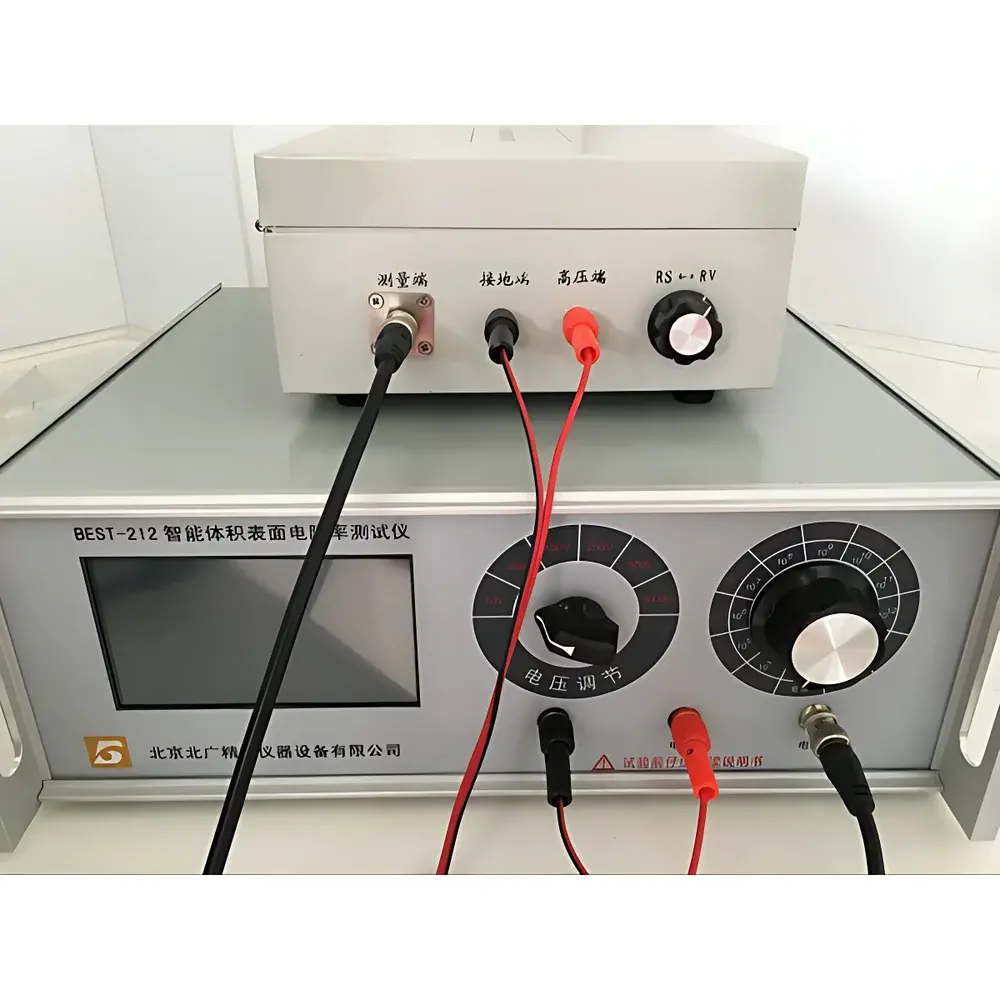
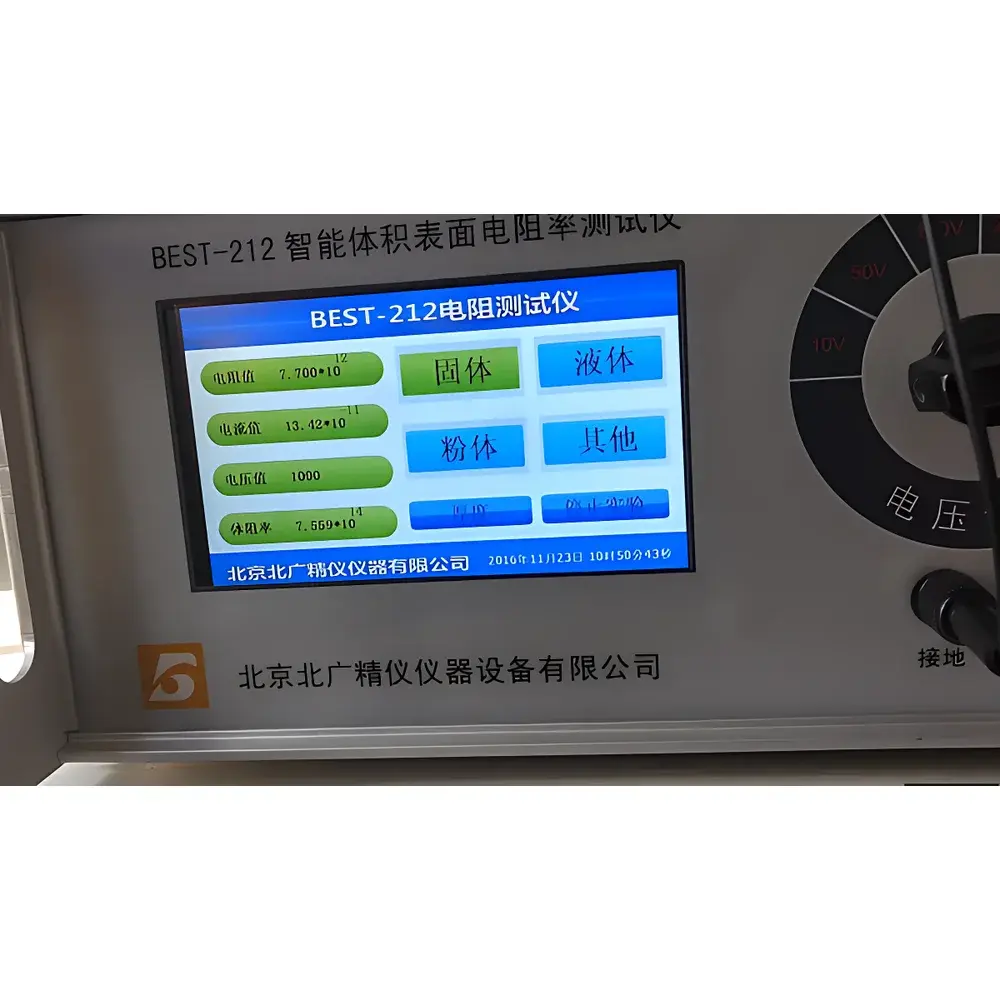
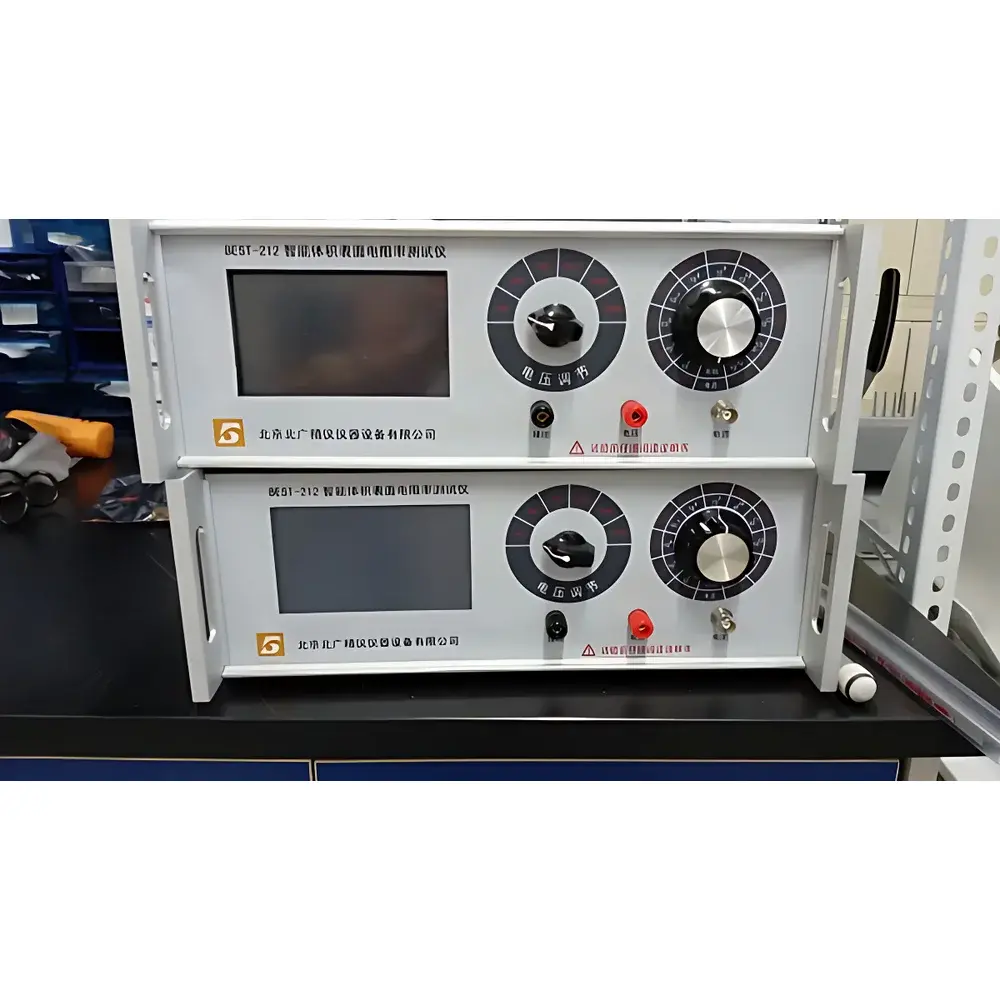
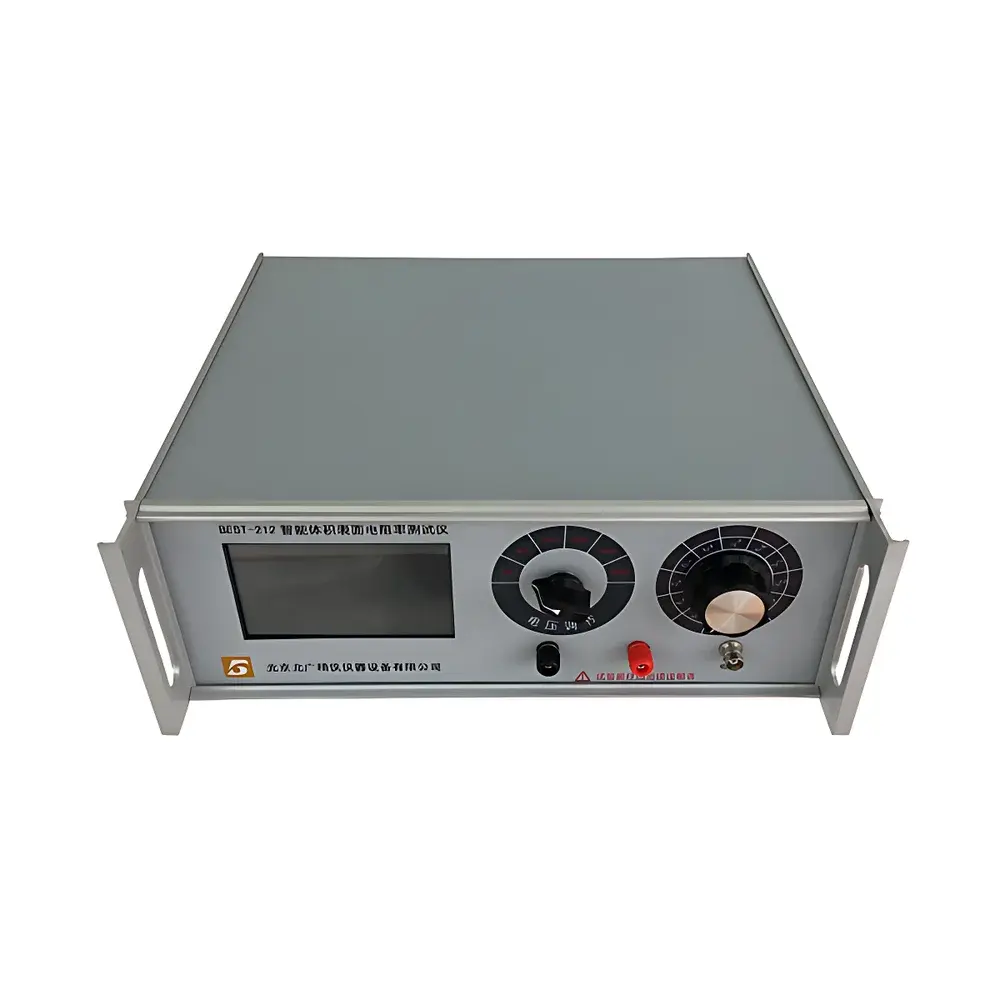
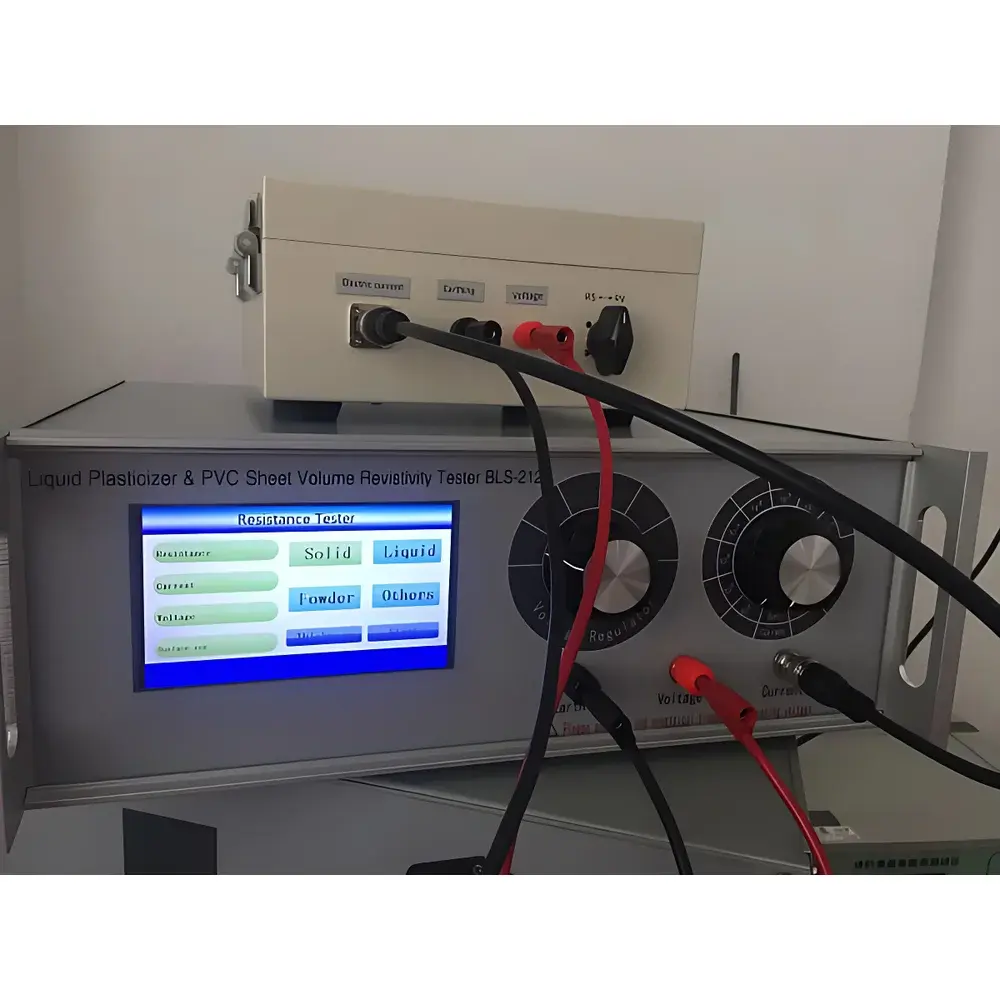
North Guang BEST-212 High-Resistance & Resistivity Tester for Rubber and Electrical Insulating Materials
| Brand | North Guang / All Precision Instrument |
|---|---|
| Origin | Beijing, China |
| Manufacturer Type | Manufacturer |
| Product Category | Domestic |
| Model | BEST-212 |
| Price | USD 1,700 (approx.) |
Overview
The North Guang BEST-212 High-Resistance & Resistivity Tester is a precision digital instrument engineered for the accurate measurement of volume resistivity, surface resistivity, and insulation resistance of solid, powdered, and liquid dielectric materials—including vulcanized rubber, thermoplastic elastomers, polymer films, anti-static flooring, insulating composites, and electronic packaging materials. It operates on the fundamental principle of Ohm’s Law (R = V/I), employing simultaneous high-precision analog-to-digital acquisition of applied DC test voltage (100 V to 1000 V) and resulting leakage current (2 × 10⁻⁴ A to 1 × 10⁻¹⁶ A). Unlike conventional analog megohmmeters with nonlinear scales and fixed-voltage limitations, the BEST-212 utilizes dual-channel real-time signal processing to compute resistance directly—eliminating scale distortion, range-dependent correction factors, and voltage-induced nonlinearity errors. Its measurement range spans 1 × 10⁴ Ω to 1 × 10¹⁸ Ω with a basic accuracy of ±1% (at 23 °C ±5 °C, 45–75% RH), making it suitable for R&D laboratories, QC departments, and standards-compliant certification testing in electrical insulation and electrostatic control applications.
Key Features
- Dual-parameter digital display: Simultaneous LED readout of resistance (Ω) and current (A) on a 3½-digit display
- Four selectable DC test voltages: 100 V, 250 V, 500 V, and 1000 V—fully adjustable via front-panel toggle switch
- Ultra-low current measurement capability down to 10−16 A, enabling characterization of highly insulating polymers and ceramic substrates
- Integrated overcurrent protection circuitry prevents damage during accidental short-circuit or misconfiguration
- Compact benchtop design (285 × 245 × 120 mm; ~2.5 kg) with low power consumption (<5 W, AC 220 V / 50 Hz)
- Zero-drift calibration protocol: Auto-zero function performed at open-circuit condition prior to measurement
- Shielded enclosure compatibility: Designed for use with optional Faraday cage and guarded electrode fixtures to suppress electromagnetic interference and surface leakage currents
Sample Compatibility & Compliance
The BEST-212 supports standardized volumetric and surface resistivity measurements across diverse material forms—including molded rubber specimens, elastomeric sheets, conductive/antistatic plastics, fiber-reinforced composites, and thin-film coatings. It is fully compliant with internationally recognized test standards governing electrical insulation performance and electrostatic dissipation, including: ASTM D257-99 (Standard Test Methods for DC Resistance or Conductance of Insulating Materials), GB/T 1410-2006 (Methods for Determining Volume and Surface Resistivity of Solid Electrical Insulating Materials), GB/T 2439-2001 (Determination of Conductive and Dissipative Properties of Vulcanized or Thermoplastic Rubber), GB/T 1692-2008 (Determination of Volume Resistivity of Vulcanized Rubber), and GB/T 10064-2006 (Test Methods for Insulation Resistance of Solid Insulating Materials). All test configurations—including two-electrode, three-electrode (guarded), and concentric ring setups—are supported via interchangeable electrode kits (sold separately), ensuring traceable alignment with ISO/IEC 17025-accredited laboratory practices.
Software & Data Management
While the BEST-212 operates as a standalone hardware instrument without embedded PC connectivity, its deterministic analog signal chain and stable DC output enable seamless integration into GLP/GMP-compliant data acquisition workflows. Users may record measurements manually in laboratory notebooks or log results into LIMS-compatible spreadsheets using standardized templates aligned with FDA 21 CFR Part 11 requirements for audit trails and data integrity. The instrument’s repeatable zero-point calibration, temperature-stable reference circuits, and minimal hysteresis support long-term measurement reproducibility—critical for trend analysis in aging studies, lot-release testing, and accelerated environmental stress screening. For automated reporting, third-party DAQ systems (e.g., National Instruments USB-6009 with LabVIEW) can interface via analog voltage outputs (0–10 V proportional to log10(R)) when equipped with optional signal conditioning modules.
Applications
- Volume and surface resistivity evaluation of sulfur-cured rubber compounds per GB/T 2439 and ASTM D257
- Quality assurance of ESD-safe footwear, work surfaces, and flooring systems used in cleanrooms and electronics assembly
- Insulation resistance verification of cable jackets, transformer bushings, and printed circuit board substrates
- Dark current characterization of photodiodes and optoelectronic sensors
- Resistivity mapping of polymer nanocomposites containing carbon black, graphene, or metal oxides
- High-resistance monitoring in electrochemical cell components and battery separator films
- Research-grade resistivity profiling in academic labs studying charge transport mechanisms in amorphous polymers and ion-conducting gels
FAQ
What is the difference between volume resistivity and surface resistivity?
Volume resistivity (ρ, in Ω·m) quantifies bulk conduction through a material’s cross-section, while surface resistivity (ρs, in Ω/sq) measures lateral conduction along the material’s exposed surface—both are critical for evaluating insulation integrity and static dissipation pathways.
Can the BEST-212 measure conductivity directly?
Yes—the instrument reports resistance and current; conductivity (σ) can be derived as σ = 1/ρ, where ρ = R × (A/L), using known electrode geometry (A = area, L = spacing). Units are convertible to S/m or μS/cm via standard scaling.
Is guarding required for measurements above 1010 Ω?
Yes—measurements exceeding 1010 Ω must employ guarded electrodes and a shielded test chamber to minimize stray capacitance, humidity-induced surface leakage, and electromagnetic noise.
Does the instrument comply with FDA 21 CFR Part 11 for electronic records?
The BEST-212 itself does not store or transmit data electronically; however, its analog outputs and deterministic behavior support validated external data capture systems meeting Part 11 requirements for audit trails and electronic signatures.
What safety precautions apply during high-voltage operation?
Operators must avoid contact with red high-voltage leads during operation; microcurrent terminals must remain isolated from ESD sources; all tests above 500 V require insulated gloves and adherence to IEC 61010-1 safety protocols.



