
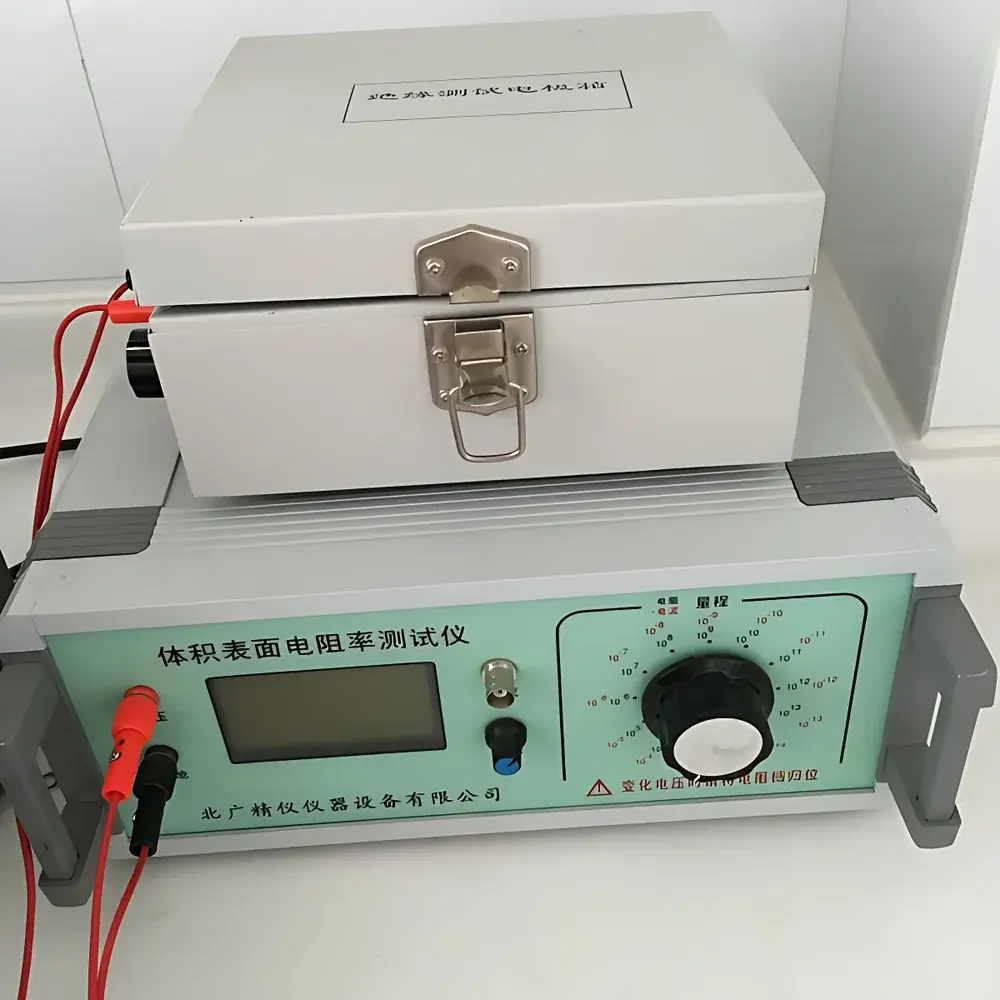
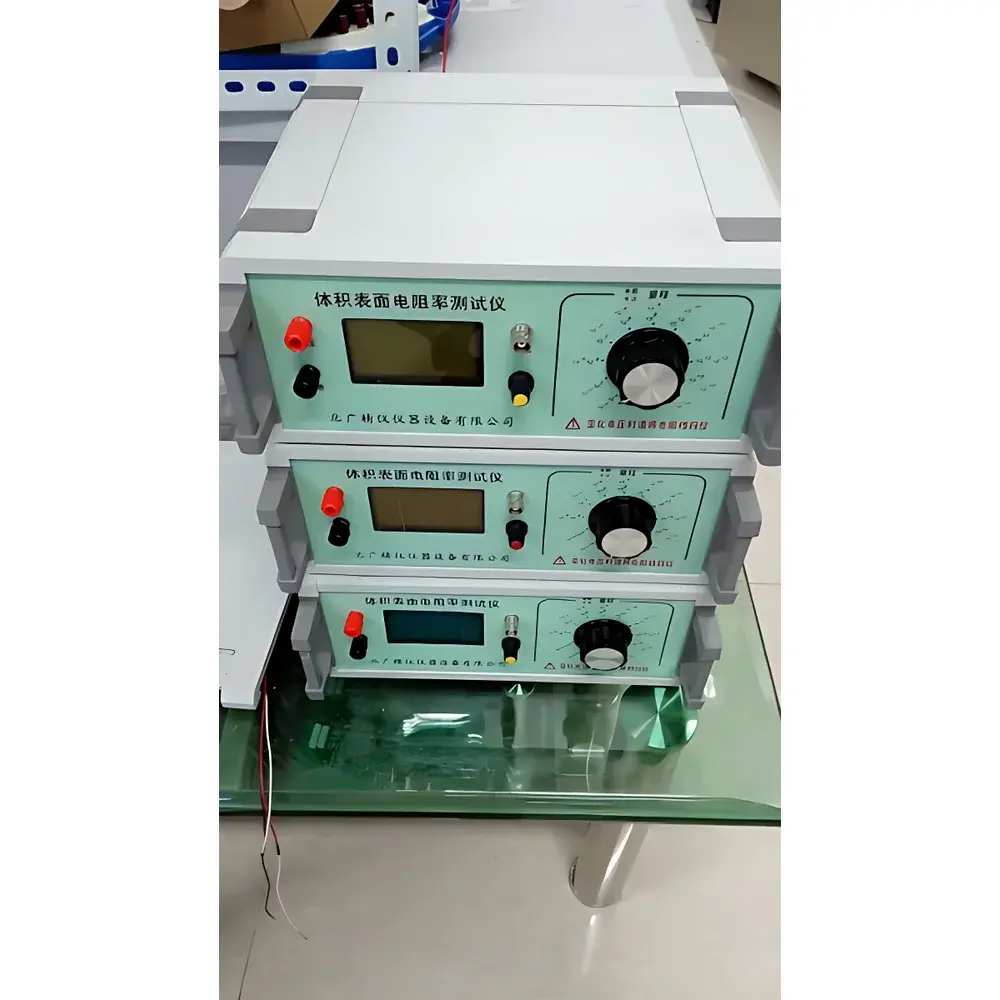
North Guang Jingyi BEST-121 Ceramic Volume & Surface Resistivity Tester
| Brand | North Guang Jingyi / All Precision Instrument |
|---|---|
| Origin | Beijing, China |
| Manufacturer Type | Direct Manufacturer |
| Model | BEST-121 |
| Test Voltage Range | 10 V / 50 V / 100 V / 250 V / 500 V / 1000 V |
| Resistance Measurement Range | 1×10⁴ Ω to 1×10¹⁸ Ω |
| Current Measurement Range | 2×10⁻⁴ A to 1×10⁻¹⁶ A |
| Basic Accuracy | ±1% |
| Display | Digital LCD |
| Dimensions | 285 mm × 245 mm × 120 mm |
| Weight | ~5 kg |
| Compliance | GB/T 1410–2006, GB/T 10581–2006, GB/T 1692–2008, GB/T 2439–2001, ASTM D257–99, IEC 93:1980 (equivalent), EN 1149-1:1995, SJ/T 10694–2006 |
Overview
The North Guang Jingyi BEST-121 Ceramic Volume & Surface Resistivity Tester is a precision digital high-resistance meter engineered for accurate, stable, and traceable measurement of volume resistivity (ρv) and surface resistivity (ρs) in insulating and antistatic materials. It operates on the fundamental principle of Ohm’s Law (R = V/I), but distinguishes itself from conventional electrometer-based high-resistance meters through simultaneous, synchronized digitization of applied test voltage (V) and resulting current (I). This dual-parameter acquisition—implemented via high-stability analog front-end circuitry and precision low-noise current sensing—eliminates nonlinearity inherent in analog galvanometer-based systems and ensures true linear resistance readout across its full 14-decade range (1×10⁴ Ω to 1×10¹⁸ Ω). The instrument supports standardized three-electrode configuration per GB/T 1410–2006 and ASTM D257–99, enabling compliant separation of bulk conduction (volume resistance) from interfacial leakage (surface resistance), critical for ceramic dielectrics, polymer composites, and functional coatings.
Key Features
- Simultaneous high-resolution voltage and current digitization eliminates scale nonlinearity and improves repeatability over traditional analog high-resistance meters
- Adjustable DC test voltages: 10 V, 50 V, 100 V, 250 V, 500 V, and 1000 V — selectable via front-panel interface to match material polarization behavior and standard requirements
- Dual-display capability: real-time numeric readout of both resistance (Ω) and current (A) on a backlit LCD screen, supporting direct verification of measurement integrity
- Ultra-low current detection down to 1×10⁻¹⁶ A with guarded input architecture and electromagnetic shielding, minimizing leakage and noise coupling
- Compact benchtop form factor (285 × 245 × 120 mm; ~5 kg) with integrated power supply (AC 220 V, 50 Hz, <5 W), suitable for QC labs and R&D environments with limited space
- Compliant three-electrode support: compatible with standard brass or stainless-steel electrodes (e.g., concentric ring, guarded electrode, parallel plate) for solids, powders, and liquids per IEC 60093 and GB/T 1410
Sample Compatibility & Compliance
The BEST-121 is validated for use with rigid and flexible insulating ceramics, sintered oxides, polymer matrix composites, elastomers, thin films, textile laminates, and conductive/antistatic coatings. Its design accommodates solid slabs (≥1 mm thickness), granular powders (via compression cell), and homogeneous liquids (using guarded cup electrodes). All measurements adhere to internationally harmonized test protocols including ASTM D257–99 (Standard Test Methods for DC Resistance or Conductance of Insulating Materials), IEC 60093 (Methods of Test for Volume Resistivity and Surface Resistivity of Solid Electrical Insulating Materials), and GB/T 1410–2006 (equivalent to IEC 60093:1980). For regulated environments—including ISO/IEC 17025-accredited laboratories—the instrument supports documented calibration traceability to national metrology institutes (e.g., China Academy of Metrology, CAAM; China Electronics Standardization Institute, CESI) and enables audit-ready recordkeeping when paired with external data logging.
Software & Data Management
While the BEST-121 operates as a standalone instrument with local LCD display, it features RS-232 serial output (optional USB-to-serial adapter) for integration into laboratory information management systems (LIMS) or custom QA workflows. Raw voltage and current values, along with timestamped resistance results, can be streamed to PC-based applications for statistical process control (SPC), trend analysis, and GLP/GMP-compliant report generation. Though no proprietary software is bundled, the ASCII-formatted output is compatible with common platforms including LabVIEW, MATLAB, and Excel-based templates. All calibration constants and user-defined test parameters are stored in non-volatile memory. For FDA-regulated environments (e.g., medical device packaging validation), the system may be configured with electronic audit trails and user access controls via external middleware satisfying 21 CFR Part 11 requirements.
Applications
- Quality control of alumina, zirconia, and silicon carbide substrates used in microelectronics packaging and sensor housings
- Resistivity mapping of antistatic additives in polymeric insulators for aerospace wiring harnesses
- Verification of ESD-safe flooring systems in cleanroom and semiconductor fabrication facilities per EN 1149-1 and SJ/T 10694
- Characterization of conductive fillers (e.g., carbon black, graphene) in rubber compounds for automotive gaskets and seals
- Surface resistivity assessment of coated optical ceramics and IR-transmissive windows exposed to humidity cycling
- Volume resistivity screening of high-k dielectric pastes prior to thick-film sintering
- Research-grade evaluation of charge trapping dynamics in ferroelectric ceramics under controlled bias and temperature
FAQ
What standards does the BEST-121 fully comply with?
It meets the technical and procedural requirements of GB/T 1410–2006, GB/T 10581–2006, ASTM D257–99, IEC 60093:1980, EN 1149-1:1995, and SJ/T 10694–2006 for volume/surface resistivity testing.
Can the instrument measure both volume and surface resistivity on the same sample?
Yes—when used with a three-electrode fixture (e.g., guarded electrode assembly), it isolates volume current path from surface leakage, enabling independent calculation of ρv and ρs per GB/T 1410 and ASTM D257.
Is calibration traceable to national standards?
Calibration certificates issued by accredited third-party labs (e.g., No. 514 Institute, No. 304 Institute, China Academy of Metrology) provide NIM-traceable uncertainty statements for voltage, current, and resistance channels.
Does it support automated testing sequences?
Not natively—but RS-232 output enables programmable control (voltage ramping, dwell time, multi-point sampling) via external scripting or LIMS integration.
What environmental conditions are required for optimal accuracy?
Operation is specified at 0–40 °C ambient temperature and relative humidity <80% non-condensing; for Class 1.0 accuracy, measurements should be performed in electrostatically shielded enclosures with temperature stabilization ±1 °C.





