
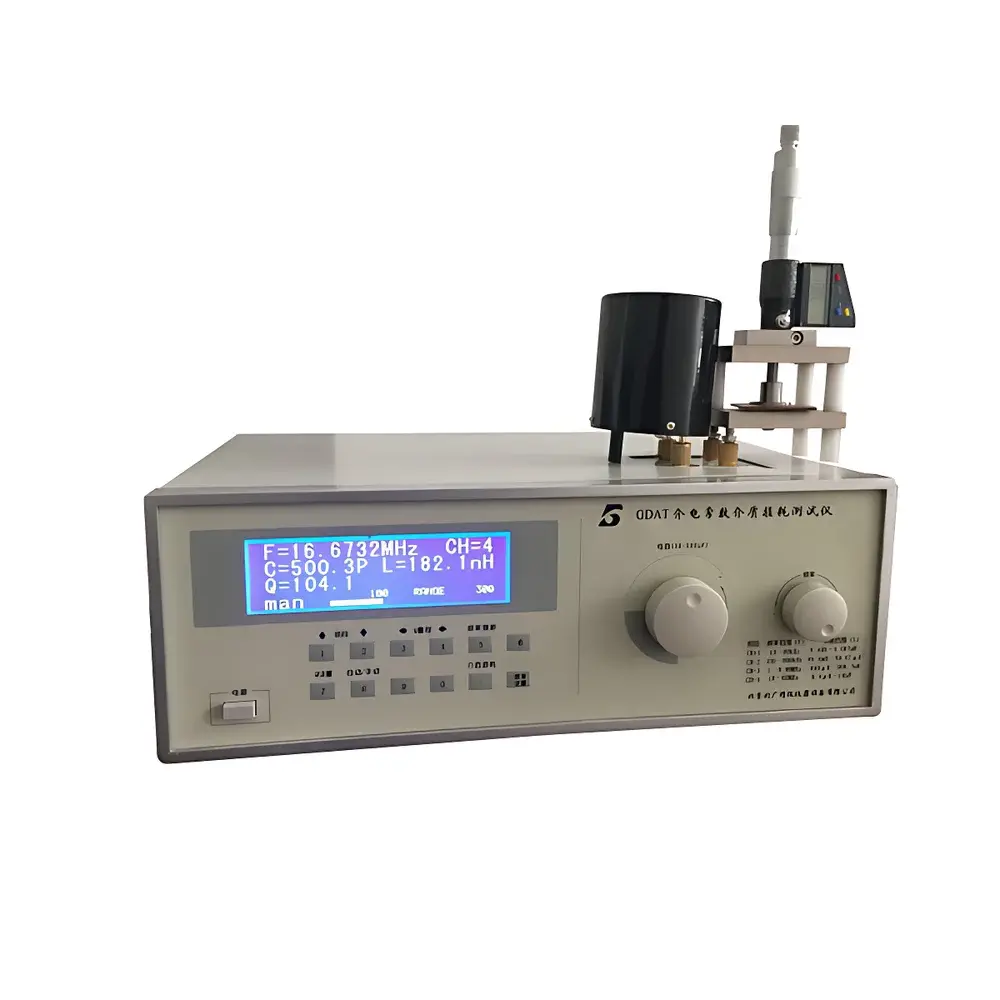
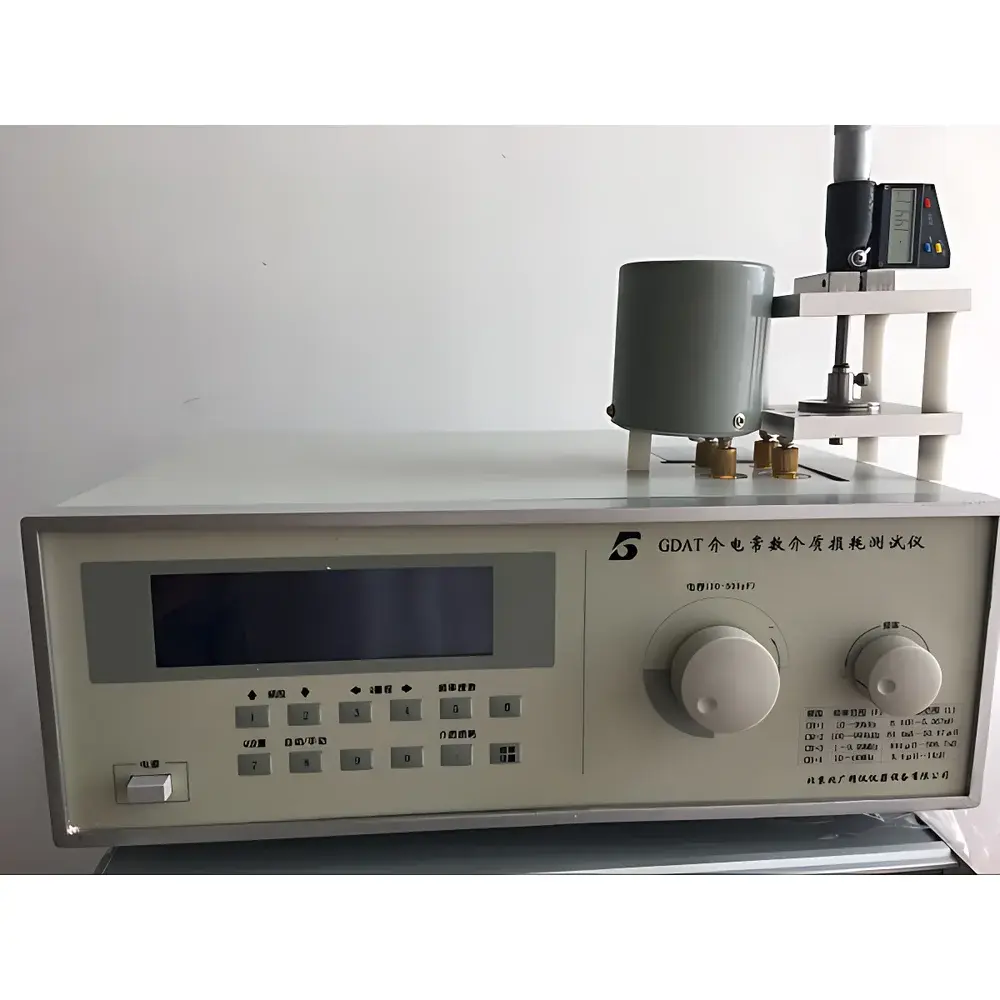
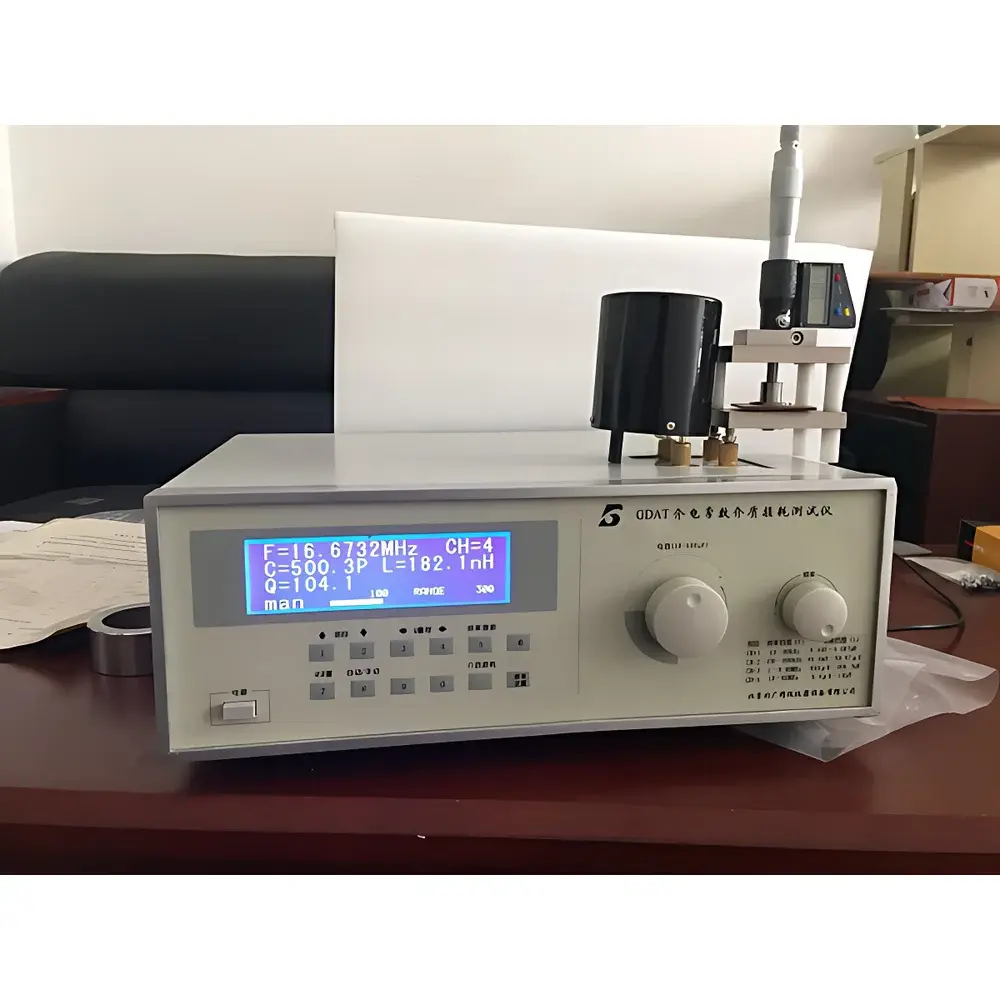
North Guang Jingyi GDAT-A High-Frequency Dielectric Constant and Dissipation Factor Analyzer
| Brand | North Guang Jingyi / All Precision Instrument |
|---|---|
| Origin | Beijing, China |
| Manufacturer Type | OEM Manufacturer |
| Country of Origin | China |
| Model | GDAT-A |
| Display | VFD Dot-Matrix (Full Chinese UI) |
| Interface | RS232 Serial Port |
| Printer | Integrated Thermal Printer (Chinese Output) |
| Frequency Range | 100 kHz – 160 MHz |
| Q Factor Range | 1–1023 (Auto/Manual Range: 30 / 100 / 300 / 1000) |
| Inductance Measurement | 1 nH – 140 mH |
| Capacitance Direct Measurement | 1 pF – 25 nF |
| Main Capacitor Tuning Range | 17 pF – 240 pF |
| Capacitance Accuracy | ±1 pF (<150 pF), ±1% (>150 pF) |
| Test Signal Source | Synthesized RF Oscillator (100 kHz–160 MHz) |
| tanδ Resolution | ≤4×10⁻⁴ @ 1 MHz (with supplied fixture) |
| Electrode Options | Φ38 mm or Φ50 mm parallel-plate |
| Liquid Cell | 48 mm diameter × 7 mm depth |
| Standard Accessories | LKI-1 Inductor Set (10 values: 0.05 µH to 10 mH), dielectric test fixture, host unit |
| Compliance | GB/T 1409–2006 (equivalent to IEC 60250:1969 for εᵣ and tanδ measurement at power/audio/radio frequencies) |
Overview
The North Guang Jingyi GDAT-A High-Frequency Dielectric Constant and Dissipation Factor Analyzer is a precision impedance measurement instrument engineered for the quantitative characterization of dielectric properties in liquid and solid insulating materials. It operates on the principle of high-frequency resonant cavity perturbation and series/parallel resonance Q-factor analysis—enabling direct determination of relative permittivity (εᵣ) and loss tangent (tanδ) across a broad frequency spectrum from 100 kHz to 160 MHz. Unlike low-frequency bridge methods that rely on voltage balancing under high-voltage conditions, the GDAT-A employs a digitally stabilized RF oscillator and automatic resonance tracking algorithm to minimize residual inductance and parasitic capacitance effects. This architecture ensures high reproducibility in measurements of complex permittivity (ε* = ε’ − jε”) under controlled field conditions, making it suitable for R&D labs evaluating capacitor dielectrics, transformer oils, polymer electrolytes, and high-frequency substrate materials.
Key Features
- Wide-frequency RF excitation source (100 kHz–160 MHz) with digital frequency locking and auto-resonance search
- Q-factor measurement range of 1–1023, supported by five manual or auto-ranging scales (30, 100, 300, 1000)
- Dual-mode electrode system: interchangeable Φ38 mm and Φ50 mm parallel-plate fixtures with micrometer-driven gap control (resolution ≤0.001 mm, max travel ≥15 mm)
- Integrated liquid cell (48 mm × 7 mm) compatible with standard S916 lower electrodes for repeatable volumetric sample containment
- VFD dot-matrix display with full Chinese graphical interface—including real-time warning prompts, contextual operation guidance, and no-reference-required navigation
- Built-in thermal printer for immediate hardcopy output of εᵣ, tanδ, C, L, Q, and test conditions—all in native Chinese
- RS232 serial interface compliant with EIA/TIA-232-E standards, supporting bidirectional communication with Windows-based data acquisition software (optional)
- LKI-1 calibrated inductor set (0.05 µH–10 mH, 10 values) included for system verification and Q calibration per GB/T 1409–2006 Annex B
Sample Compatibility & Compliance
The GDAT-A supports both solid sheet specimens (e.g., ceramic substrates, polymer films) and low-conductivity liquids (e.g., silicone oils, ester-based insulating fluids, non-aqueous electrolyte solutions). For liquids, the standard 48 mm-diameter cup ensures uniform field distribution between parallel electrodes while minimizing fringing effects. Solid samples are measured using either guarded or unguarded electrode configurations per IEC 60250 and GB/T 1409–2006 Clause 5. When used with the optional air-gap or fluid-displacement electrode systems, the instrument meets requirements for edge-effect correction and stray capacitance compensation. All measurements conform to the harmonized methodology specified in GB/T 1409–2006, which aligns technically with IEC 60250:1969 and ASTM D150 for permittivity and dissipation factor testing. Fixture losses are characterized at 1 MHz and verified ≤4×10⁻⁴, ensuring traceability to national metrology standards.
Software & Data Management
While the GDAT-A operates as a standalone instrument with embedded firmware, its RS232 interface enables integration into laboratory data management workflows. Optional PC application software provides CSV export of time-stamped measurement logs—including frequency, Q, C, L, εᵣ, tanδ, temperature, and operator ID. The software supports batch statistical analysis (mean, SD, CV%), trend charting versus frequency or temperature, and customizable report generation compliant with GLP documentation requirements. Audit trail functionality—though not natively embedded—can be implemented externally via timestamped serial logging with third-party DAQ platforms. No internal storage or user-accessible memory is present; all data persistence relies on external capture or printed records.
Applications
- Quality control of insulating oils in power transformers and switchgear (IEC 60296 compliance screening)
- Development of high-εᵣ ceramic capacitors (e.g., X7R, Y5V formulations) and low-loss microwave substrates (e.g., Al₂O₃, LTCC)
- Characterization of battery electrolyte stability under RF excitation (e.g., LiPF₆ in EC/DMC)
- Research on dielectric relaxation behavior in polymer nanocomposites (Cole-Cole plot generation)
- Verification of coating uniformity and interfacial polarization in multilayer dielectric stacks
- Evaluation of moisture ingress effects in epoxy-encapsulated electronic components via tanδ vs. humidity correlation
FAQ
What standards does the GDAT-A comply with?
It fully implements GB/T 1409–2006, which is technically equivalent to IEC 60250:1969 and consistent with core clauses of ASTM D150 for high-frequency dielectric measurements.
Can the instrument measure aqueous solutions?
No—due to high ionic conductivity, water-based samples cause excessive RF heating and measurement instability; only low-conductivity organic liquids (σ < 10⁻⁶ S/m) are recommended.
Is the LKI-1 inductor set traceably calibrated?
The LKI-1 set serves as a reference tool for system verification per GB/T 1409–2006 Annex B but is not supplied with NIST-traceable calibration certificates; users should perform periodic validation against certified standards.
Does the GDAT-A support 21 CFR Part 11 compliance?
No—the instrument lacks electronic signature capability, audit trail logging, or role-based access control; data integrity must be ensured through procedural controls and external software.
What is the minimum sample thickness required for solid film measurements?
For reliable εᵣ extraction with <±2% uncertainty, solid specimens should be ≥0.5 mm thick when using the Φ50 mm electrode; thinner films require guard-ring correction per IEC 60250 Section 6.2.



