
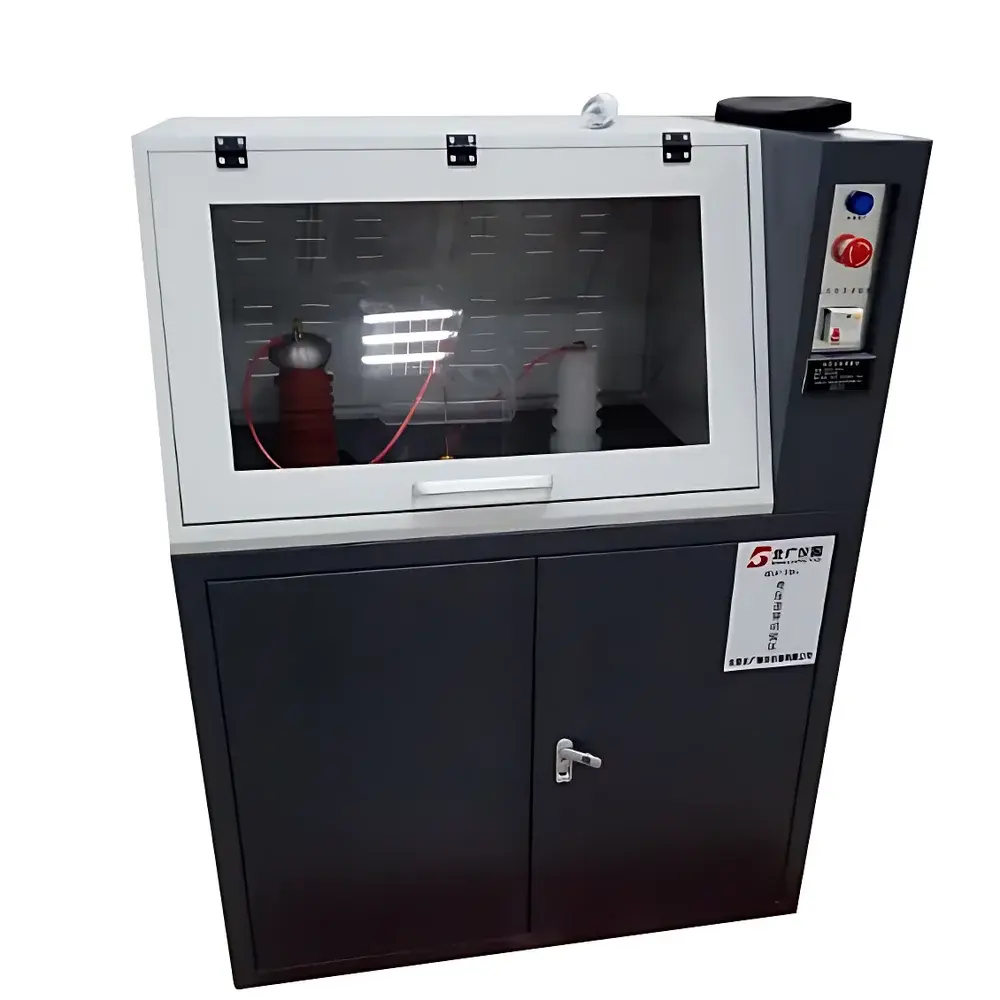
North Guang Precision BDJC-50KV Dielectric Breakdown Tester for Polyethylene Terephthalate (PET) Films
| Brand | North Guang Precision / All Precision Instrument |
|---|---|
| Origin | Beijing, China |
| Manufacturer Type | Direct Manufacturer |
| Product Category | Domestic |
| Model | BDJC-50KV |
| Breakdown Voltage Range | AC/DC 0–50 kV |
| Output Power | 5 kVA |
| Voltage Measurement Accuracy | ≤2% |
| Ramp Rate | 1–5 kV/s |
| Hold Time Range | 0–4 h |
| Leakage Current Setting Range | 1–30 mA |
| Input Supply | AC 220 V ±10%, 50 Hz ±1% |
| Operating Ambient | 15–30 °C, RH ≤85% |
| Dimensions (L×W×H) | 1000 × 800 × 1400 mm |
| Weight | 100 kg |
| Grounding Requirement | Dedicated earth electrode ≥1.5 m depth |
Overview
The North Guang Precision BDJC-50KV Dielectric Breakdown Tester is an engineered solution for determining the dielectric strength and voltage endurance of solid insulating materials under standardized AC or DC stress conditions. Designed in strict compliance with GB/T 1695–2005, GB/T 1408.1–2006, GB/T 1408.2–2006, ASTM D149, and other internationally referenced test protocols, this system applies controlled high-voltage ramping to evaluate the intrinsic electrical resistance of polymeric films—including PET, PVC, polyimide—and composite laminates, ceramics, glass, and impregnated fiber systems. The instrument operates on the principle of controlled voltage escalation until dielectric failure occurs, at which point the breakdown voltage is recorded as a function of material thickness, electrode geometry, and environmental parameters. Its architecture integrates a high-stability 50 kV transformer, Siemens PLC-based closed-loop control, and real-time digital feedback for reproducible test execution across laboratories engaged in quality assurance, R&D validation, and regulatory submission workflows.
Key Features
- Full AC/DC dual-mode operation with independent 0–50 kV output capability and precision-regulated ramp rates (1–5 kV/s)
- Integrated automatic discharge circuitry with audible/visual alert and interlocked safety gate—mandatory for post-DC-test personnel protection
- Dedicated oil-immersed test chamber with adjustable electrode positioning frame for uniform field distribution per IEC 60243 and ASTM D149 geometries
- Real-time voltage/current acquisition at 10 kHz sampling rate, synchronized with software-triggered event logging
- Mechanical and electronic dual-limit protection: hardware high-voltage cutoff (mechanical limiter), software-defined termination voltage, zero-voltage startup enforcement
- Comprehensive safety architecture including door interlock, ground-fault detection, overcurrent interruption (<0.1 s response), short-circuit suppression, and transformer thermal ventilation
- Self-contained grounding subsystem compliant with GB 50169 and IEC 61000-5-1 requirements; includes dedicated copper rod grounding kit (≥1.5 m burial depth)
Sample Compatibility & Compliance
The BDJC-50KV accommodates flat, rigid, and flexible sheet specimens up to 200 mm × 200 mm and thicknesses from 0.025 mm to 6 mm. Standard electrode configurations include brass disk electrodes (25 mm diameter, 25 mm spacing) conforming to ASTM D149 Type A and GB/T 1408.1 Clause 6. Optional custom electrodes (ring, needle, spherical) support specialized evaluations per UL 746A, IPC-TM-650 2.5.1, or MIL-STD-202 Method 301. The system meets GLP-aligned operational traceability: all test parameters—including ramp rate, hold time, current limit, ambient temperature/humidity—are logged with timestamp and operator ID. Audit-ready data records comply with FDA 21 CFR Part 11 requirements when paired with user-authenticated software profiles and electronic signature-enabled reporting.
Software & Data Management
The proprietary Windows-based control suite provides ISO/IEC 17025-aligned test orchestration. Users define multi-step protocols (pre-conditioning, ramp-to-breakdown, step-hold endurance) via intuitive graphical interface. Real-time Lissajous-style voltage–time and current–time curves are rendered with zoomable overlays, enabling comparative analysis across batches or formulations. Raw datasets export natively to CSV, Excel (.xlsx), and Word (.docx) formats without third-party conversion. Built-in report templates adhere to ISO/IEC 17025 Annex A.3 documentation standards—each report embeds instrument calibration status, environmental logs, operator credentials, and digital signatures. Role-based access control enforces parameter lockdown per user profile, preventing unauthorized modification of test definitions or system settings.
Applications
This tester serves laboratories performing routine QC on polymer films for packaging, capacitors, flexible electronics, and aerospace insulation systems. It supports accelerated life modeling of dielectric aging under sustained voltage stress, qualification of new resin formulations against UL 94 or IEC 60674-2, and root-cause analysis of field failures linked to contamination, moisture ingress, or interfacial delamination. In academic research, it enables correlation studies between crystallinity (via DSC/XRD), free volume (via PALS), and breakdown threshold in nanocomposite dielectrics. Regulatory submissions for medical device packaging (ISO 11607) and EV battery separators (UL 2598) routinely reference data generated on BDJC-series instruments due to their documented metrological traceability to CNAS-accredited calibration labs.
FAQ
What standards does the BDJC-50KV explicitly support?
It complies with GB/T 1695–2005, GB/T 1408.1–2006, GB/T 1408.2–2006, ASTM D149, GB/T 3333, HG/T 3330, and GB 12656.
Can the system perform both AC and DC breakdown tests without hardware reconfiguration?
Yes—dual-mode operation is enabled via internal solid-state switching; no manual rewiring or electrode replacement is required.
Is remote monitoring or integration with LIMS possible?
The software supports TCP/IP communication and OPC UA protocol extension for enterprise-level data pipeline integration.
What maintenance intervals are recommended for long-term reliability?
Transformer oil analysis every 12 months; electrode polishing and calibration verification every 6 months; annual full-system metrological recalibration per JJG 1088–2013.
Does the system include audit-trail functionality for regulated environments?
Yes—full electronic audit trail logs all parameter changes, test starts/stops, user logins, and calibration events with immutable timestamps and operator IDs.



