
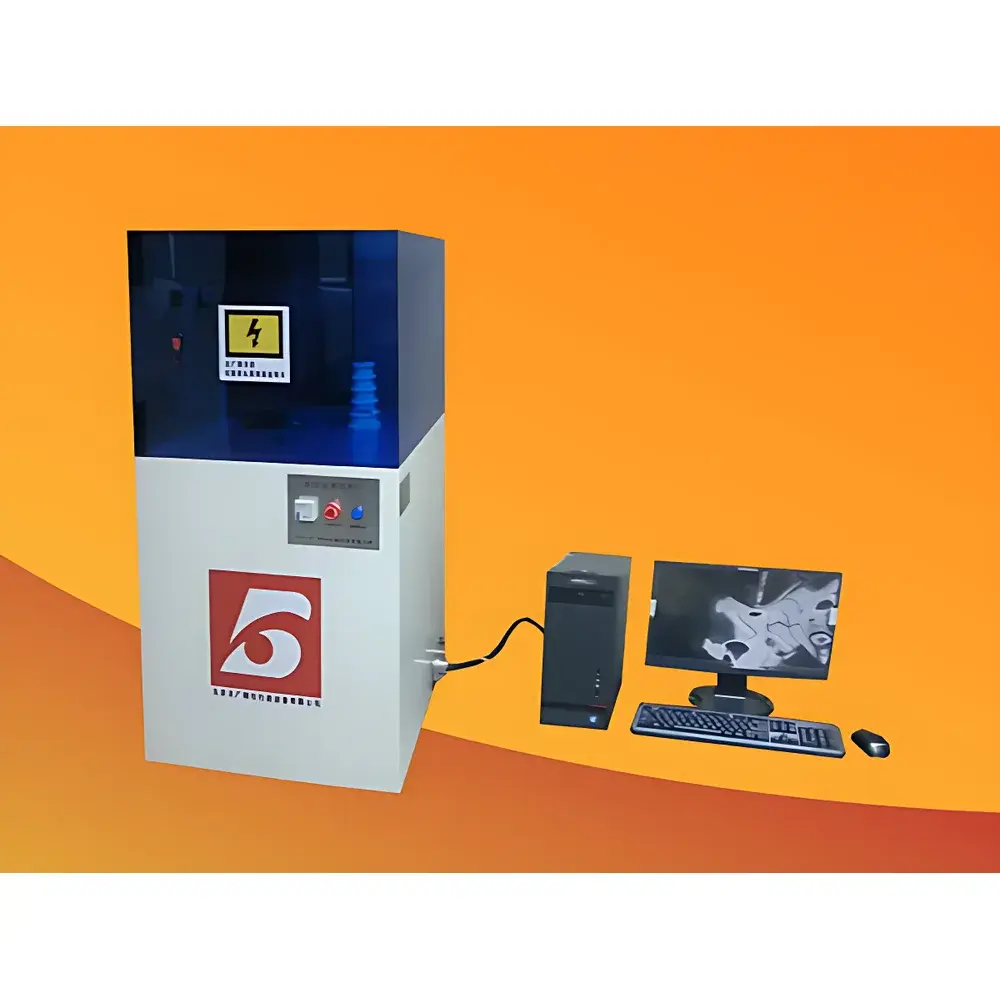
North Guang Precision BDJC-50KV Dielectric Breakdown Tester
| Brand | North Guang Precision / All Precision Instrument |
|---|---|
| Origin | Beijing, China |
| Manufacturer Type | OEM Manufacturer |
| Country of Origin | China |
| Model | BDJC-50 |
| Pricing | Upon Request |
| Input Voltage | AC 220 V |
| Output Voltage | AC 0–50 kV |
| Power Rating | 10 kVA |
| Voltage Control | Fully adjustable 0–50 kV (high-accuracy voltage sampling eliminates need for stepped HV ranges) |
| Ramp Rates | 100, 200, 500, 1000, 2500, 3000 V/s |
| Test Modes | AC/DC — ramp-up, step-stress, and hold-time (dielectric withstand) |
| Voltage Accuracy | ≤ ±1% |
| Electrode Sets | (1) Two 25 mm disc electrodes |
| Hold Time Range | 0–6 hours (software-configurable) |
| Safety Interlocks | Door-activated HV cutoff, ≥250 mm clearance between HV electrode and chamber wall, dedicated grounding terminal, multi-stage protection (overcurrent, overvoltage, ground-fault, short-circuit, DC discharge alarm, EMI suppression) |
Overview
The North Guang Precision BDJC-50KV Dielectric Breakdown Tester is an industrial-grade, microprocessor-controlled high-voltage testing system engineered for precise determination of dielectric strength and withstand voltage performance of solid insulating materials under standardized AC and DC stress conditions. Operating on the principle of controlled voltage ramping until electrical breakdown occurs—defined as the irreversible loss of insulating integrity—the instrument complies with core international test methodologies including ASTM D149, IEC 60243-1, GB/T 1408.1–2006, GB/T 1695–2005, and related national standards for polymeric, ceramic, elastomeric, and composite dielectrics. Its dual-mode architecture supports both sinusoidal (50/60 Hz) and polarity-stable DC output, enabling comparative evaluation of material behavior under alternating versus unidirectional electric fields—a critical distinction in qualification of insulation systems for power electronics, aerospace components, medical devices, and high-reliability cable assemblies.
Key Features
- Full-range continuously adjustable AC output (0–50 kV) and DC output (0–70 kV), enabled by high-precision resistive-capacitive voltage dividers and real-time digital feedback control—eliminating reliance on mechanical tap changers or segmented HV ranges.
- Six programmable voltage ramp rates (100–3000 V/s), satisfying accelerated testing requirements defined in ASTM D149 Annex A2 for rapid dielectric strength screening and time-lag analysis.
- Triple-mode test sequencing: linear ramp, step-stress (with user-defined voltage increments and dwell times), and timed dielectric withstand (0–6 h continuous hold at target voltage).
- Integrated safety architecture compliant with EN 61010-1:2010 and GB/T 3836.1–2021: interlocked test chamber door disables primary HV input; minimum 250 mm creepage distance between active electrode and enclosure wall; dedicated protective earth terminal with low-impedance path (<0.1 Ω).
- Comprehensive electronic protection suite: hardware-based overcurrent cutoff (<10 µs response), overvoltage clamping, ground-fault detection, short-circuit current limiting, and mandatory DC discharge verification prior to chamber access.
- Modular electrode configuration supporting ISO 60243-compliant geometry: standard 25 mm and 75 mm parallel-plate electrodes for sheet/film specimens; tubular electrodes for cylindrical samples such as insulated wires or tubing.
Sample Compatibility & Compliance
The BDJC-50KV accommodates rigid and semi-rigid dielectric specimens up to 10 mm thickness and 100 mm lateral dimension, including thermoplastics (e.g., PE, PP, PTFE), thermosets (epoxy, phenolic), elastomers (silicone rubber, EPDM), ceramics (alumina, steatite), glass, mica composites, laminated substrates (FR-4, G10), impregnated papers, and conformal coatings. All test protocols align with GLP documentation requirements: full audit trail logging (operator ID, timestamp, parameter set, pass/fail status, raw voltage/current waveforms), electronic signature support per FDA 21 CFR Part 11 (when deployed with validated software configuration), and traceable calibration against NIST-traceable HV reference standards. Test reports are exportable in PDF and CSV formats, meeting internal QA/QC, third-party certification (UL, TÜV), and regulatory submission needs.
Software & Data Management
The embedded Windows-based control platform provides intuitive graphical interface for test definition, real-time waveform visualization (voltage, current, derivative dV/dt), and automated pass/fail classification per selected standard. Data acquisition operates at 100 kHz sampling rate with 16-bit resolution, capturing transient pre-breakdown leakage currents and arc inception events. Software modules include statistical analysis (Weibull distribution fitting per IEC 60243-2), batch reporting, comparative trend charts across material lots or processing batches, and configurable pass criteria (e.g., “no flashover within 60 s at 30 kV AC”). All test records are stored with immutable metadata—including environmental sensor inputs (ambient temperature, relative humidity)—and support hierarchical user access levels (admin, operator, reviewer) to enforce data integrity controls.
Applications
This system serves R&D laboratories, quality assurance departments, and certification bodies engaged in electrical insulation validation across multiple sectors: polymer compound development (filler dispersion effects on breakdown threshold), automotive EV battery module encapsulation testing, aerospace wire harness qualification per SAE AS4373, medical device lead insulation compliance (IEC 60601-1), renewable energy component testing (inverter busbar coatings, solar junction box potting compounds), and grid infrastructure material approval (transformer pressboard, bushing insulation). Its reproducibility (CV < 2.5% across ten replicate tests on identical LDPE sheets) supports ISO/IEC 17025-accredited testing workflows.
FAQ
What standards does the BDJC-50KV explicitly support?
ASTM D149, IEC 60243-1, GB/T 1408.1–2006, GB/T 1695–2005, GB/T 3333, HG/T 3330, and GB 12656.
Is the system suitable for testing liquid dielectrics?
No—it is configured exclusively for solid and semi-solid insulating materials. Liquid dielectric testing requires specialized oil-test cells with electrode immersion geometry and moisture control not provided in this configuration.
Can test parameters be locked to prevent unauthorized modification?
Yes. Role-based access control allows administrators to restrict parameter editing, report generation, and calibration functions to authorized personnel only.
What maintenance is required for long-term accuracy?
Annual verification of HV divider linearity and current shunt calibration using certified reference instruments; biannual inspection of electrode surface finish and chamber grounding continuity.
Does the system provide raw waveform data export?
Yes—full-resolution voltage and current time-series data (CSV) are archived per test and available for post-processing in MATLAB, Python, or commercial analysis tools.





