
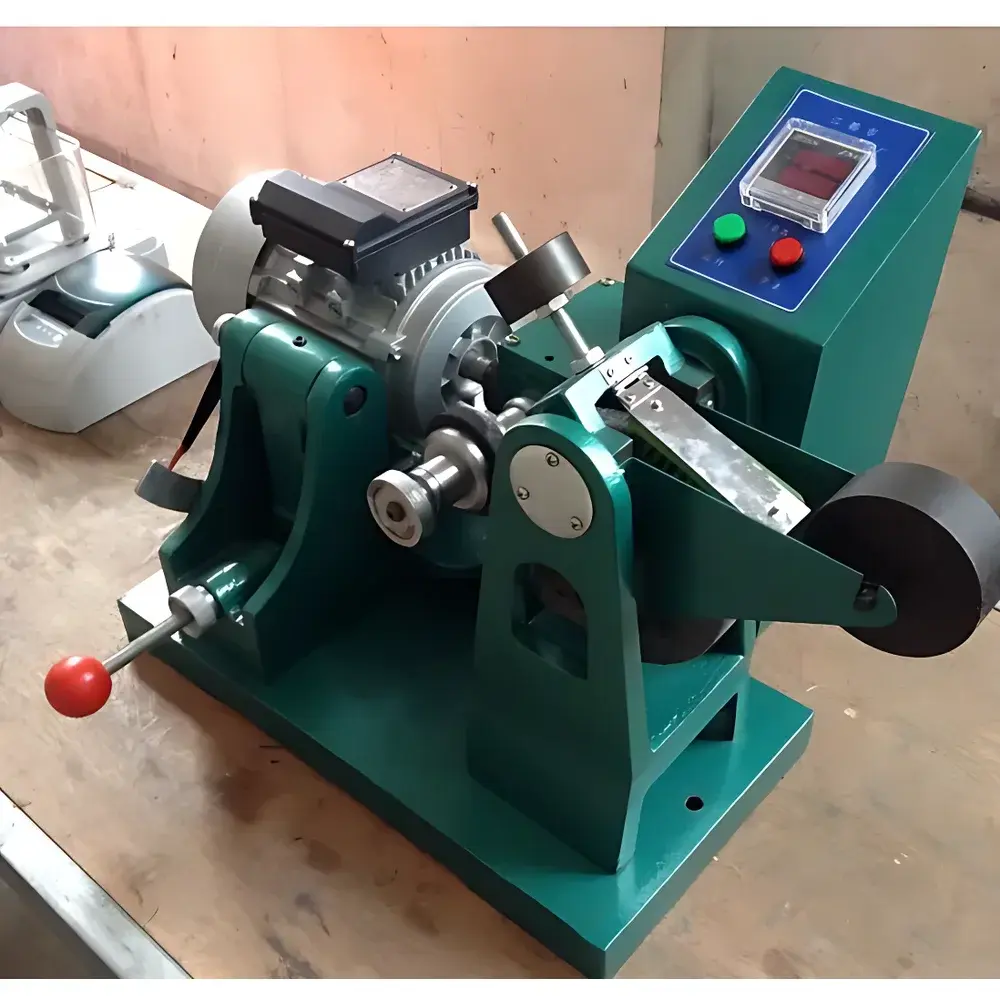
North Guang Precision BG-8205 Akron Abrasion Tester for Vulcanized Rubber
| Brand | North Guang Precision Instrument |
|---|---|
| Origin | Beijing, China |
| Manufacturer Type | Direct Manufacturer |
| Country of Origin | China |
| Model | BG-8205 |
| Load on Specimen | 26.7 ± 0.2 N |
| Roller Shaft Speed | 76 ± 2 rpm |
| Abrasive Wheel Speed | 34 ± 1 rpm |
| Adjustable Angle Between Roller and Wheel | 15° or 25° |
| Power Supply | AC 220 V |
| Power Consumption | 250 W |
| Dimensions (L×W×H) | 600 × 480 × 400 mm |
| Net Weight | 60 kg |
Overview
The North Guang Precision BG-8205 Akron Abrasion Tester is a dedicated mechanical wear testing instrument engineered for the quantitative evaluation of abrasion resistance in vulcanized rubber compounds. Based on the standardized Akron abrasion test principle—defined in ASTM D1630, ISO 4649, and GB/T 1689—the instrument simulates abrasive wear under controlled kinematic and loading conditions. During operation, a cylindrical rubber test specimen rotates against a calibrated abrasive grinding wheel at fixed angular orientation (15° or 25°), under a constant normal load of 26.7 N. The relative motion between the rotating rubber roller and the counter-rotating abrasive wheel generates surface wear, and the volumetric loss—measured gravimetrically before and after a defined travel distance (typically 1.61 km)—is expressed as abrasion volume (cm³) or abrasion index (relative to a reference compound). This method delivers high reproducibility for comparative ranking of rubber formulations, particularly in tire treads, conveyor belts, industrial rollers, and footwear soles.
Key Features
- Compliant with international standards including ASTM D1630, ISO 4649, and Chinese national standard GB/T 1689—ensuring data traceability and cross-laboratory comparability.
- Precision-machined dual-shaft drive system: rubber roller shaft rotates at 76 ± 2 rpm; abrasive wheel shaft rotates at 34 ± 1 rpm—both independently regulated via synchronous motors with mechanical speed feedback.
- Adjustable angular geometry: user-selectable 15° or 25° inclination between roller axis and abrasive wheel plane—enabling adaptation to material-specific wear mechanisms and regulatory requirements.
- Stable load application: calibrated dead-weight loading mechanism ensures consistent 26.7 ± 0.2 N normal force across test cycles, minimizing operator-induced variability.
- Robust structural frame: fabricated from high-rigidity steel with vibration-dampening base—designed to maintain alignment stability during extended testing sessions (up to 8 hours continuous operation).
- Integrated safety interlocks: emergency stop button, wheel guard enclosure, and motor overload protection conforming to IEC 61000-6-2 EMC immunity requirements.
Sample Compatibility & Compliance
The BG-8205 accommodates standard ASTM/ISO-compliant rubber test specimens: cylindrical rollers (25.4 mm diameter × 12.7 mm width) prepared per ASTM D3182 or GB/T 6038. It supports both natural rubber (NR), styrene-butadiene rubber (SBR), butadiene rubber (BR), and halogenated elastomers—including compounds containing silica, carbon black, or hybrid fillers. All mechanical components comply with RoHS Directive 2011/65/EU. Calibration procedures follow ISO/IEC 17025:2017 guidelines for testing laboratories, and routine verification includes load cell calibration (certified annually), rotational speed validation (using optical tachometer), and dimensional inspection of abrasive wheels (aluminum oxide, 36-grit, 150 mm diameter, conforming to ASTM D1630 Annex A1). Documentation package includes full compliance statement, factory calibration certificate, and traceable metrology records.
Software & Data Management
While the BG-8205 operates as a standalone electromechanical tester without embedded digital control, it is fully compatible with external laboratory data acquisition systems. Test parameters—including elapsed time, total revolutions, and ambient temperature/humidity (when monitored externally)—can be logged via RS-232 or USB-to-serial interface using third-party software (e.g., LabVIEW, MATLAB, or custom LIMS modules). For GLP/GMP-regulated environments, users may integrate the instrument into audit-trail-enabled platforms supporting FDA 21 CFR Part 11 compliance—requiring electronic signatures, change control logs, and secure user access management. North Guang provides detailed I/O pinout schematics and ASCII command protocol documentation to facilitate seamless integration.
Applications
- Tire compound development: benchmarking tread rubber abrasion resistance across formulation variants (e.g., silica vs. carbon black reinforcement).
- Quality control in rubber manufacturing: batch release testing per internal specifications aligned with ISO 9001:2015 clause 8.6.
- R&D labs evaluating polymer modifications: impact of plasticizers, antioxidants, or nanofillers on wear kinetics.
- Academic research on tribological behavior of elastomers under dry sliding conditions.
- Third-party certification laboratories performing accredited testing per ISO/IEC 17025 scope.
FAQ
What standards does the BG-8205 comply with?
ASTM D1630, ISO 4649, and GB/T 1689 are fully supported through mechanical configuration, load accuracy, and rotational speed tolerances.
Is the abrasive wheel included with the instrument?
Yes—a certified aluminum oxide (Al₂O₃) grinding wheel (36 grit, 150 mm diameter, 25 mm width) meeting ASTM D1630 Annex A1 specifications is supplied with each unit.
Can test results be exported digitally?
The instrument outputs analog signals and TTL-level status pulses; digital export requires connection to an external DAQ system or PLC with appropriate interface hardware.
What maintenance is required for long-term accuracy?
Monthly verification of load application, biannual speed calibration, and replacement of abrasive wheels after 50 test cycles—or when groove depth exceeds 1.5 mm—per ASTM D1630 Section 7.3.
Does North Guang offer installation and operator training?
Yes—on-site commissioning, mechanical alignment verification, and hands-on operator training (including sample preparation, test execution, and gravimetric calculation per ASTM D1630 Section 10) are included in standard delivery terms.







