
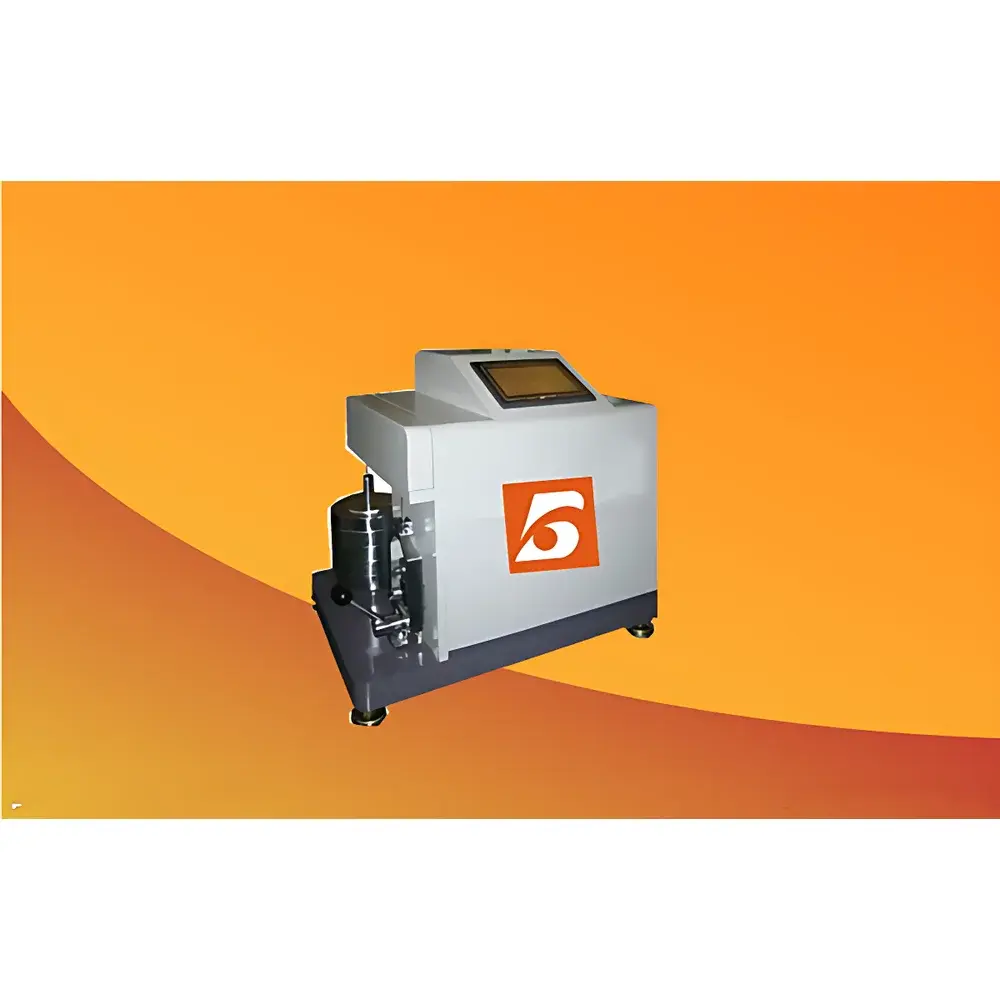
North Guang Precision Instrument Co., Ltd. Model 200 Rubber & Plastic Friction and Wear Tester
| Brand | North Guang Precision Instrument |
|---|---|
| Origin | Beijing, China |
| Manufacturer Type | Manufacturer |
| Country of Origin | China |
| Model | 200 |
| Power Supply | 220 V AC |
| Speed Range | 0–500 rpm |
| Applied Load | Up to 200 N (via standard weights) |
| Torque Measurement Range | 0–5 N·m |
| Friction Ring Dimensions | Ø40 × 10 mm, 0.5 × 45° chamfer, concentricity deviation < 0.01 mm |
| Friction Ring Material | 45# steel, quenched & tempered, hardness HRC 40–45, surface roughness Ra ≤ 3.2 µm |
| Standard Weights | One 4 kg weight + four 1 kg weights |
| Control Interface | PC-based upper-computer software |
| Data Output | Real-time torque vs. time curve, coefficient of friction (COF) calculation, operator ID, test parameters, and unit annotation |
Overview
The North Guang Precision Instrument Model 200 Rubber & Plastic Friction and Wear Tester is a benchtop tribological evaluation system engineered for standardized measurement of static and kinetic coefficients of friction (COF), wear resistance, and frictional torque under controlled sliding conditions. Designed in strict compliance with GB/T 3960–2016 “Determination of the Coefficient of Friction of Plastics”, this instrument employs a rotating ring-on-flat geometry—where a precisely machined hardened steel friction ring rotates against a stationary flat specimen (e.g., rubber sheet, thermoplastic film, or elastomeric compound)—to generate reproducible shear stress at the interface. The rotational speed is continuously adjustable from 0 to 500 rpm via closed-loop motor control, while normal load is applied through calibrated dead-weight loading (1–4 kg increments, up to 200 N). A high-sensitivity torque transducer captures real-time torsional reaction, enabling direct computation of COF = T / (r × FN), where T is measured torque (N·m), r is effective radius (0.02 m), and FN is applied normal force (N). All signal acquisition, parameter logging, and curve visualization are performed via dedicated Windows-based upper-computer software.
Key Features
- Compliant architecture for GB/T 3960–2016, ISO 8295 (Plastics – Determination of coefficient of friction), and ASTM D1894 (Standard Test Method for Static and Kinetic Coefficients of Friction of Plastic Film and Sheeting)
- High-precision friction ring manufactured from 45# carbon steel, heat-treated to HRC 40–45, with surface roughness Ra ≤ 3.2 µm and geometric concentricity maintained within ±0.01 mm
- Modular dead-weight loading system: one 4 kg and four 1 kg stainless-steel calibration weights, traceable to national mass standards
- Integrated torque sensor with 0–5 N·m range and resolution better than 0.01 N·m, mounted on low-inertia shaft assembly to minimize dynamic error
- Brushless DC motor drive with encoder feedback ensures stable speed regulation across full 0–500 rpm range, with repeatability ≤ ±1 rpm
- Full PC-based control interface supporting customizable test protocols, multi-parameter logging (time, speed, load, torque, COF), and export to CSV/PDF formats
Sample Compatibility & Compliance
The Model 200 accommodates flat, rigid or semi-flexible specimens up to 100 mm × 100 mm × 20 mm thickness, including vulcanized rubber compounds (NR, SBR, EPDM), thermoplastics (PP, PE, PET, PVC), coated films, laminates, and packaging substrates. Specimen mounting uses a precision-machined clamping stage with parallelism tolerance < 0.02 mm over contact area. The system supports both static COF (breakaway torque at zero slip) and kinetic COF (steady-state torque during continuous rotation) determinations. All hardware and firmware comply with CE electromagnetic compatibility (EMC) directives and meet functional safety requirements for laboratory-grade mechanical testing equipment. Data integrity aligns with GLP principles: operator ID, timestamp, environmental metadata (optional ambient temperature/humidity input), and audit trail are embedded in every exported dataset.
Software & Data Management
The proprietary upper-computer software provides intuitive workflow navigation, real-time graphical display of torque vs. time and COF vs. time curves, and automated calculation of mean/peak COF values per test cycle. Each test record stores raw analog-to-digital converter (ADC) samples at ≥100 Hz sampling rate, ensuring sufficient temporal resolution for transient friction event capture. Export functions support ISO/IEC 17025-compliant reporting templates, including uncertainty estimation placeholders for torque and load channels. Software configuration files are password-protected and version-controlled; all user actions (test start/stop, parameter edits, data export) are logged with timestamps and operator credentials. While not FDA 21 CFR Part 11 certified out-of-the-box, the architecture supports optional digital signature integration and electronic record archiving when deployed in regulated QA/QC environments.
Applications
- Quality control of rubber seals, gaskets, and conveyor belt surfaces for automotive and industrial OEMs
- Evaluation of anti-slip performance in polymer flooring materials and footwear soles
- Development of low-friction packaging films (e.g., shrink wrap, pouch laminates) for high-speed filling lines
- Research into filler dispersion effects (e.g., silica, carbon black) on elastomer–metal interfacial friction
- Comparative wear screening of biodegradable plastics (PLA, PHA) versus conventional resins under standardized sliding conditions
- Validation of surface treatments (plasma, corona, silane coupling) on polymer substrates for improved adhesion and reduced drag
FAQ
What standards does the Model 200 explicitly support?
GB/T 3960–2016, ISO 8295:2017, and ASTM D1894–22 are fully implemented in test protocol definitions and reporting logic.
Can the instrument measure wear volume or mass loss?
No—the Model 200 is optimized for friction coefficient and torque quantification; gravimetric or profilometric wear assessment requires post-test specimen analysis using external instrumentation.
Is the friction ring replaceable, and are spare rings available?
Yes—standard Ø40 × 10 mm rings are field-replaceable; North Guang supplies certified replacement sets with material certification and hardness verification reports.
Does the system support automated multi-cycle testing?
Yes—software allows programming of sequential load/speed steps, dwell periods, and automatic COF averaging across up to 99 cycles per run.
What is the recommended calibration interval for torque and load sensors?
Annual recalibration is advised per ISO/IEC 17025 guidelines; North Guang provides accredited third-party calibration services with NIST-traceable certificates.





