
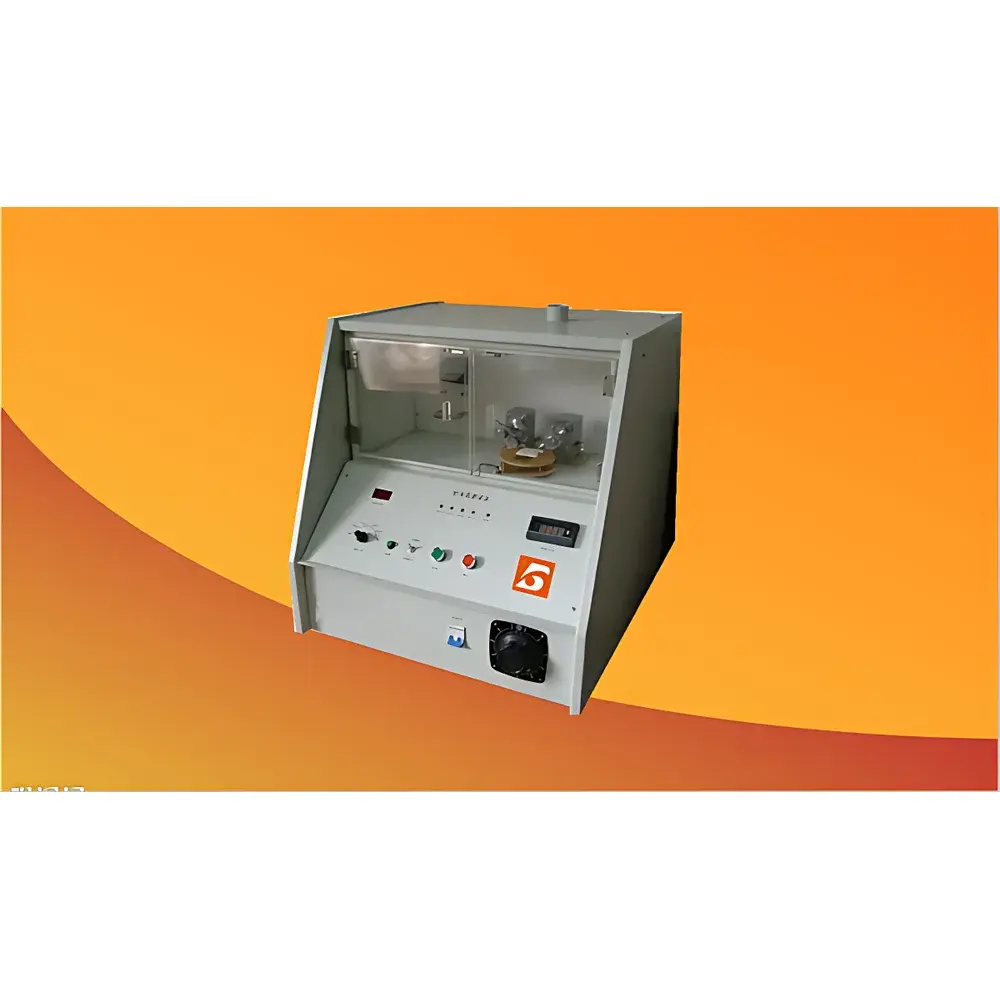
North Guangjingyi BDH-20KV Computer-Controlled Arc Resistance Tester
| Brand | North Guangjingyi / All Precision Instrument |
|---|---|
| Origin | Beijing, China |
| Manufacturer Type | Manufacturer |
| Country of Origin | Domestic (China) |
| Model | BDH-20KV |
| Breakdown Voltage | 150 kV |
| Input Voltage | AC 220 V |
| Output Voltage Range | 0–20 kV AC |
| Power Rating | 1.5 kVA |
| Arc Mode | Intermittent & Continuous Arc |
| Adjustable Arc Current | 10 mA / 20 mA / 30 mA / 40 mA |
| Voltage Control Accuracy | ≤2% |
| Arc On/Off Timing Accuracy | <5 ms |
| Electrode Configuration | Stainless Steel Plate Electrodes (25.4 mm × 12.7 mm × 0.15 mm), Tungsten Carbide Rod Electrodes (Ø2.4 mm × 70 mm), Electrode Angle: 110°, Electrode Mass: 50 g |
| Safety Protections | Overvoltage, Overcurrent, Short-Circuit, Interlocked Safety Door, Software-Based Operational Safeguarding |
| Compliance Standards | GB 1411–2002, IPC-TM-650 2.5.1, IEC 61621, ASTM D495, JEC-149, UL 746A |
Overview
The North Guangjingyi BDH-20KV Computer-Controlled Arc Resistance Tester is an engineered system designed to quantify the arc resistance of solid insulating materials under standardized high-voltage stress conditions. Based on the principle of controlled surface tracking degradation—where a sustained or cyclic low-current electric arc induces carbonization and conductive path formation on the material surface—the instrument delivers reproducible, traceable performance for quality assurance and R&D validation in electrical insulation applications. It operates by applying precisely regulated AC voltage (0–20 kV) across two fixed-geometry electrodes while monitoring real-time current response, arc duration, and time-to-failure. The system conforms to internationally recognized test protocols that define arc initiation, propagation, and failure criteria—including electrode geometry, spacing, current magnitude, and timing sequences—ensuring compatibility with regulatory submissions and interlaboratory comparison studies.
Key Features
- Computer-integrated control architecture with serial communication interface for synchronized voltage regulation, arc timing, data acquisition, and event logging
- Dual-mode arc generation: programmable intermittent arc (e.g., 0.25 s on / 1.75 s off cycles) and continuous arc operation with user-defined current setpoints (10–40 mA)
- High-fidelity voltage regulation with ≤2% deviation across full 0–20 kV output range and sub-5 ms arc switching repeatability
- Dedicated high-voltage source rated at 1.5 kVA, housed in EMI-shielded enclosure with reinforced insulation and thermal management
- Standardized electrode assembly per ASTM D495 and IEC 61621: tungsten carbide rods (Ø2.4 mm × 70 mm) and stainless steel plates (25.4 mm × 12.7 mm × 0.15 mm), mounted at 110° included angle with precise 50 g mass calibration
- Comprehensive hardware safety layer: overvoltage cutoff, electronic overcurrent limiting, short-circuit detection, mechanically interlocked safety door, and software-enforced parameter bounds
- Integrated data acquisition module capturing voltage, current, arc status, and elapsed time at ≥1 kHz sampling rate for waveform reconstruction
Sample Compatibility & Compliance
The BDH-20KV accommodates flat, rigid, or semi-rigid solid dielectrics up to 15 mm thick and ≥100 mm × 100 mm in planar dimension. Compatible specimen types include thermosetting and thermoplastic polymers (e.g., epoxy, phenolic, polyamide), laminated composites (G10/FR4), ceramic substrates, glass-reinforced plastics, mica-based sheets, and cured insulating varnishes. Testing is performed in accordance with mandatory requirements of GB 1411–2002 (Chinese national standard), ASTM D495 (Standard Test Method for Dielectric Breakdown Voltage of Insulating Oils of Petroleum Origin), IEC 61621 (Electrical insulating liquids — Determination of the arc resistance), IPC-TM-650 2.5.1 (Arc Resistance of Laminates), UL 746A (Polymeric Materials – Short Term Property Evaluations), and JEC-149 (Japanese Electrical Committee specification). All test sequences are preconfigured to match clause-specified arc current profiles, dwell times, and pass/fail thresholds defined in these standards.
Software & Data Management
The proprietary arc resistance control software runs on a dedicated industrial-grade PC (2 GB RAM, 160 GB SSD, Windows OS) with 18.5″ shielded LCD display. It provides real-time oscillographic visualization of voltage and current waveforms during arcing, supports multi-step test sequencing with conditional branching (e.g., terminate upon sustained conduction >100 ms), and auto-generates compliant test reports including raw data export (CSV), summary statistics (time-to-failure, arc count, total energy dissipated), and digital signature fields. Audit trail functionality records operator ID, timestamp, parameter modifications, and system events in alignment with GLP and ISO/IEC 17025 documentation requirements. Data files are stored with SHA-256 hash integrity verification and support long-term archival via network-attached storage or encrypted USB backup.
Applications
This tester serves critical evaluation roles across multiple sectors requiring validated arc resistance data: qualification of motor winding insulation systems; comparative screening of encapsulant resins for power electronics modules; certification of printed circuit board base materials (e.g., FR-4, polyimide); assessment of high-voltage bushing and transformer barrier materials; development of arc-resistant switchgear housings; and formulation optimization of flame-retardant polymer blends. Its deterministic arc exposure methodology enables direct correlation between measured arc resistance (seconds) and end-use reliability metrics such as Comparative Tracking Index (CTI) and Proof Tracking Index (PTI), supporting both internal design control and third-party certification workflows.
FAQ
What standards does the BDH-20KV fully support out-of-the-box?
The system includes preloaded test templates for GB 1411–2002, ASTM D495, IEC 61621, IPC-TM-650 2.5.1, UL 746A, and JEC-149, with all electrode geometries, timing sequences, and pass/fail logic embedded per standard clauses.
Can the instrument perform both intermittent and continuous arc testing within a single run?
Yes—test sequences may be programmed with mixed modes, e.g., three intermittent cycles followed by one continuous arc segment, each with independent current and duration settings.
Is the software compliant with FDA 21 CFR Part 11 requirements?
While the base software provides audit trail, electronic signatures, and data integrity safeguards, full Part 11 compliance requires site-specific validation documentation and role-based access configuration, which is supported via optional IQ/OQ/PQ protocol packages.
What maintenance is required for the high-voltage generator and electrodes?
Tungsten carbide electrodes require periodic surface polishing using 600-grit alumina paper to maintain tip geometry; the HV generator demands annual calibration by an accredited metrology lab using NIST-traceable reference dividers and oscilloscopes.
Does the system support remote operation or integration into a laboratory information management system (LIMS)?
Yes—the control software exposes TCP/IP and Modbus RTU interfaces for bidirectional communication with external LIMS or MES platforms, enabling automated job dispatch, result ingestion, and equipment status polling.



