
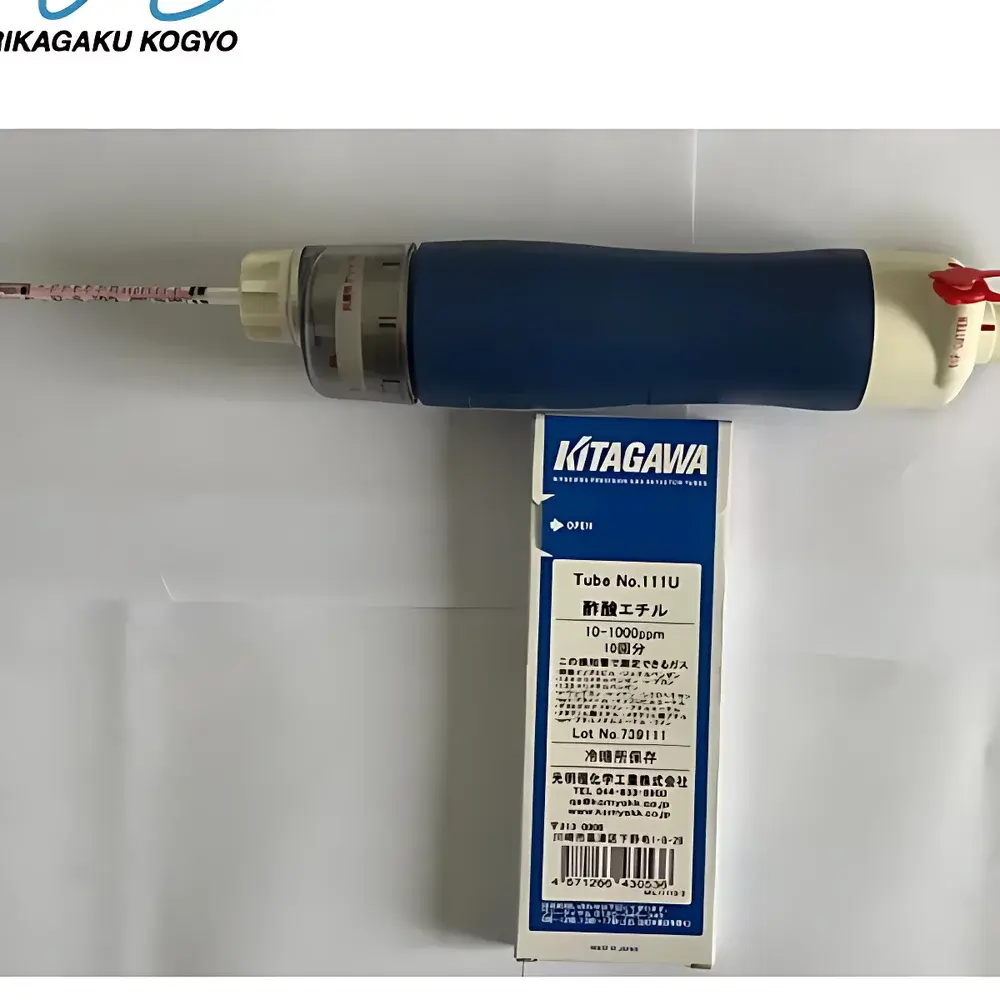
North Kawanishi Ethyl Acetate Gas Detection Tube Model 111U
| Brand | Meikou Rikagaku |
|---|---|
| Origin | Japan |
| Manufacturer Type | Authorized Distributor |
| Origin Category | Imported |
| Model | 111U |
| Price | USD 0.12 (per tube, FOB Japan) |
| Detection Principle | Colorimetric Reaction via Capillary Diffusion |
| Measurement Range | 10–1000 ppm (as ethyl acetate, v/v) |
| Pack Size | 10 tubes per box |
| Compatible Pump | AP-20 Manual Bellows Pump |
| Response Time | 100 strokes (≈60–90 s) |
| Shelf Life | 24 months from manufacture date (stored at 5–30 °C, dry, dark) |
| Calibration Traceability | Certified against NIST-traceable ethyl acetate gas standards |
| Compliance | Meets JIS K 0804:2017 and ISO 8573-2:2010 Annex B for colorimetric tube methodology |
Overview
The North Kawanishi Ethyl Acetate Gas Detection Tube Model 111U is a single-use, quantitative colorimetric indicator tube engineered for on-site, real-time measurement of ethyl acetate vapor concentration in ambient air or workplace breathing zones. Based on the well-established capillary diffusion principle, the tube contains a chemically impregnated silica gel reagent bed that undergoes a stoichiometric, irreversible oxidation-reduction reaction with ethyl acetate. Upon manual aspiration using the AP-20 dual-stroke bellows pump, sampled air passes through the tube at a controlled flow rate (defined by stroke count and volume per stroke), enabling precise diffusion-controlled contact between analyte and reagent. A sharp, stable color front develops along the calibrated glass bore; the endpoint position—measured in millimeters from the tube inlet—is directly correlated to ethyl acetate concentration via pre-determined calibration curves validated under ISO 8573-2:2010 Annex B protocols. This method eliminates dependence on electrical power, external instrumentation, or laboratory infrastructure, making it suitable for rapid hazard assessment in confined spaces, solvent-handling areas, coating operations, and pharmaceutical manufacturing environments where volatile organic compound (VOC) exposure monitoring is mandated under OSHA 1910.1200 and EU Directive 2004/37/EC.
Key Features
- Quantitative measurement range of 10–1000 ppm ethyl acetate (v/v), optimized for occupational exposure limit (OEL) verification against ACGIH TLV® (200 ppm TWA) and OSHA PEL (400 ppm TWA)
- Pre-calibrated linear scale with ±15% accuracy (k = 2) across full range, verified per JIS K 0804:2017 inter-laboratory reproducibility criteria
- Stable reagent formulation resistant to humidity interference (tested at 30–80% RH); no zero drift during field deployment
- Non-explosive, intrinsically safe operation—no spark risk, battery, or heat generation; certified for use in Zone 2/Class I, Division 2 hazardous locations
- AP-20 pump compatibility ensures consistent 100 mL/stroke delivery and repeatable 100-stroke aspiration protocol
- Individually sealed aluminum-laminated foil packaging preserves reagent integrity and extends shelf life to 24 months when stored at 5–30 °C
Sample Compatibility & Compliance
The 111U tube is validated for direct analysis of ethyl acetate in clean, non-condensing air matrices. Cross-sensitivity to common co-solvents—including acetone, methyl ethyl ketone (MEK), and ethanol—is quantified and documented in the Certificate of Analysis (CoA) supplied with each batch. Interference thresholds are reported per ISO 8573-2:2010 Section 7.3. The product complies with Japanese Industrial Standard JIS K 0804:2017 for chemical detection tubes and supports GLP-aligned recordkeeping when used with AP-20 pump log sheets and traceable calibration gas certificates. It is not intended for continuous monitoring or stack emission compliance testing but fulfills requirements for initial site surveys, leak detection, and periodic personal exposure checks under ISO 45001:2018 Clause 8.1.3.
Software & Data Management
As a passive, analog measurement device, the 111U requires no software, firmware, or digital interface. All data acquisition is manual: users record stroke count, ambient temperature/pressure, observed color front position (mm), and calculated concentration (ppm) on standardized field worksheets. For enterprise-level traceability, laboratories may integrate readings into LIMS platforms via structured CSV upload templates aligned with ASTM E2500-13 Annex A3 for paper-based analytical records. Audit trails comply with FDA 21 CFR Part 11 when handwritten entries are contemporaneously signed, dated, and reviewed per internal SOPs governing qualitative/quantitative field methods.
Applications
- Occupational hygiene screening in paint mixing rooms, adhesive application stations, and printing facilities
- Routine verification of local exhaust ventilation (LEV) effectiveness during ethyl acetate-based cleaning processes
- Emergency response triage following solvent spill incidents—provides immediate concentration estimates for evacuation or respirator selection decisions
- Pre-startup safety checks in pharmaceutical tablet coating booths prior to operator entry
- Educational demonstrations of VOC behavior and colorimetric reaction kinetics in university environmental engineering labs
FAQ
What is the minimum detectable concentration for Model 111U?
The lower limit of quantitation (LLOQ) is 10 ppm, defined as the lowest concentration yielding a color front ≥3 mm from the inlet with signal-to-noise ratio ≥5:1 under standard aspiration conditions.
Can this tube be reused after one measurement?
No. Each tube is designed for single-use only. Reuse compromises reagent stoichiometry, introduces carryover bias, and invalidates calibration traceability per JIS K 0804 Section 5.2.
Is temperature correction required during field use?
Yes. A temperature correction factor (TCF) table is provided in the instruction manual for measurements conducted outside 20–25 °C. Uncorrected readings at 10 °C or 35 °C may deviate by up to ±8%.
How does humidity affect measurement accuracy?
Relative humidity between 30% and 80% has been verified to induce ≤±5% bias. Above 85% RH, condensation may obstruct diffusion path; desiccant pre-filters are recommended.
Does Meikou Rikagaku provide calibration gas certification?
Yes. Each production lot includes a NIST-traceable calibration certificate issued by Japan Calibration Service System (JCSS) accredited laboratory, referencing SRM 1862a ethyl acetate in nitrogen.
Related Products







