
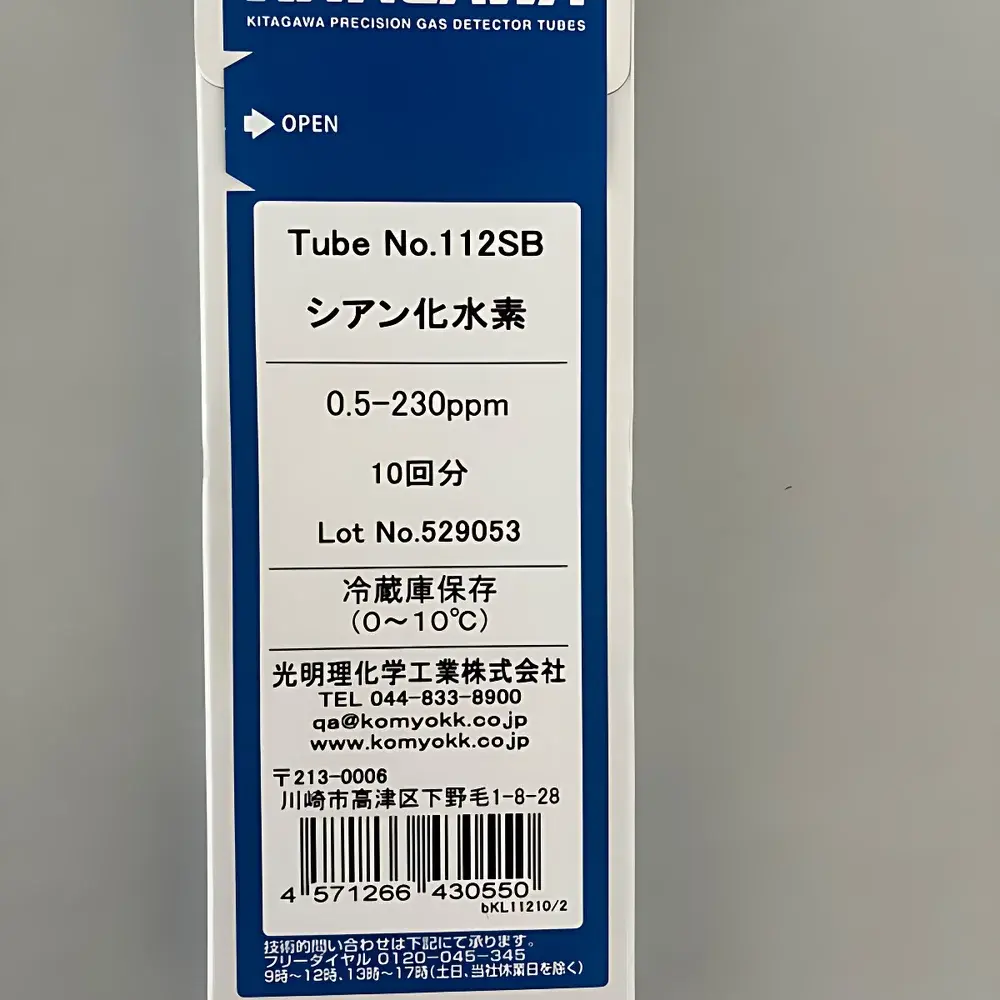
NorthKawamura HCN Gas Detection Tubes Model 112SB / 112SC
| Brand | Komyo Rikagaku (Komyo Chemical Co., Ltd.) |
|---|---|
| Origin | Japan |
| Tube Models | 112SA, 112SB, 112SC, 112ST |
| Detection Principle | Colorimetric Reaction with Pre-impregnated Reagent |
| Measuring Ranges | 112SA: 0.01–3% (v/v) |
| 112SB | 2–100 ppm, 0.25–25 ppm, and 4.6–230 ppm (three-scale dual-range tube) |
| 112SC | 0.3–8 ppm |
| 112ST | 20–2500 ppm |
| Sampling Volume | 100 mL (standard, using AP-20 manual air pump) |
| Calibration Traceability | NIST-traceable reference gas standards used during manufacturing |
| Shelf Life | 24 months from manufacture date when stored at ≤30°C and protected from light and moisture |
| Compliance | Designed in accordance with JIS K 0321 (Japanese Industrial Standard for Gas Detection Tubes), compatible with ISO 8573-2 (compressed air purity) and OSHA 29 CFR 1910.120 (HAZWOPER) field screening protocols |
Overview
The NorthKawamura HCN Gas Detection Tubes (Models 112SB and 112SC) are precision-engineered, single-use colorimetric devices for rapid, on-site quantification of hydrogen cyanide (HCN) vapor in ambient air or confined-space atmospheres. Based on the well-established length-of-stain principle, these tubes utilize a chemically specific reagent bed pre-impregnated onto silica gel or glass microbeads. When a defined volume of sample air is drawn through the tube via the AP-20 handheld piston pump, HCN molecules react stoichiometrically with the immobilized reagent—typically a copper(II) salt or aromatic aldehyde derivative—producing a sharp, linear color front. The distance traveled by this front, calibrated directly in concentration units (ppm or % v/v), is read against the printed scale on the tube’s outer surface. This method delivers immediate, instrument-free results without electrical power, software, or calibration gases—making it ideal for emergency response, industrial hygiene surveys, and routine leak checks where laboratory-grade GC-MS or electrochemical sensors are impractical.
Key Features
- Multi-range capability: Model 112SB incorporates three distinct concentration scales (2–100 ppm, 0.25–25 ppm, and 4.6–230 ppm) within a single tube, enabling flexible deployment across low-, medium-, and high-exposure scenarios.
- High selectivity for HCN: Optimized reagent formulation minimizes cross-sensitivity to common interferents including CO, NO₂, SO₂, H₂S, acetonitrile, and formaldehyde—validated per JIS K 0321 Annex B interference testing protocols.
- Controlled sampling geometry: Each tube features precisely engineered internal diameter and reagent bed length to ensure consistent flow resistance and reaction kinetics under standard 100 mL draw volume with AP-20 pump (100 ± 5 mL per stroke, 1.0 ± 0.1 bar peak pressure).
- Stable shelf life: Manufactured under cleanroom conditions and sealed in aluminum-laminated foil pouches with desiccant; certified stability of 24 months when stored at ≤30°C and shielded from UV exposure.
- Traceable metrology: Production batches are verified against NIST-traceable HCN-in-nitrogen calibration standards (SRM 1622), with certificate of analysis provided per lot number.
Sample Compatibility & Compliance
These detection tubes are validated for use in ambient air, indoor workplace environments, and inert carrier gas streams (e.g., N₂, Ar) at temperatures between 10–40°C and relative humidity up to 90% RH (non-condensing). They comply with Japanese Industrial Standard JIS K 0321:2020 (“Gas-detection tubes — General rules”) and support adherence to international occupational exposure frameworks including ACGIH TLV®, OSHA PEL, and EU Directive 2019/1837 (carcinogen risk management). While not intended for continuous monitoring, they meet the performance criteria for initial hazard assessment under OSHA 29 CFR 1910.120(q)(6)(ii) and EPA Region 10 Emergency Response Field Screening Guidelines. Tubes are classified as non-hazardous for transport (UN 3335, Class 9) when unopened.
Software & Data Management
As analog, self-contained chemical sensors, NorthKawamura detection tubes require no firmware, drivers, or data acquisition software. Quantitative results are recorded manually in field logs, LIMS-compatible spreadsheets, or digital inspection platforms (e.g., SafetyCulture iAuditor, Fulcrum). For audit readiness, users are advised to document tube lot number, expiration date, sampling location, time, temperature, humidity, pump strokes, and observed stain length—supporting GLP-aligned traceability and 21 CFR Part 11–compliant record retention when paired with electronic signature-enabled workflows.
Applications
- Routine industrial hygiene monitoring near electroplating baths, fumigation chambers, and metal-cleaning lines where HCN may evolve from sodium cyanide or potassium cyanide solutions.
- Emergency first-response screening following transportation incidents involving cyanide-based pesticides or industrial chemicals (e.g., methyl isocyanate hydrolysis byproducts).
- Confined-space entry verification prior to maintenance in wastewater treatment digesters or chemical storage vaults.
- Validation of local exhaust ventilation (LEV) system efficacy during maintenance of HCN-handling processes.
- Educational demonstrations of stoichiometric gas-phase reactions and occupational toxicology principles in university environmental health labs.
FAQ
What is the recommended sampling volume for accurate results?
A single 100 mL draw using the AP-20 pump is standard for all models; deviations beyond ±5% invalidate the calibration scale reading.
Can these tubes be reused after initial sampling?
No—each tube is a single-use, disposable device. Reuse compromises reagent integrity and introduces unacceptable measurement uncertainty.
How does humidity affect measurement accuracy?
Results remain reliable up to 90% RH; above this threshold, condensation may disrupt stain formation—pre-drying the sample stream with a silica gel filter is advised.
Are Lot-specific certificates of analysis available?
Yes—certificates listing batch-specific calibration curves, interference test reports, and NIST traceability documentation are supplied with each case shipment.
Do these tubes meet FDA or ISO 17025 requirements?
While not accredited test methods per ISO/IEC 17025, their design, validation, and production follow ISO 9001:2015 quality management systems and align with ISO 8573-2 Annex D for qualitative/semi-quantitative field screening applications.
Related Products







