
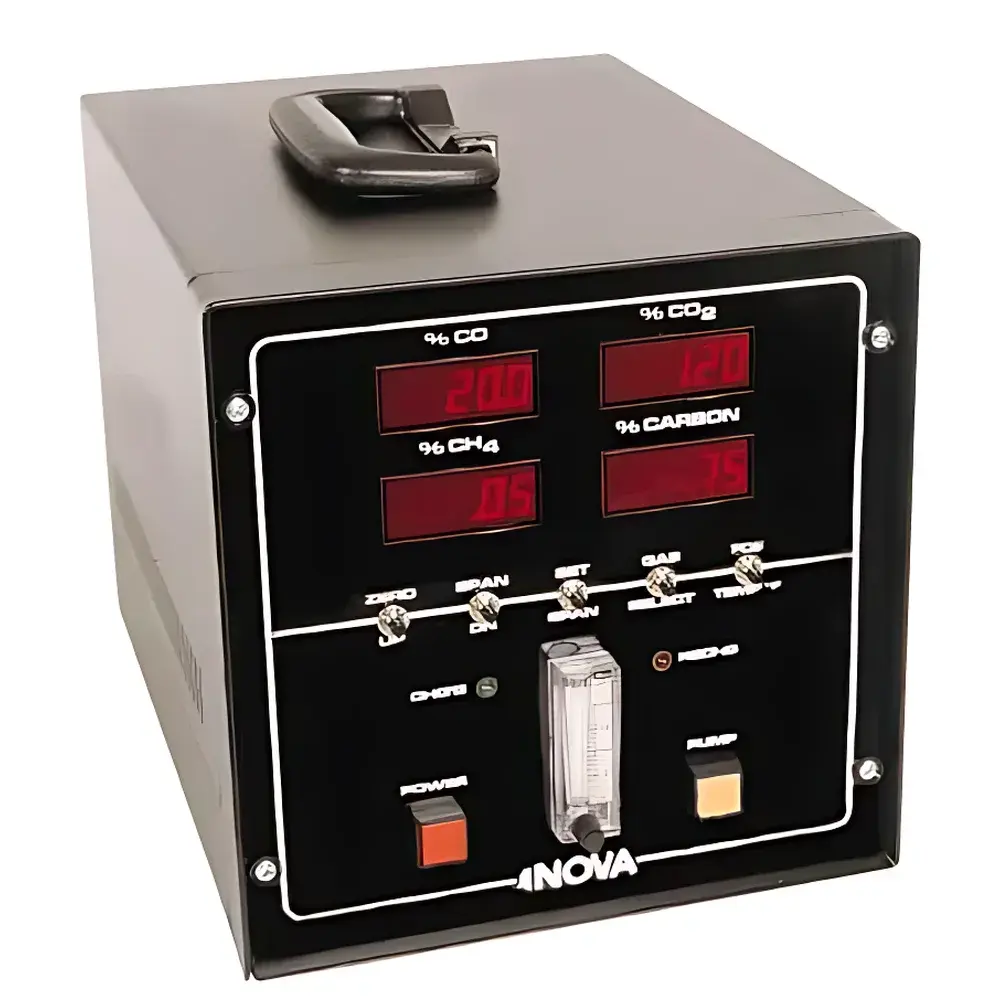
NOVA 7900P Portable Flue Gas Analyzer
| Brand | NOVA |
|---|---|
| Origin | Canada |
| Model | NOVA 7900P |
| Instrument Type | Continuous Emission Monitoring System (CEMS) |
| Measurement Principle | Non-Dispersive Infrared (NDIR) for CO/CO₂/CH₄ |
| Accuracy | ≤ ±1% FS |
| Repeatability | ≤ ±1% FS |
| Response Time (T90) | ≤ 30 s |
| Drift (Zero & Span, 8 h) | ≤ ±0.5% FS |
| Operating Temperature | 0–50 °C |
| Dimensions | 254 mm H × 254 mm W × 356 mm D |
| Weight | ~9 kg |
| Gas Ranges (Standard) | CO: 0–25.0% vol |
| CO₂ | 0–2.00% vol |
| CH₄ | 0–10.00% vol |
| H₂ | 0–40.00% vol |
| O₂ | 0–1.00% vol (or ppm range optional) |
| Output | 0–1 V DC per gas channel |
| Power | Rechargeable Li-ion battery |
| Sampling | Integrated diaphragm pump, particulate filter, condensate trap, and flow meter |
| Compliance | Designed to support ASTM D6522, ISO 12039, EN 15267, and EPA Method 3A / 10 |
Overview
The NOVA 7900P Portable Flue Gas Analyzer is an engineered field-deployable instrument designed for real-time, multi-component analysis of combustion and process gases in industrial thermal environments. Built upon a modular sensor architecture, it integrates non-dispersive infrared (NDIR) detection for carbon monoxide (CO), carbon dioxide (CO₂), and methane (CH₄); thermal conductivity detection (TCD) for hydrogen (H₂); a long-life electrochemical cell for oxygen (O₂) quantification across percent- or ppm-level ranges; and a ceramic capacitive dew point sensor for moisture assessment. The analyzer operates on dual power modes—rechargeable lithium-ion battery for up to 6 hours of continuous operation or AC mains supply—enabling flexibility across plant audits, stack testing, furnace commissioning, and CEMS validation tasks. Its measurement traceability aligns with internationally recognized reference methods including ASTM D6522 (for CO/CO₂/O₂ in flue gas), ISO 12039 (for continuous monitoring of CO, NOₓ, SO₂, O₂), and EPA Method 3A (O₂ and CO₂ calibration verification). All optical and electrochemical sensing elements are temperature-compensated and factory-calibrated against NIST-traceable standards.
Key Features
- Triple-channel NDIR optics with individual optical path compensation for CO, CO₂, and CH₄—minimizing cross-sensitivity and enabling simultaneous, independent quantification
- Dedicated TCD module optimized for H₂ detection in reducing atmospheres, with auto-zero stabilization and thermal drift correction
- Electrochemical O₂ sensor rated for >24 months service life under continuous operation, supporting both %vol and ppm measurement modes
- Ceramic dew point sensor with ±0.5 °C accuracy (–60 to +20 °C DP range), integrated into the sample stream post-filter and pre-analyzer
- Onboard sampling system: corrosion-resistant diaphragm pump (max. flow 1.2 L/min), stainless-steel particulate filter (5 µm), PTFE-coated condensate separator, and calibrated laminar flow meter (0–2 L/min)
- High-contrast LED display with dedicated numeric readouts per gas channel, configurable units (%vol, ppm, mg/m³), and real-time trend logging
- Robust aluminum alloy chassis with IP54-rated enclosure, shock-absorbing elastomer feet, and MIL-STD-810G compliant mechanical design
- Standard analog outputs: isolated 0–1 V DC per measured component; optional 4–20 mA current loop output with HART protocol support
Sample Compatibility & Compliance
The NOVA 7900P is validated for use with hot, humid, and particulate-laden flue gases from natural gas-fired furnaces, annealing lines, catalytic reformers, and waste incineration systems. Sample conditioning includes automatic water vapor removal via thermoelectric cooling and membrane-based drying, ensuring stable NDIR signal integrity. The analyzer meets functional requirements for periodic verification under ISO 14064-3 (GHG verification) and supports GLP-compliant data capture when paired with NOVA’s certified software suite. It complies with CE marking directives (EMC 2014/30/EU, RoHS 2011/65/EU), and its sensor modules conform to IEC 60079-29-1 for intrinsic safety in non-hazardous zones. While not intrinsically safe for Zone 1, it is routinely deployed in classified areas under temporary permit protocols aligned with NFPA 56 and OSHA 1910.120.
Software & Data Management
Data acquisition and reporting are managed through NOVA Link™ PC software (Windows 10/11 compatible), which provides full audit trail functionality compliant with FDA 21 CFR Part 11 requirements—including electronic signatures, user role-based access control, and immutable timestamped logs. Raw sensor voltages, corrected concentration values, dew point trends, and pump status diagnostics are recorded at user-selectable intervals (1–60 s). Export formats include CSV, PDF reports (with customizable templates), and XML for integration into SCADA or LIMS platforms. Firmware updates are performed over USB-C, with version rollback capability and SHA-256 signature verification. Calibration history, sensor health metrics (e.g., O₂ cell voltage decay rate, NDIR source intensity), and alarm event logs are retained onboard for ≥30 days.
Applications
- Thermal processing atmosphere control in metal heat treatment (e.g., carburizing, nitriding, brazing) where precise O₂/CO/CH₄/H₂ balance governs case depth and microstructure
- Stack emission auditing per EPA Performance Specification 2 (PS-2) for CO and CO₂, supporting Title V permit compliance
- Biogas upgrading facility monitoring—tracking CH₄ purity, CO₂ scrubber efficiency, and H₂S surrogate indicators (via CO/CH₄ ratio trends)
- Validation of continuous emission monitoring systems (CEMS) during relative accuracy test audits (RATA) as specified in 40 CFR Part 60, Appendix B
- Combustion optimization in boiler and kiln operations—using real-time O₂ excess and CO slip data to adjust air/fuel ratios
- Leak detection and purge verification in inerted vessels, especially where residual H₂ or hydrocarbons pose explosion risk
FAQ
What calibration gases are required for routine maintenance?
Certified zero gas (N₂ or synthetic air) and span gases traceable to NIST or equivalent national metrology institutes—e.g., 10% CO in N₂, 1% CO₂ in N₂, 5% CH₄ in air, and 0.5% O₂ in N₂—are recommended for daily bump checks. Full 3-point calibration is advised every 30 days or after sensor replacement.
Can the NOVA 7900P be used for high-moisture flue gas without external conditioning?
Yes—the integrated ceramic dew point sensor and thermoelectric condensate trap enable direct sampling of gases with up to 15% vol water vapor at ≤180 °C inlet temperature. For sustained operation above 200 °C or >20% humidity, an external heated line and chiller are recommended.
Is remote data transmission supported?
Standard Ethernet and optional Wi-Fi (802.11ac) modules allow secure MQTT or Modbus TCP communication to cloud dashboards or local HMIs. Cellular LTE-M connectivity is available via third-party gateway integration.
How is measurement uncertainty quantified per ISO/IEC 17025?
Uncertainty budgets are provided in the Certificate of Conformance (CoC) shipped with each unit, accounting for sensor nonlinearity, temperature coefficient, pressure sensitivity, and calibration standard uncertainty. Typical expanded uncertainty (k=2) for CO at 10% vol is ±0.15% vol.
Does the analyzer support automated zero/span sequences?
Yes—programmable auto-zero and auto-span routines can be scheduled via NOVA Link™ software or triggered manually using front-panel controls. All sequences log operator ID, timestamps, and pre/post-calibration deviations.







