
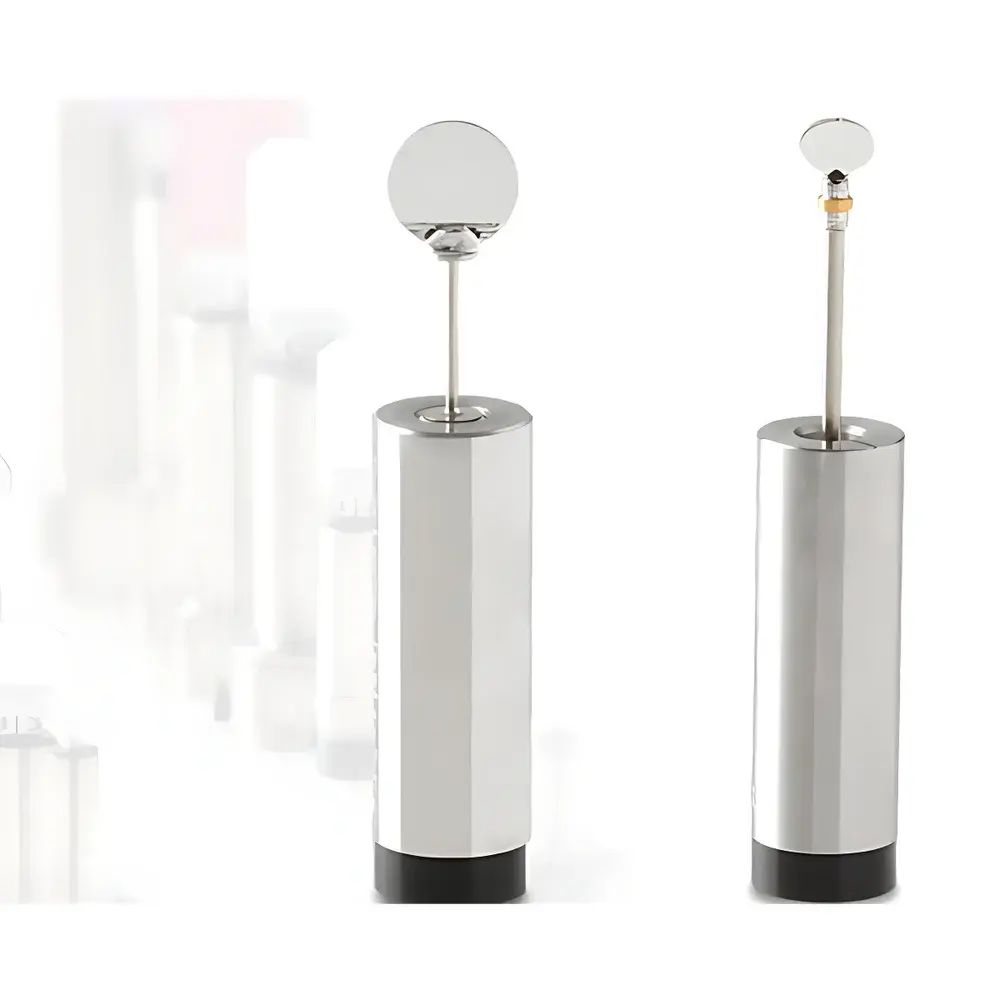
Novanta Cambridge Technology CRS Ultra-High-Speed Resonant Laser Scanning Galvanometer Module
| Brand | Novanta |
|---|---|
| Origin | United Kingdom |
| Manufacturer | Cambridge Technology (Novanta) |
| Model | CRS Series Ultra-High-Speed Resonant Galvanometer Module |
| Mirror Substrate | Beryllium (Be) |
| Resonant Frequencies | 3.938 kHz, 7.910 kHz, 12.000 kHz |
| Mirror Aperture | 12 × 9.25 mm (circular), 7.2 × 5.0 mm (elliptical) |
| Max Scan Angle | 24°, 26°, 10° (model-dependent) |
| Angular Repeatability | <250 μrad, <250 μrad, <175 μrad |
| Drive Voltage | 0–4 V DC / 0–5 V DC |
| Power Supply | +12 V DC, single-rail |
| Typical Power Consumption | 1.0 W, 1.0 W, 1.5 W |
| Temperature Coefficient of Resonance | 10 ppm/°C |
| Position Feedback | Integrated velocity-sensing coil |
| Synchronization Output | TTL-compatible edge-triggered signal per scan reversal |
| Dimensions (L × W) | 30.5 mm × 43 mm |
| Coating Options | Broadband Ag (400–1100 nm), custom dielectric HR coatings |
Overview
The Novanta Cambridge Technology CRS Ultra-High-Speed Resonant Laser Scanning Galvanometer Module is an engineered optical scanning solution optimized for applications demanding extreme temporal resolution and mechanical stability. Unlike conventional galvanometric scanners operating in closed-loop vector mode (e.g., Cambridge Technology’s 62xx or 83xx series), the CRS module operates exclusively at its mechanical resonant frequency—driven by a sinusoidal current waveform—to achieve fundamentally higher scan rates. This resonant architecture leverages the intrinsic dynamic response of a torsional oscillator, eliminating settling time constraints inherent to step-and-settle positioning systems. The core innovation lies in the use of beryllium (Be) as the mirror substrate—a lightweight, high-stiffness, low-thermal-expansion material with the lowest atomic mass among structurally viable metals. This enables mechanical resonance frequencies up to 12.0 kHz while maintaining sub-microradian angular repeatability and long-term thermal stability. Designed for integration into OEM optical systems, the CRS module delivers deterministic, repeatable sinusoidal motion ideal for line-scan imaging, confocal microscopy, adaptive optics wavefront correction, and real-time ophthalmic diagnostics.
Key Features
- Resonant-frequency-optimized scanning: Operates at fixed fundamental resonance (3.938 kHz, 7.910 kHz, or 12.000 kHz) with ±50 Hz or ±15 Hz tolerance at 25 °C.
- Beryllium mirror substrate: Provides exceptional specific stiffness (modulus/density ratio), enabling high resonant frequencies without compromising mechanical Q-factor or fatigue life.
- Thermally stable design: Resonant frequency drift limited to 10 ppm/°C—critical for applications requiring multi-hour operational consistency under ambient temperature fluctuations.
- Integrated velocity feedback: On-axis electromagnetic sensing coil delivers analog tachometer output proportional to mirror angular velocity—enabling precise timing synchronization and closed-loop amplitude regulation.
- OEM-ready interface: Compact footprint (30.5 mm × 43 mm), single +12 V DC supply, analog voltage-controlled amplitude (0–4 V or 0–5 V DC), and TTL sync pulse on every scan reversal.
- Optical flexibility: Multiple mirror geometries (circular and elliptical apertures) and broadband silver or custom dielectric high-reflection coatings (e.g., 400–1100 nm, 1064 nm, or dual-band options).
Sample Compatibility & Compliance
The CRS module is compatible with standard laser sources across visible and near-infrared spectra, including DPSS, diode, and fiber lasers (CW or pulsed). Its beryllium mirror supports high-power density operation when paired with appropriate coatings—validated for average powers up to 5 W (dependent on spot size and coating specification). All CRS variants comply with ISO 9001-certified manufacturing processes at Cambridge Technology’s UK facility. Mechanical and electrical designs adhere to IEC 61000-6-2 (immunity) and IEC 61000-6-4 (emissions) standards. While not classified as a medical device itself, the CRS module is routinely integrated into Class IIa and Class IIb ophthalmic systems compliant with ISO 13485 and FDA 21 CFR Part 820. Its deterministic scan timing and traceable calibration support GLP/GMP-aligned validation protocols for regulated imaging workflows.
Software & Data Management
The CRS module requires external waveform generation and synchronization logic—typically implemented via FPGA-based timing controllers or real-time DAQ systems (e.g., National Instruments PXIe, AlazarTech ATS9373). Cambridge Technology provides detailed electrical interface specifications, timing diagrams, and mechanical mounting templates—not proprietary software. Integration into existing image acquisition pipelines is facilitated by the TTL sync output, which aligns precisely with zero-crossing events of the sinusoidal scan trajectory. For quantitative metrology applications, the analog velocity feedback signal may be digitized and used to reconstruct instantaneous angular position via numerical integration—enabling post-acquisition geometric correction and pixel-to-angle mapping. All CRS modules ship with NIST-traceable calibration reports documenting resonant frequency, amplitude linearity, and thermal coefficient under controlled environmental conditions.
Applications
- High-speed confocal and multiphoton microscopy: Enables video-rate line scanning with sub-10 µs dwell time per pixel—reducing phototoxicity and motion artifacts in live-cell imaging.
- Ophthalmic retinal imaging and adaptive optics: Supports real-time correction of ocular aberrations at >10 kHz bandwidth, essential for high-resolution AO-SLO and OCT angiography.
- Laser marking and micro-machining: Delivers consistent beam placement at ultra-high repetition rates for precision ablation of thin-film materials and polymer substrates.
- Optical coherence tomography (OCT) swept-source synchronization: Acts as a high-fidelity optical delay line actuator synchronized to laser sweep triggers.
- Neuroscience optogenetics: Facilitates targeted, millisecond-scale light delivery to spatially distributed neuronal populations via patterned illumination.
- Industrial inline inspection: Integrated into vision-guided robotic systems for real-time defect detection on moving webs or rotating components.
FAQ
Is the CRS module compatible with closed-loop position control?
No—the CRS is a resonant-only device with no absolute position encoder. It is designed for open-loop sinusoidal excitation at its natural frequency; position feedback is limited to analog velocity sensing.
What is the maximum safe laser power for the standard Ag-coated mirror?
For continuous-wave operation at 532 nm or 1064 nm, the recommended maximum average power is 3 W with >1 mm beam diameter and uniform intensity distribution. Higher powers require custom coatings and thermal modeling.
Can multiple CRS modules be synchronized?
Yes—using the TTL sync output from one master CRS unit to trigger auxiliary modules or external detectors ensures phase-locked operation across multi-axis configurations.
Does the module include drive electronics?
No—CRS modules are bare galvanometers requiring external resonant driver amplifiers (e.g., Cambridge Technology’s GDS series or third-party LCC/LCA drivers optimized for high-Q resonant loads).
How is angular repeatability verified during production?
Each unit undergoes interferometric angular displacement measurement using a stabilized HeNe laser and quadrant photodiode system, with repeatability confirmed over 10⁶ cycles at rated amplitude and temperature.




