
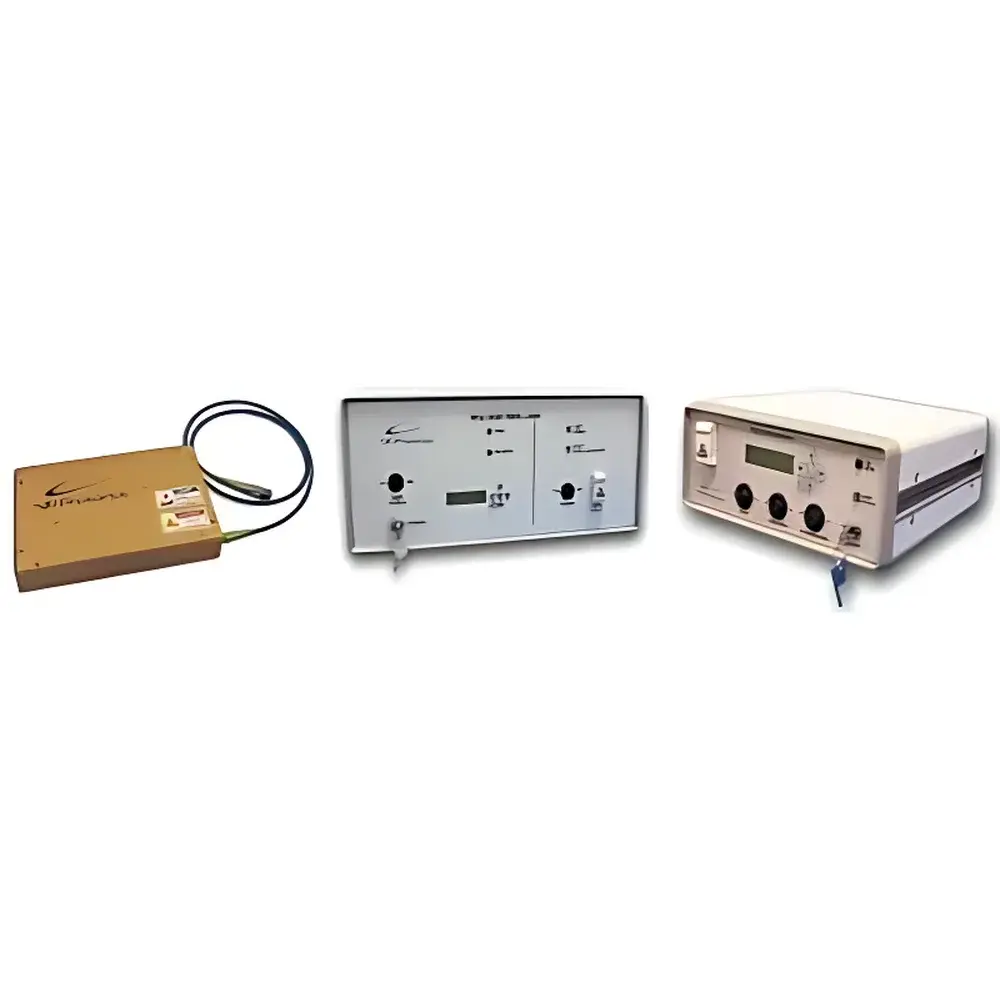
NP Photonics Single-Frequency Fiber Laser Model 220
| Origin | USA |
|---|---|
| Manufacturer Type | Authorized Distributor |
| Origin Category | Imported |
| Model | 220 |
| Pricing | Available Upon Request |
Overview
The NP Photonics Single-Frequency Fiber Laser Model 220 is an engineered solution for applications demanding ultra-narrow linewidth, high spectral purity, and long-term wavelength stability. Based on proprietary rare-earth-doped microstructured fiber technology and advanced thermal and electronic control architectures developed from the University of Arizona’s Optical Sciences Center, this laser operates on the principle of stimulated emission in a single longitudinal mode (SLM) cavity—ensuring diffraction-limited beam quality and minimal phase noise. It is designed for integration into precision interferometric sensing, coherent LIDAR, fiber optic gyroscopes, atomic physics experiments, and as a seed source for high-power MOPA systems. The laser supports dual-wavelength operation: in the 1030–1080 nm range (including standard lines at 1047 nm, 1053 nm, and 1064 nm) and the C-band telecom window (1530–1565 nm), enabling cross-platform compatibility across scientific, defense, and industrial infrastructure monitoring applications.
Key Features
- Single-frequency operation with intrinsic linewidth ≤ 3 kHz (typical), verified via delayed self-heterodyne interferometry
- High output power options: 25–150 mW in low-power modules; up to 5 W in high-power configurations using erbium-doped microstructured fiber (EMF)
- Integrated active noise suppression circuitry reducing relative intensity noise (RIN) to < −110 dB/Hz (10 Hz–10 MHz)
- Dual-mode wavelength tuning: thermal tuning range > 20 GHz; fast piezoelectric or current-based tuning up to 100 MHz
- Polarization-maintaining (PM) fiber output with polarization extinction ratio > 20 dB
- Microcontroller-based digital control system with RS232 interface for remote configuration, real-time monitoring, and firmware updates
- Long-term wavelength stability < ±1 pm over 24 h (at constant temperature); short-term drift < ±0.5 pm over 1 h
- Optical signal-to-ASE ratio > 55 dB, ensuring minimal broadband background interference in sensitive detection schemes
Sample Compatibility & Compliance
The Model 220 is compatible with standard SMF-28, PM1550, and HI1060 fibers via FC/APC or FC/PC connectors. Its optical architecture meets fundamental requirements for use in ISO/IEC 17025-accredited calibration laboratories and complies with IEC 60825-1:2014 Class 3B laser safety standards. While not certified under FDA 21 CFR Part 11, its embedded logging functionality—including timestamped power, temperature, and setpoint history—supports GLP/GMP-aligned audit trails when integrated into validated measurement workflows. The device conforms to RoHS Directive 2011/65/EU and CE marking requirements for electromagnetic compatibility (EN 61326-1) and low-voltage safety (EN 61010-1).
Software & Data Management
NP Photonics provides a vendor-agnostic ASCII command protocol over RS232, enabling seamless integration with LabVIEW, MATLAB, Python (PySerial), and custom SCADA environments. The firmware supports programmable ramping profiles, alarm thresholds for temperature/power deviation, and non-volatile storage of up to 10 user-defined operating presets. Optional OEM SDKs include DLL libraries for Windows and shared object interfaces for Linux-based embedded controllers. All operational logs are exportable in CSV format for traceability—critical for ISO 9001 process documentation and third-party metrology audits.
Applications
- Coherent optical time-domain reflectometry (C-OTDR) for distributed acoustic sensing (DAS) in oil & gas well monitoring
- Seed source for diode-pumped solid-state (DPSS) lasers, including Nd:YAG and Yb:fiber amplifiers
- Atomic vapor spectroscopy (e.g., Rb, Cs D-lines pumping) requiring sub-MHz frequency agility
- High-finesse cavity ring-down spectroscopy (CRDS) and photoacoustic gas sensing platforms
- Navigation-grade fiber optic gyroscopes (FOGs) where bias stability < 0.001°/h depends on laser coherence length > 100 km
- Gravitational wave detector prototype development requiring sub-Hz frequency noise floors
FAQ
Is the Model 220 qualified for continuous 24/7 operation in unattended field deployments?
Yes—rated for MTBF ≥ 50,000 hours under controlled ambient conditions (15–35°C, <70% RH). Industrial-grade thermal management includes dual-stage TECs and internal airflow optimization.
Can the laser be locked to an external reference such as a Fabry–Pérot cavity or atomic transition?
Yes—the analog modulation input (0–5 V) and built-in PID controller support external locking via Pound–Drever–Hall or offset-phase-lock techniques. Lock acquisition time is typically < 2 s.
What is the typical coherence length for the 1550 nm variant at 3 kHz linewidth?
Approximately 100 km in vacuum (λ²/Δλ), assuming Gaussian spectral shape and no environmental perturbation.
Does the system include factory calibration data for wavelength and power accuracy?
Each unit ships with NIST-traceable calibration certificates for center wavelength (±0.01 nm) and output power (±2% at 25°C), valid for 12 months from date of shipment.
Are OEM mechanical or electrical integration packages available?
Yes—custom chassis mounting, DC power input variants (±12 V or 24 V), and TTL-compatible status outputs (Laser ON, Fault, Temp OK) are offered under NP Photonics’ OEM program.




