
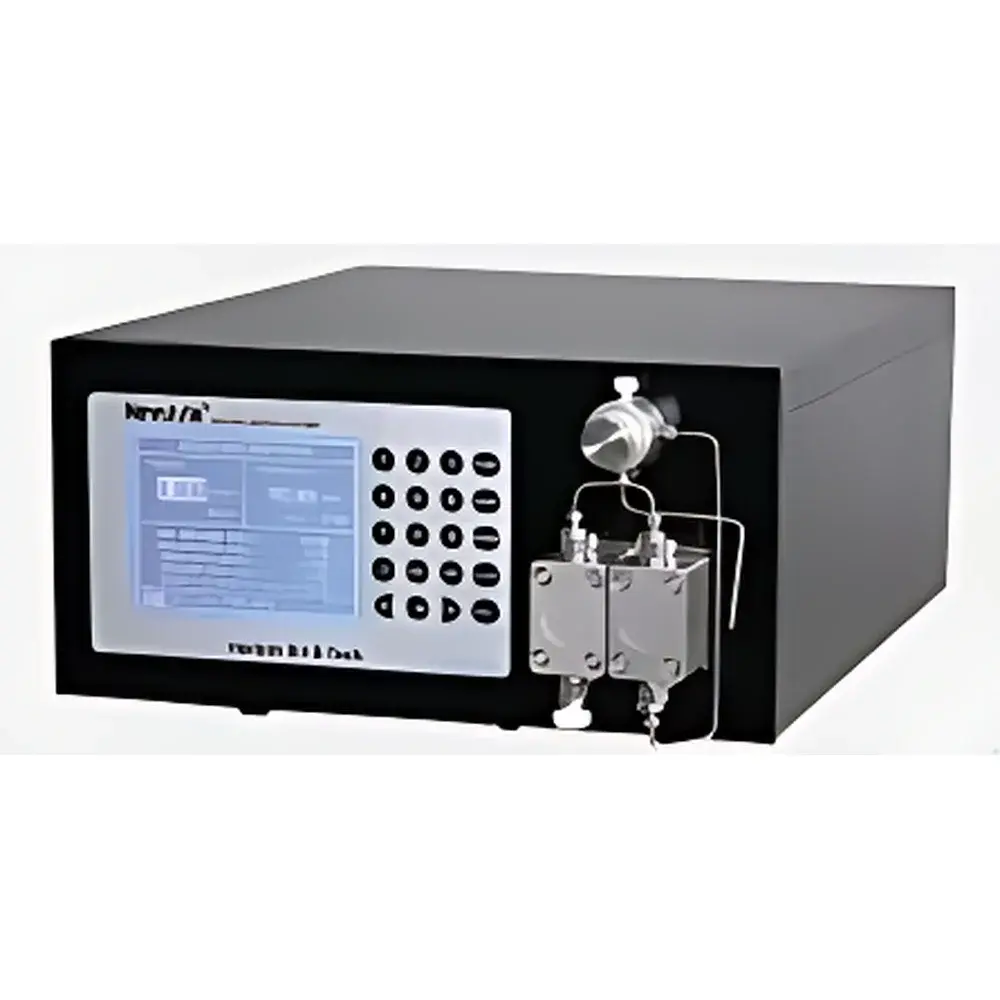
NP7001 High-Performance Binary Solvent Delivery Pump for HPLC Systems
| Origin | Jiangsu, China |
|---|---|
| Manufacturer Type | Authorized Distributor |
| Origin Category | Domestic (PRC) |
| Model | NP7001 |
| Price Range | USD 14,000–28,000 (FOB) |
| Instrument Type | Conventional High-Performance Liquid Chromatograph (HPLC) Pump |
| Flow Mode | Dual-Piston Serial Configuration |
| Flow Range | 0.001–9.999 mL/min |
| Flow Increment | 0.001 mL/min |
| Flow Accuracy | ≤0.5% or ≤10 µL/min |
| Flow Precision (RSD) | ≤0.1% |
| Pressure Pulsation | ≤0.5 MPa |
| Maximum Operating Pressure | ≤42 MPa |
| Tubing Connection | 1/16″ Stainless Steel Standard Fittings |
| Display | 4.7″ LCD (320 × 240 pixels), Tab-Based UI |
| User Programs | 10 Predefined Methods |
| Gradient Capability | Linear Flow Gradient Programming |
| Communication Protocol | Open ASCII-Based RS-232/RS-485 Protocol (Third-Party Software Compatible) |
| Maintenance Feature | Optional Automatic Back-Flush Mechanism for Piston Seal and Rear Seal Area |
| Sealing Architecture | Floating Piston Design with Extended Seal Life |
| Flow Damping | Integrated Electronic Pulse Damping Control |
| Calibration | Multi-Point Flow Calibration Curve (Spanning Full Range) |
Overview
The NP7001 High-Performance Binary Solvent Delivery Pump is a precision-engineered solvent delivery module designed for integration into conventional high-performance liquid chromatography (HPLC) systems. It operates on the principle of dual-piston serial displacement, where two synchronized reciprocating pistons—configured in series—generate continuous, pulse-dampened mobile phase flow without reliance on mechanical check valves alone. This architecture ensures stable hydrostatic pressure generation across the full operational range (0.001–9.999 mL/min), critical for baseline stability and retention time reproducibility in gradient elution methods. The pump’s floating piston design minimizes lateral shear stress on high-pressure seals, significantly extending seal service life under sustained 42 MPa (6,090 psi) operation—a requirement for modern sub-2 µm particle-packed columns. Its electronic pulse damping system actively compensates for inherent volumetric displacement fluctuations, reducing pressure pulsation to ≤0.5 MPa and enabling ultra-low baseline noise (<0.5 mAU typical) when coupled with UV/VIS or fluorescence detectors.
Key Features
- Dual-piston serial configuration with real-time position feedback and adaptive stroke compensation for consistent volumetric output
- Floating piston mechanism engineered to maintain concentric alignment under thermal expansion and load variation, reducing seal wear by up to 40% compared to fixed-piston designs
- Multi-point flow calibration curve (10-point) stored in non-volatile memory, ensuring traceable accuracy across the entire flow range (0.001–9.999 mL/min) per ISO 11607-2 verification protocols
- Optional automated back-flush function activates during idle intervals to purge crystalline salt deposits from the rear face of the piston seal—critical for long-term reliability in phosphate- or ammonium acetate-based mobile phases
- Open ASCII-based serial communication protocol (RS-232/RS-485) compliant with ASTM E1382-95 and EU Annex 11 data integrity guidelines; supports bidirectional command/response framing for third-party CDS integration
- Tab-oriented 4.7″ LCD interface (320 × 240 resolution) with intuitive navigation, real-time pressure/flow monitoring, and 10 user-programmable method slots supporting linear flow gradients
Sample Compatibility & Compliance
The NP7001 is compatible with all standard HPLC-grade solvents—including aqueous buffers (pH 1.5–12), acetonitrile, methanol, tetrahydrofuran, and chlorinated organics—when used with chemically resistant wetted materials (316L stainless steel pump heads, sapphire-ruby check valves, PEEK/PTFE tubing). It meets mechanical safety requirements per IEC 61010-1:2010 and electromagnetic compatibility (EMC) standards EN 61326-1:2013. For regulated environments, its firmware supports audit-trail-enabling event logging (power-on, method change, pressure fault, seal flush activation) aligned with FDA 21 CFR Part 11 Subpart B controls. While not certified as GMP-compliant out-of-box, it is routinely validated per USP Analytical Instrument Qualification (AIQ) protocols for Installation Qualification (IQ), Operational Qualification (OQ), and Performance Qualification (PQ) in QC laboratories.
Software & Data Management
The NP7001 does not include proprietary chromatography data system (CDS) software but provides deterministic, low-latency serial control via documented ASCII command sets. Each command returns a structured status response (e.g., “ACK:FLOW=0.500|PRESS=18.3|TEMP=32.1|ERR=0”), enabling robust error handling in custom LabVIEW, Python (pySerial), or MATLAB automation frameworks. Time-stamped operational logs—including flow setpoint, actual flow (via integrated flow sensor feedback), pressure, temperature, and seal maintenance cycles—are exportable as CSV for trending analysis. Firmware revision history and calibration certificate metadata are embedded in device memory and retrievable via query command, satisfying ALCOA+ data integrity principles (Attributable, Legible, Contemporaneous, Original, Accurate, Complete, Consistent, Enduring, Available).
Applications
- Isocratic and linear binary gradient separations in pharmaceutical QC (e.g., assay of active pharmaceutical ingredients per USP monographs)
- Method development for reversed-phase, HILIC, and ion-pair chromatography requiring precise low-flow delivery (e.g., 0.01 mL/min capillary-scale methods)
- Integration into multi-pump solvent selection manifolds for ternary or quaternary gradient systems
- Long-duration stability studies (>72 h) where seal longevity and flow drift (<0.02%/h) are critical
- Academic research labs requiring open-control architecture for custom hyphenated techniques (e.g., HPLC–electrochemical detection, HPLC–ICP-MS interface tuning)
FAQ
Does the NP7001 support gradient mixing at the pump head?
No—it is a binary solvent delivery pump without an integrated mixer; gradient formation requires external low-dead-volume T-mixer or high-pressure mixing manifold.
What validation documentation is provided with the instrument?
Factory calibration report (traceable to NIST-certified flow standards), electrical safety test record, and firmware version log; IQ/OQ templates available upon request.
Can the automatic seal flush be scheduled independently of method runs?
Yes—flush cycles can be triggered manually or programmed via time-based scheduler (e.g., every 4 hours during overnight operation).
Is the 42 MPa maximum pressure rating maintained across the full flow range?
Yes—pressure rating is specified at all flows ≥0.1 mL/min; below this, pressure capability is limited by system compliance and detector backpressure tolerance.
How is flow accuracy verified post-installation?
Using gravimetric flow verification per ISO 5725-2:2019, with certified analytical balance (±0.01 mg) and temperature-controlled collection vessel (±0.1 °C).





