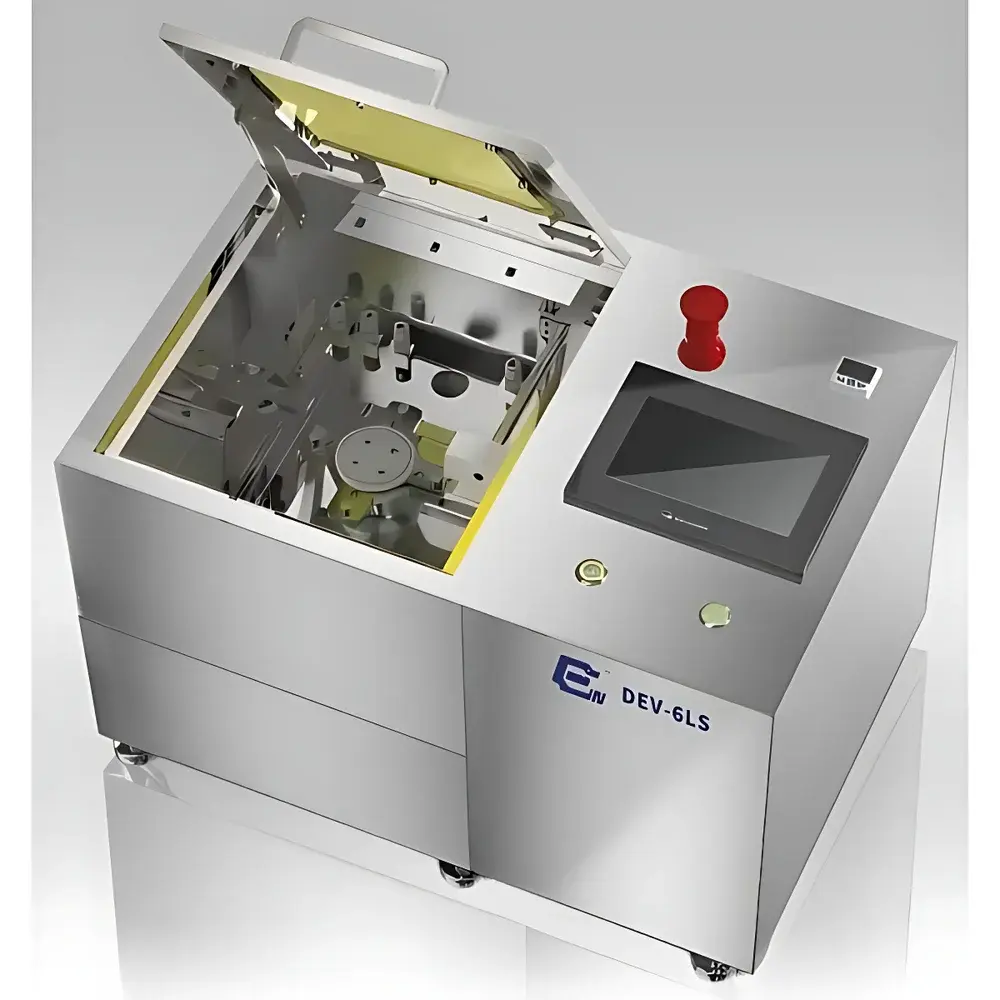
NS Ion Beam Etcher NS-5 (Kaufman-Type, 10 cm Diameter Source)
| Brand | NS |
|---|---|
| Origin | Japan |
| Model | NS-5 |
| Ion Source Type | Kaufman-type |
| Beam Diameter | 10 cm |
| Sample Stage Cooling | Direct-contact cryogenic cooling |
| Stage Motion | Combined rotation and revolution |
| Beam Tilt Adjustment | Fully variable (0–90°) |
| Application Scope | R&D and low-volume production |
| Substrate Compatibility | Up to 6-inch diameter wafers |
| Power Supply Compatibility | Interchangeable with domestic 220 V / 50 Hz AC input |
| Compliance | Designed for ISO Class 5 cleanroom integration |
Overview
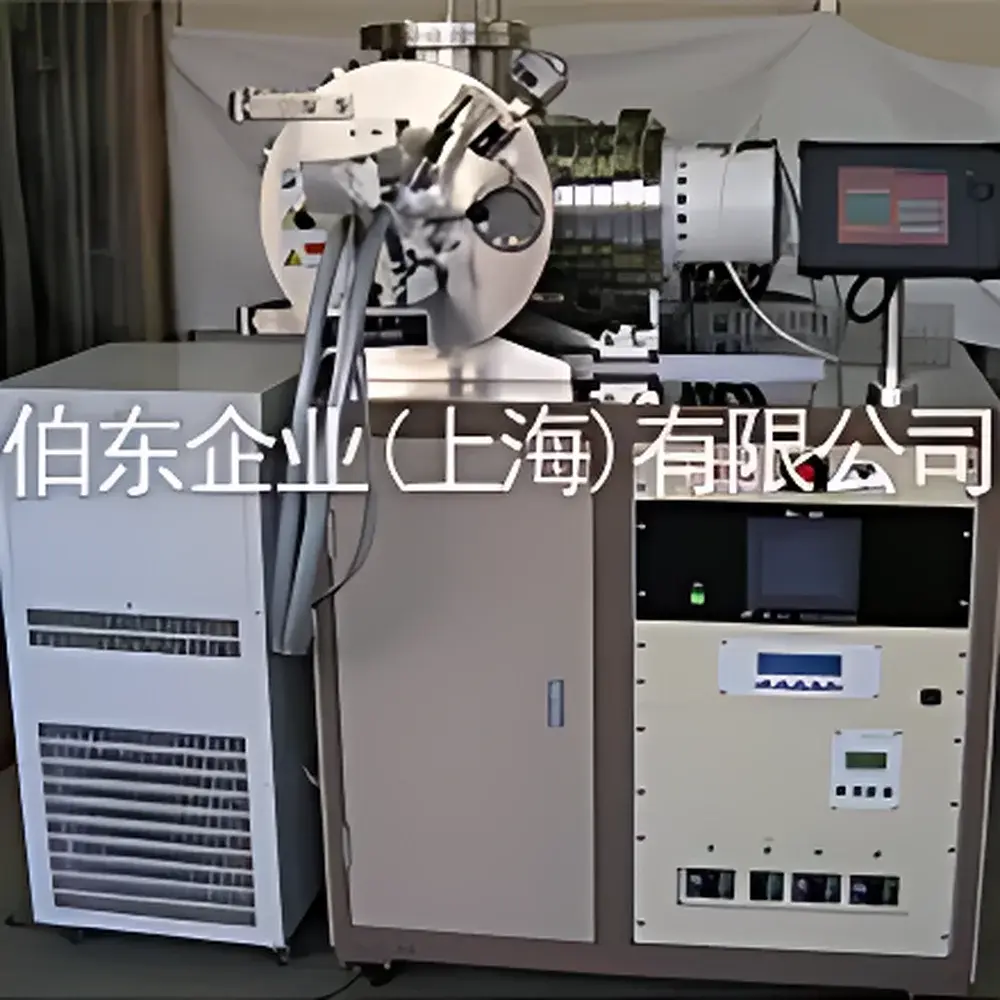
The NS-5 Ion Beam Etcher is a compact, high-precision Kaufman-type ion beam sputtering system engineered for physical vapor etching in semiconductor process development, thin-film device fabrication, and advanced materials research. Unlike reactive plasma etching methods, the NS-5 employs a neutralized broad-beam ion source—specifically a 10 cm diameter Kaufman ion source manufactured under license by Kaufman & Robbins (USA)—to deliver energetic argon (or other process gas) ions toward the target surface at controlled incidence angles. This physical sputtering mechanism enables material removal independent of chemical reactivity, making it uniquely suitable for etching refractory metals (e.g., Pt, Ta, W), magnetic alloys (NiFe, CoFeB), insulators (Al₂O₃, SiO₂, MgO), and compound semiconductors (GaAs, InP) where plasma-induced damage or selectivity limitations hinder conventional dry etch tools. The system supports both single-wafer processing (up to 6-inch diameter substrates) and discrete sample mounting, with direct-contact stage cooling enabling substrate temperature control down to −40 °C—critical for minimizing thermal drift during high-resolution patterning and preserving spintronic or piezoelectric layer integrity.
Key Features
- Kaufman-type 10 cm ion source with stable beam current density (typical range: 0.5–3 mA/cm²) and long-term emission stability (>1000 h mean time between maintenance)
- Fully adjustable ion beam incidence angle (0° to 90° relative to substrate normal), enabling anisotropic vertical etching, controlled sidewall tapering, and directional surface texturing
- Direct-contact cryogenic stage cooling system integrated into the sample holder, facilitating precise thermal management without liquid nitrogen dewars or external chillers
- Combined planetary motion stage: simultaneous rotation and revolution ensures uniform ion flux distribution across 6-inch substrates, reducing radial etch rate non-uniformity to <±3.5% (1σ)
- Modular power supply architecture supporting international AC inputs (100–240 V, 50/60 Hz); optional retrofit for 220 V / 50 Hz domestic grid compatibility
- Vacuum chamber constructed from electropolished stainless steel (ISO-KF 63 and CF 100 flanges), base pressure <5×10⁻⁷ Pa (achieved with turbomolecular pump + cryo-trap configuration)
- Integrated residual gas analyzer (RGA) port and multiple mass flow controllers (MFCs) for Ar, O₂, Xe, and N₂—enabling multi-gas sequential or mixed-gas etch protocols
Sample Compatibility & Compliance
The NS-5 accommodates rigid planar substrates up to 150 mm (6-inch) in diameter, including silicon wafers, quartz masks, sapphire substrates, and ceramic carriers. It is routinely deployed in academic cleanrooms and pilot-line fabs for MRAM stack patterning, GMR/TMR sensor definition, MEMS release etching, and hard mask trimming prior to ALD or CVD. The system complies with ISO 14644-1 Class 5 cleanroom operational requirements when installed with appropriate air filtration and grounding. All electrical subsystems meet IEC 61000-6-2 (immunity) and IEC 61000-6-4 (emission) standards. While not certified for full GMP manufacturing, its repeatable process logs, timestamped parameter records, and hardware interlocks support GLP-aligned documentation practices per ISO/IEC 17025 guidelines for calibration and method validation.
Software & Data Management
Operation is managed via a dedicated Windows-based HMI with real-time monitoring of ion current, beam voltage, chamber pressure, stage temperature, and gas flow rates. All process parameters are stored with UTC timestamps and user ID tagging. Export formats include CSV and XML for traceability; raw data archives support post-run analysis using third-party tools (e.g., Python/Pandas, MATLAB). Optional audit trail module satisfies FDA 21 CFR Part 11 requirements for electronic records and signatures—including role-based access control, change history logging, and digital signature enforcement on critical recipe modifications.
Applications
- High-resolution patterning of magnetic tunnel junctions (MTJs) and spin-transfer torque layers without interfacial oxidation
- Isotropic and anisotropic etching of AlN, ScAlN, and ZnO for BAW/SAW resonator fabrication
- Surface smoothing and defect reduction in epitaxial GaN and SiC substrates prior to heterostructure growth
- Maskless top-down nanofabrication of plasmonic nanostructures on Au, Ag, and TiN films
- Controlled thinning of TEM lamellae for site-specific cross-sectional analysis
- Removal of native oxides and carbon contamination from ultra-clean metal surfaces prior to UHV deposition
FAQ
What gases can be used with the NS-5 ion source?
Argon is standard; oxygen, nitrogen, xenon, and hydrogen are supported with appropriate MFC calibration and chamber conditioning.
Is remote operation or automation integration possible?
Yes—the system provides RS-232, Ethernet (TCP/IP), and optional SECS/GEM interface for factory automation (SEMI E30/E37 compliant) and integration into MES environments.
Does the NS-5 require liquid nitrogen or external chillers for low-temperature etching?
No—its integrated Peltier-based direct-contact cooling achieves stable sub-zero temperatures without consumables or auxiliary equipment.
Can the NS-5 perform ion beam deposition (IBD) as well as etching?
Not natively; however, with minor vacuum chamber modification (target mounting and biasing capability), it may be adapted for co-sputter deposition—consult NS technical documentation for mechanical interface specifications.
What maintenance intervals are recommended for the Kaufman ion source?
Anode and cathode inspection every 500 hours; filament replacement every 1,000–1,500 hours depending on beam current and gas chemistry—full service kits and OEM spares are available through authorized distributors.