
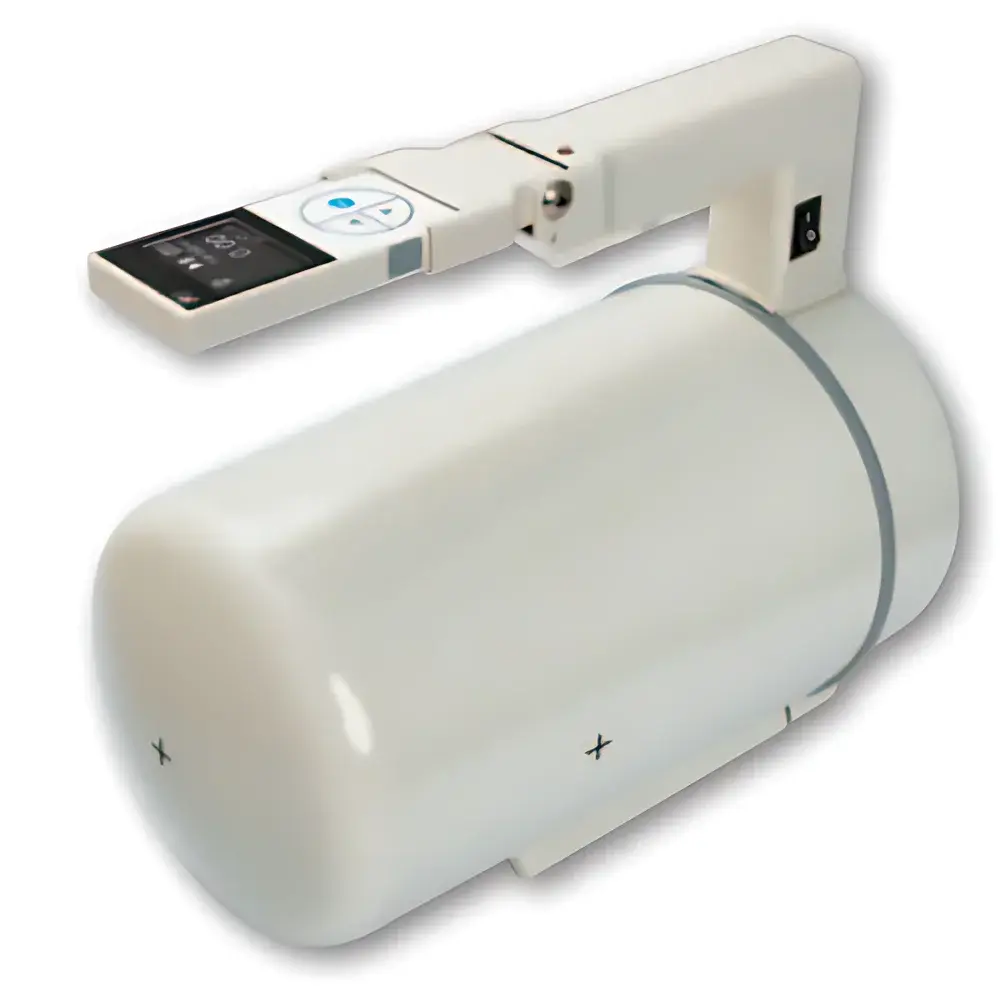
NSN31045-111YY-S Portable Neutron Spectrometer
| Origin | Japan |
|---|---|
| Manufacturer Type | Authorized Distributor |
| Origin Category | Imported |
| Model | NSN31045-111YY-S |
| Instrument Type | Portable |
| Instrument Kind | Spectrometer |
| Measured Medium | Solid |
| Detector Type | Gas-filled Proportional Counter |
| Radiation Type | Neutrons |
| Dose Rate Range | 0.01 μSv/h to 99.99 mSv/h |
| Dose Range | 0.01 μSv to 99.99 mSv |
| Energy Range | 0.025 eV to 15 MeV |
| Dose Rate Accuracy | ≤ ±15% at 10 μSv/h |
| Dose Accuracy | ≤ ±25% at 0.05 μSv |
| Angular Dependence | ≤ ±25% (±90° from reference axis) |
| Gamma Rejection | <1 mSv/h (effectively insensitive) |
| Battery Life | >12 h (continuous display) |
| Operating Temperature | –10 °C to +45 °C |
| Operating Humidity | 35–90% RH (non-condensing) |
| Dimensions | Φ164 mm × 289.5 mm |
| Weight | ~3 kg |
| Interface | USB |
| Compliance | IEC 61005 |
Overview
The NSN31045-111YY-S Portable Neutron Spectrometer is a field-deployable, gas-filled proportional counter-based instrument engineered for accurate measurement of ambient neutron dose equivalent rate and accumulated dose equivalent in radiological environments. Designed in accordance with the energy response characteristics defined in ICRP Publication 74, it delivers spectrometric-capable neutron detection across an exceptionally broad energy range—from thermal neutrons (0.025 eV) up to fast neutrons (15 MeV)—without requiring external moderation or spectral unfolding software for routine operational use. Its compact cylindrical form factor (Φ164 mm × 289.5 mm) and mass of approximately 3 kg enable single-operator deployment in nuclear facilities, decommissioning sites, border control checkpoints, emergency response scenarios, and environmental monitoring campaigns where rapid neutron field characterization is critical. Unlike scintillation- or solid-state alternatives, this instrument employs a pressure-stabilized, boron-trifluoride (BF3) or 3He-filled proportional counter optimized for high neutron/gamma discrimination—achieving effective gamma insensitivity below 1 mSv/h.
Key Features
- True portable design with integrated power management supporting three independent supply modes: six AA alkaline cells, six AA Ni-MH rechargeables, or universal AC input (100–240 V) via included adapter
- High-fidelity 5-digit LCD display showing real-time dose rate (μSv/h, mSv/h) and cumulative dose (μSv, mSv) simultaneously
- Compliant with IEC 61005 for neutron survey instruments—validated angular dependence ≤ ±25% over ±90° azimuthal and polar acceptance
- Energy response calibrated per ICRP 74 fluence-to-dose conversion coefficients, ensuring traceable ambient dose equivalent (H*(10)) reporting
- USB interface enables direct data streaming to host PC for time-stamped logging, post-processing, and integration into centralized radiation safety information systems (RSIS)
- Robust mechanical architecture rated for operation in demanding field conditions: –10 °C to +45 °C ambient temperature and 35–90% relative humidity (non-condensing)
Sample Compatibility & Compliance
The NSN31045-111YY-S is specifically configured for neutron detection in heterogeneous solid-field geometries—such as concrete shielding interfaces, spent fuel cask surfaces, soil matrices, and activated metal components—where neutron emission arises from spontaneous fission, (α,n) reactions, or photoneutron production. It does not require sample preparation or contact measurement; all readings reflect unmoderated ambient neutron fields incident on the detector volume. Regulatory alignment includes conformity with IEC 61005 Ed. 2.0 (2019) for neutron survey meters, and its performance envelope satisfies technical requirements referenced in IAEA Safety Standards Series No. RS-G-1.9 (Application of the ISO/IEC 17025 Standard to Radiation Protection Instrument Calibration Laboratories). While not intrinsically certified for Zone 1 hazardous areas, its low-power electronics and sealed detector housing support safe use in classified radiological work zones under ALARA protocols.
Software & Data Management
Data acquisition is supported via standard USB CDC (Communication Device Class) protocol, enabling plug-and-play compatibility with Windows, Linux, and macOS platforms. The device transmits ASCII-formatted telemetry packets—including timestamp (UTC), dose rate, accumulated dose, battery voltage, and status flags—at user-selectable intervals (1 s to 60 s). Optional vendor-provided software provides GLP-compliant audit trail generation, configurable alarm thresholds (audible/visual), and export to CSV or XML for import into LIMS or regulatory reporting tools. All firmware updates are delivered via signed binary packages, preserving integrity verification per NIST SP 800-193 guidelines. No proprietary drivers are required; no cloud dependency or subscription licensing applies.
Applications
- Routine neutron area monitoring around research reactors, isotope production facilities, and accelerator-based neutron sources
- Post-incident radiological assessment following suspected neutron-emitting source loss or transport incidents
- Decommissioning surveys of neutron-activated structural materials (e.g., reactor pressure vessel internals, biological shields)
- Border and port-of-entry screening for illicit neutron-emitting special nuclear materials (SNM)
- Environmental baseline studies near legacy nuclear test sites or uranium mining tailings
- Calibration verification of fixed-area neutron monitors using traceable point-source exposures
FAQ
Does the NSN31045-111YY-S provide energy-resolved neutron spectra?
No—it reports ambient dose equivalent H*(10) derived from a pre-calibrated response function aligned to ICRP 74. Spectral deconvolution requires external unfolding algorithms and is not performed onboard.
Can it be used in high-humidity outdoor environments?
Yes, provided condensation is avoided. Its IP54-equivalent enclosure rating supports operation at 35–90% RH within the specified temperature range.
Is gamma compensation active or passive?
Passive—gamma rejection is achieved through detector geometry, fill gas selection, and pulse-height discrimination thresholds; no electronic compensation circuitry is employed.
What is the calibration interval recommendation?
Annual calibration against traceable neutron sources (e.g., 252Cf, Am-Be) is recommended per ISO/IEC 17025 and national metrology institute guidelines.
Does it meet FDA 21 CFR Part 11 requirements for electronic records?
The instrument itself does not implement Part 11 controls; however, when paired with validated third-party data acquisition software featuring audit trails, electronic signatures, and secure storage, full compliance is achievable in regulated QA/QC workflows.
Related Products







