
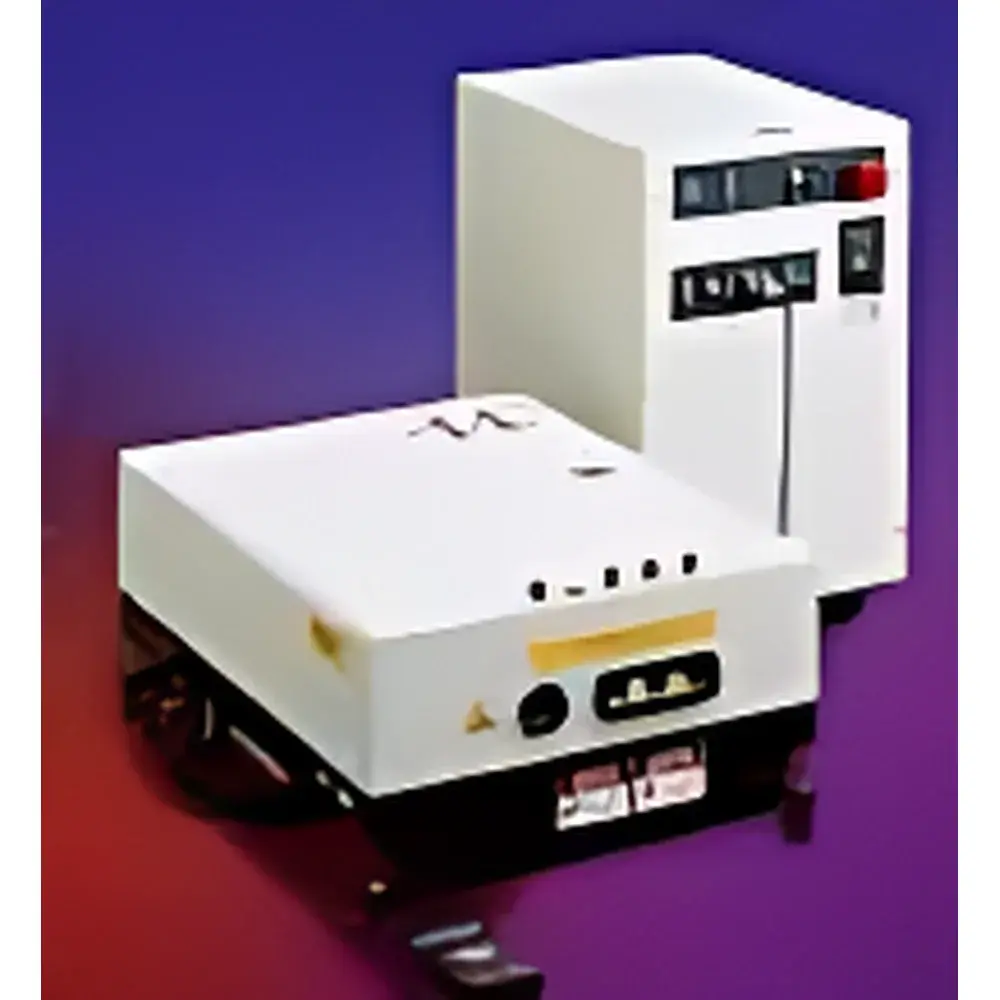
NT373 Nanosecond Infrared Optical Parametric Oscillator (OPO) and Pump Laser System
| Brand | Ekspla |
|---|---|
| Model | NT373 |
| Pump Wavelength | Fixed @ 1572 nm |
| Tuning Ranges | XIR1: 4.1–6.0 µm & 2.13–2.55 µm |
| XIR2 | 2.13–2.55 µm & 1.81–2.13 µm |
| XIR3 | 5.0–11.0 µm & 1.83–2.30 µm |
| Repetition Rate | 10 Hz |
| Spectral Linewidth | <4 cm⁻¹ (at 1572 nm), ~15 cm⁻¹ (XIR1/XIR2 options) |
Overview
The NT373 Nanosecond Infrared Optical Parametric Oscillator (OPO) and Pump Laser System is a turnkey, solid-state laser source engineered for high-stability mid-infrared (MIR) and near-infrared (NIR) spectral generation in research and industrial spectroscopy applications. Based on optical parametric oscillation in nonlinear crystals pumped by a Q-switched Nd:YAG or Nd:YLF master oscillator, the system delivers tunable, nanosecond-duration pulses with precise wavelength control across multiple spectral bands. Its core architecture integrates a robust, air-cooled pump laser with a thermally stabilized OPO cavity, enabling reliable operation without external water cooling or complex alignment infrastructure. Designed for laboratory environments requiring reproducible MIR output—such as gas-phase absorption spectroscopy, trace molecular detection, and photoacoustic sensing—the NT373 operates at a fixed fundamental pump wavelength of 1572 nm and supports three interchangeable tuning modules (XIR1, XIR2, XIR3) to access distinct infrared windows critical for fundamental vibrational transitions of organic molecules, greenhouse gases (e.g., CH₄, CO₂, N₂O), and explosives precursors.
Key Features
- Integrated pump energy monitoring via built-in calibrated photodiode sensor, enabling real-time pulse-to-pulse energy normalization for quantitative spectroscopic measurements.
- RS232 serial interface for full remote control of OPO cavity alignment, wavelength selection, and pump energy threshold adjustment—compatible with LabVIEW, Python, and MATLAB-based automation frameworks.
- Thermally compensated OPO crystal mounts and passive cavity stabilization minimize drift over extended acquisition periods (>8 hours), supporting long-duration spectral scans with sub-wavenumber repeatability.
- Modular tuning architecture: XIR1, XIR2, and XIR3 options provide non-overlapping coverage from 1.81 µm to 11.0 µm, each optimized for specific crystal phase-matching conditions and damage-threshold constraints.
- Nanosecond pulse duration (~5–8 ns FWHM) ensures sufficient peak power for nonlinear detection schemes while maintaining compatibility with gated detection electronics and fast-response MCT detectors.
Sample Compatibility & Compliance
The NT373 is compatible with standard FTIR-compatible sample cells (e.g., multipass White cells, Herriott cells, and sealed gas cuvettes) and supports both transmission and reflection geometries. Its output beam profile (TEM₀₀, M² < 1.3) and pointing stability (<25 µrad RMS over 1 hour) meet requirements for coupling into single-mode fibers or free-space interferometers. The system conforms to IEC 60825-1:2014 Class 4 laser safety standards; interlocked enclosure design and integrated shutter functionality ensure compliance with institutional laser safety protocols (ANSI Z136.1). While not certified for GMP or FDA-regulated production environments, its deterministic tuning behavior, audit-ready parameter logging (via RS232), and stable pulse energy output support GLP-aligned experimental workflows in academic and contract research laboratories.
Software & Data Management
Control is implemented through Ekspla’s proprietary OPO Manager software (Windows-based), which provides graphical wavelength scanning, automated calibration routines using reference gas cells (e.g., N₂O, NH₃), and export of spectral metadata in HDF5 and CSV formats. All hardware parameters—including cavity temperature, crystal angle position (for manual variants), pump energy, and repetition rate—are timestamped and logged with millisecond resolution. The RS232 API supports integration into custom data acquisition systems compliant with IEEE 1159 or ASTM E2915 standards for spectral instrument qualification. No cloud connectivity or proprietary cloud services are embedded; all data remains local and fully exportable without vendor lock-in.
Applications
- High-resolution rovibrational spectroscopy of transient species in combustion diagnostics and plasma chemistry.
- Isotope ratio analysis (e.g., ¹³C/¹²C in CO₂) using wavelength-modulation spectroscopy (WMS-2f) at atmospheric pressure.
- Calibration source for Fourier-transform infrared (FTIR) spectrometers operating in the 2–12 µm range.
- Photoacoustic spectroscopy (PAS) of trace VOCs in environmental monitoring and breath analysis platforms.
- Nonlinear optical studies including difference-frequency generation (DFG) seeding and MIR supercontinuum initiation in chalcogenide fibers.
FAQ
What is the typical pulse energy stability over a 1-hour measurement session?
Pulse energy variation remains within ±3% RMS when operated under constant ambient temperature (±1°C) and with active pump diode current regulation.
Can the NT373 be synchronized with external detectors or delay generators?
Yes—TTL-compatible trigger outputs (rising edge, 5 V, 50 Ω) are provided for precise timing synchronization with oscilloscopes, streak cameras, or pulsed THz emitters.
Is vacuum-compatible operation supported for the OPO cavity?
No—the standard NT373 OPO head is designed for ambient-air operation; vacuum-rated versions require factory modification and are available under custom order (lead time: 16–20 weeks).
Does the system include wavelength calibration certificates traceable to NIST standards?
Each unit ships with a factory calibration report referencing HCN and CO₂ absorption lines; NIST-traceable recalibration services are offered annually through Ekspla’s authorized service centers.
What maintenance intervals are recommended for optimal OPO crystal lifetime?
Under nominal operating conditions (≤10⁸ shots), periodic inspection of crystal AR coatings and cavity mirror reflectivity is advised every 12 months; no routine consumables are required.




