
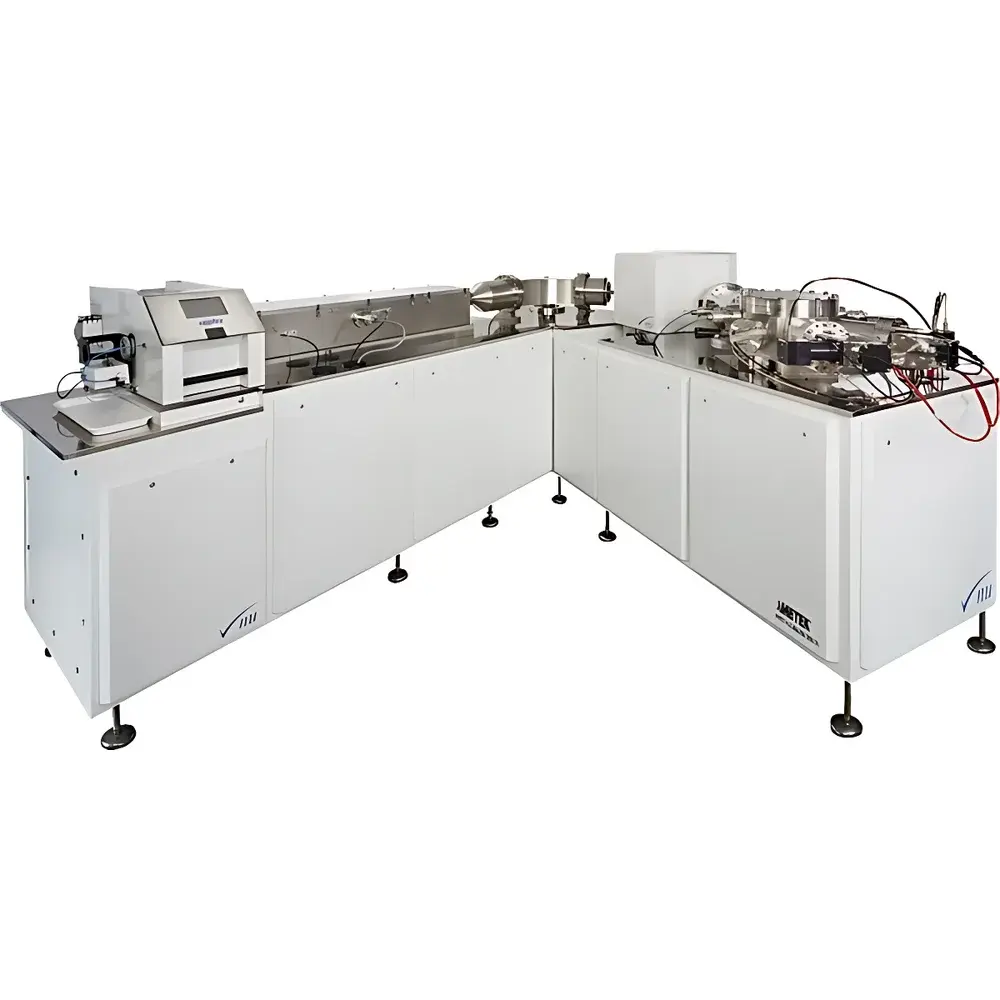
NU Sapphire Collision Cell Multi-Collector ICP-MS
| Brand | NU |
|---|---|
| Origin | United Kingdom |
| Manufacturer Type | Authorized Distributor |
| Import Status | Imported Instrument |
| Model | Nu Sapphire |
| Instrument Type | Multi-Collector ICP-MS |
| Isotope Measurement Capability | Fe, Cu, Hf, U, Pb, Nd, K, Ca, and other elements |
| Mass Range | 1–300 u |
| Resolution (M/ΔM) | 350–10,000 |
| Precision | Element- and isotope-dependent |
| Ion Optics Architecture | Dual-path: high-energy conventional MC-ICP-MS path + low-energy collision/reaction cell path |
Overview
The NU Sapphire Collision Cell Multi-Collector ICP-MS is a purpose-engineered magnetic sector mass spectrometer designed for high-precision, high-sensitivity isotopic ratio measurements across both traditional and non-traditional stable and radiogenic isotope systems. Operating on the principle of multi-collector inductively coupled plasma mass spectrometry (MC-ICP-MS), the Sapphire integrates a dual-beam ion optical architecture that physically separates high-energy and low-energy ion transmission paths. The high-energy path preserves standard MC-ICP-MS performance—ideal for elements with minimal polyatomic interference (e.g., Pb, Nd, Hf)—while the dedicated low-energy path incorporates an integrated collision/reaction cell (CRC) to suppress isobaric interferences (e.g., 40Ar16O+ on 56Fe+, 40Ar35Cl+ on 75As+) without compromising mass resolution or signal stability. This architecture enables simultaneous optimization of sensitivity, mass bias correction, and interference removal—critical for sub-permil δ-value reproducibility in geological, environmental, and nuclear forensic applications.
Key Features
- Dual-path magnetic sector ion optics: Independent high-energy and low-energy beamlines ensure concurrent method optimization for diverse isotope systems.
- Integrated hexapole collision/reaction cell: Configurable with He, H2, NH3, or CH4 gases to selectively remove polyatomic interferences while maintaining >80% ion transmission efficiency.
- 10 Faraday cup detectors + 3 secondary electron multiplier (SEM) detectors: Enable simultaneous collection of major and minor isotopes with high dynamic range (up to 1012), essential for radiogenic isotope geochronology and tracer studies.
- High mass resolution capability (M/ΔM up to 10,000): Achieved via adjustable slit settings, supporting interference-free measurement of isobaric nuclides such as 94Zr/94Mo or 180Hf/180W.
- Ultra-stable high-vacuum system (<1×10⁻⁹ mbar in analyzer chamber): Minimizes background noise and ensures long-term signal stability during extended multi-hour analyses.
- Thermalized sample introduction: Compatible with Nu’s Apex IR desolvating nebulizer and Aridus III membrane desolvation systems for improved oxide suppression (CeO+/Ce+ < 0.5%) and sensitivity enhancement.
Sample Compatibility & Compliance
The NU Sapphire accommodates liquid samples introduced via standard concentric nebulizers, microflow systems, or laser ablation (with compatible LA-ICP-MS interface). Solid samples—including silicates, carbonates, metals, and biological digests—are routinely analyzed following acid digestion (HF/HNO3/HCl protocols) and chromatographic purification (e.g., TRU, TEVA, DGA resins). The instrument meets core requirements for ISO/IEC 17025-accredited laboratories performing isotopic reference material calibration (e.g., NIST SRM 981, JMC Zn, ETH Zurich Cu standards). Its data acquisition architecture supports full audit trails and user-access logging, facilitating compliance with GLP and FDA 21 CFR Part 11 when deployed with validated Nu Instruments’ NuScript software configuration.
Software & Data Management
Controlled by Nu Instruments’ proprietary NuScript v4.x platform, the Sapphire provides real-time mass calibration, automated peak jumping and centering, and integrated mass bias correction algorithms (e.g., exponential law, internal normalization, standard-sample bracketing). Raw data are stored in vendor-neutral .csv and .raw formats, enabling direct import into third-party processing tools such as Iolite, VizualAge, or MATLAB-based custom scripts. All acquisition parameters—including detector configuration, integration time, gas flow rates, and lens voltages—are version-controlled and exportable for method transfer and regulatory documentation. Software validation packages (IQ/OQ/PQ) are available for GxP environments upon request.
Applications
- High-precision radiogenic isotope geochronology (U–Pb, Sm–Nd, Lu–Hf, Re–Os) in zircon, apatite, and garnet.
- Non-traditional stable isotope systematics (Fe, Cu, Zn, Mg, Ca, K) in biogeochemical cycling studies and metal ore fingerprinting.
- Nuclear safeguards and forensics: Isotopic characterization of uranium and plutonium materials (e.g., 235U/238U, 240Pu/239Pu ratios) at trace concentrations.
- Environmental tracing: Pb isotopic source apportionment in atmospheric aerosols, sediments, and urban soils.
- Geochemical reference material certification: Primary ratio determination for CRM development under ISO Guide 35 and IUPAC recommendations.
FAQ
What distinguishes the Sapphire’s dual-path design from conventional MC-ICP-MS instruments?
It provides independent optimization of ion transmission energy—enabling simultaneous high-resolution analysis of refractory elements (via high-energy path) and interference-prone transition metals (via low-energy CRC path) without hardware reconfiguration.
Can the Sapphire perform laser ablation analysis?
Yes, when equipped with a compatible LA interface (e.g., Nu Lasers or CETAC LSX-213), it supports in situ isotopic analysis of solid samples with spatial resolution down to ~5 µm.
Is the collision/reaction cell compatible with reactive gases like NH3 or CH4?
Yes—the cell operates with inert (He), reducing (H2), and reactive (NH3, CH4) gases, allowing tailored chemistry for specific interferences (e.g., NH3 for removal of ArAr+ on 80Se+).
How is mass bias corrected during routine operation?
Through multiple strategies: internal normalization (e.g., 6Li/7Li for Li, 86Sr/88Sr for Sr), standard-sample bracketing, and external standardization using certified reference materials—all implemented in real time within NuScript.
Does the instrument support automated data reduction for large-scale isotope datasets?
Yes—NuScript includes batch processing modules for δ-value calculation, error propagation, and outlier detection, with outputs compliant with IUPAC delta notation conventions and ready for publication-grade reporting.
Related Products





