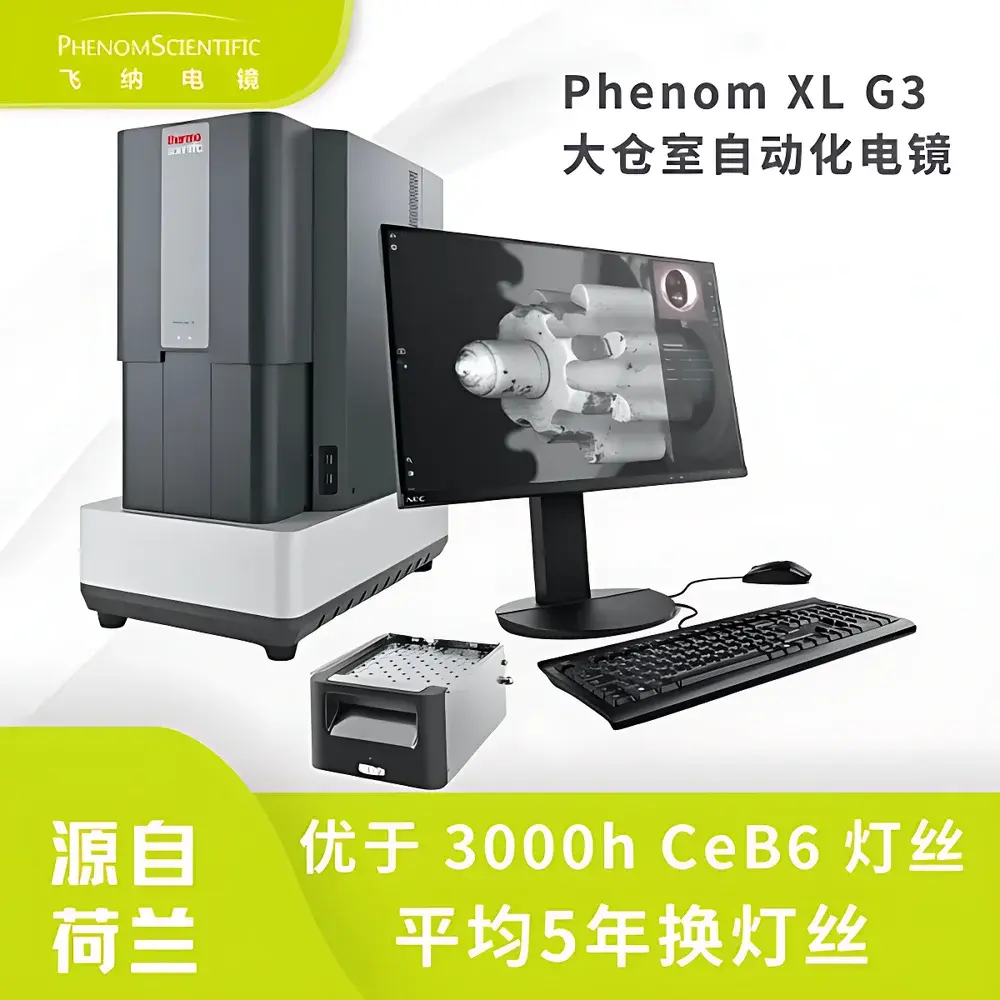
Thermo Scientific Phenom XL G3 Automated Desktop Scanning Electron Microscope
| Brand | Thermo Scientific Phenom |
|---|---|
| Origin | Netherlands |
| Model | XL G3 |
| Instrument Type | Desktop SEM |
| Electron Source | Cerium Hexaboride (CeB6) |
| Secondary Electron Resolution | 8 nm |
| Magnification | Up to 200,000× |
| Accelerating Voltage | 2–20.5 kV (continuously adjustable) |
| Backscattered Electron Resolution | 8 nm |
| Maximum Sample Size | 100 mm × 100 mm |
| Standard Detector | Backscattered Electron Detector (BSD) |
| Optional Detectors | Energy-Dispersive X-ray Spectrometer (EDS), Secondary Electron Detector (SED) |
| Vacuum System | Low–Medium–High vacuum modes |
| Pump-down Time | ≤30 s |
| CeB6 Filament Lifetime | ≥3,000 h (typical replacement interval: 5 years) |
| Automation Capacity | Up to 36 samples per batch |
| Integrated Software Suite | ParticleMetric, FiberMetric, ChemiSEM, ChemiPhase, MAPS |
Overview
The Thermo Scientific Phenom XL G3 is a fully automated desktop scanning electron microscope engineered for high-throughput quality control (QC), failure analysis, and materials R&D in industrial and academic laboratories. Leveraging over 80 years of electron optics heritage—from Philips’ foundational SEM development in the 1940s, through FEI’s innovation leadership, to Thermo Fisher Scientific’s current platform stewardship—the XL G3 delivers robust, production-grade SEM performance without requiring dedicated infrastructure. It operates on the principle of electron-sample interaction: a focused beam of electrons scans the specimen surface, generating secondary electrons (SE), backscattered electrons (BSE), and characteristic X-rays. These signals are collected simultaneously to yield high-fidelity topographic, compositional, and crystallographic information—enabling quantitative microstructural assessment at nanoscale resolution (≤8 nm) across diverse non-conductive and conductive materials.
Key Features
- Industrial-Grade Automation: Fully motorized stage with programmable sample handling supports up to 36 specimens per batch; complete acquisition-to-report workflow—including autofocus, drift correction, and image stitching—executes in under 60 seconds per sample.
- CeB6 Thermionic Source: High-brightness cerium hexaboride cathode provides stable emission at low operating voltages (2–5 kV), enabling high signal-to-noise imaging of beam-sensitive and non-conductive samples without metal coating.
- Multi-Mode Imaging & Analysis Integration: Seamless switching between SE, BSE, and EDS-based imaging within a single software interface eliminates data fragmentation and ensures traceable correlation between morphology and elemental distribution.
- ChemiSEM Real-Time Elemental Mapping: Pixel-synchronized acquisition of spectral and spatial data enables live-color elemental visualization during acquisition—critical for rapid phase identification in battery cathodes, sintered ceramics, and metallurgical interfaces.
- MAPS Large-Area Stitching: Automated panoramic imaging with sub-micron registration accuracy covers areas up to 100 mm × 100 mm, with optional region-of-interest (ROI) zoom-in for localized high-magnification analysis—ideal for wafer inspection, filter membrane QA, and fracture surface evaluation.
- Open Automation Architecture: Python Programming Interface (PPI) enables direct integration with factory MES, LIMS, or PLC systems; supports scheduled overnight batch processing, custom reporting templates, and AI-driven classification pipelines.
Sample Compatibility & Compliance
The XL G3 accommodates a broad range of industrial specimens—including metallic alloys, sintered oxides, semiconductor wafers, polymer films, battery electrode coatings, ceramic filters, and fibrous composites—without mandatory conductive coating. Its low-voltage imaging capability (2–5 kV) preserves surface integrity of delicate structures such as solar cell pyramids, CMOS pixel arrays, and cellulose fibers. The system complies with ISO/IEC 17025 requirements for testing laboratories and supports audit-ready documentation per FDA 21 CFR Part 11 when configured with electronic signature and audit trail modules. All analytical workflows—including ParticleMetric particle sizing, FiberMetric fiber diameter quantification, and ChemiPhase phase fraction calculation—are validated against ASTM E1245 (microstructural quantification) and ISO 13322-2 (image analysis of particles).
Software & Data Management
Phenom’s unified software suite runs on Windows OS and features role-based user permissions, encrypted project storage, and version-controlled method templates. Data files (.phenom) embed raw images, metadata (accelerating voltage, dwell time, detector gain), and processed results (particle statistics, elemental maps, phase masks) in a single container—ensuring full traceability from acquisition to report generation. Batch export functions produce PDF/Excel reports compliant with GLP/GMP documentation standards. Optional cloud synchronization enables remote monitoring and collaborative review across global R&D sites. Software updates follow a controlled release cycle aligned with IEC 62304 medical device software standards where applicable.
Applications
- Automotive & Aerospace: Inclusion analysis in aluminum castings, oxide layer thickness measurement on turbine blades, and fatigue crack propagation mapping.
- Battery Manufacturing: Cathode particle size distribution, separator pore uniformity, anode silicon agglomeration assessment, and interfacial SEI layer morphology.
- Electronics & Semiconductors: Defect localization on PCBs, solder joint void analysis, MEMS structural verification, and CMOS sensor contamination screening.
- Pharmaceuticals & Medical Devices: Filter membrane integrity validation, excipient particle morphology, and implant surface roughness quantification per ISO 10993-18.
- Academic Research: In situ environmental SEM studies (with optional chamber accessories), geological mineral phase identification, and biomaterial scaffold architecture characterization.
FAQ
Does the XL G3 require vibration isolation or climate-controlled rooms?
No. Its integrated passive damping system and compact column design enable stable operation in standard laboratory environments—including upper-floor offices, cleanrooms Class 10,000, and mobile labs. Field deployments in volcanic terrain and remote islands have confirmed operational reliability under ambient temperature fluctuations (15–35°C) and floor vibrations ≤2.5 µm RMS.
Can EDS analysis be performed concurrently with imaging?
Yes. ChemiSEM mode acquires BSE/SE and X-ray spectra synchronously at every pixel, enabling real-time elemental overlay without interrupting beam scanning or compromising spatial resolution.
What maintenance is required beyond filament replacement?
Routine maintenance is limited to quarterly vacuum pump oil changes and annual calibration of stage positioning accuracy (±0.5 µm). No alignment procedures or electron optical tuning are needed during normal operation.
Is the system compatible with existing LIMS or MES platforms?
Yes. The Python Programming Interface (PPI) provides documented RESTful API endpoints and native Python bindings for direct integration with LabWare, Thermo Fisher SampleManager, Siemens Opcenter, or custom-built manufacturing execution systems.
How does the XL G3 ensure data integrity for regulated industries?
Audit trail logging records all user actions, parameter modifications, and report exports with timestamps and operator IDs. When deployed with Thermo Fisher’s Secure Mode configuration, it meets ALCOA+ principles (Attributable, Legible, Contemporaneous, Original, Accurate, Complete, Consistent, Enduring, Available) for data governance under FDA and EMA guidelines.