
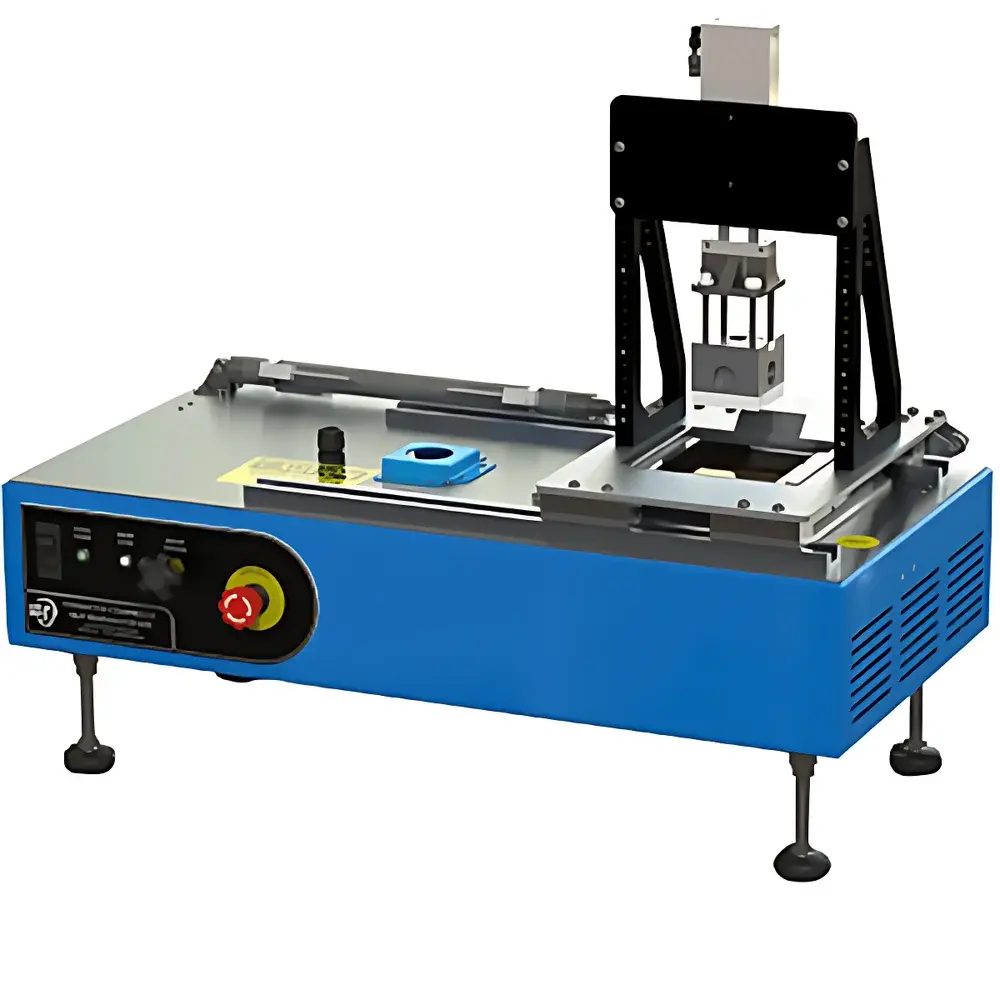
NYX CCHR Pressure-Conducted Thermal Resistance Tester
| Brand | NYX |
|---|---|
| Origin | Tianjin, China |
| Manufacturer Type | Manufacturer |
| Product Category | Domestic |
| Model | CCHR |
| Application | Thermal Resistance Testing |
| Sample Form | Solid materials including textiles, leather, and other flexible or semi-rigid fabrics |
| Repeatability Error | ±0.01% |
| Pneumatic Compression Range | 0.5–8.0 psi (adjustable and precisely regulated via gravity-actuated pressure valve) |
| Heating Plate Temperature Range | Up to 371 °C ±1.5 °C |
| Compliance | Fully conforms to ASTM F1060–22 “Standard Test Method for Thermal Protective Performance (TPP) of Materials Exposed to a Radiant Heat Source” |
Overview
The NYX CCHR Pressure-Conducted Thermal Resistance Tester is an engineered system designed to quantify the thermal resistance (Rct) of protective fabrics and flexible materials under controlled compressive loading and elevated surface temperature exposure. It operates on the principle of steady-state heat conduction through a specimen clamped between a calibrated heated plate and a water-cooled copper calorimeter—measuring the rate of heat flux across the material under defined mechanical constraint. Unlike radiant or convective thermal exposure systems, the CCHR emphasizes direct conductive energy transfer, simulating real-world conditions where flame-resistant garments are pressed against hot surfaces (e.g., industrial equipment housings, vehicle interiors, or fireground debris). Its architecture aligns with the physical basis of ASTM F1060, which defines thermal protective performance (TPP) as the product of incident heat flux (kW/m²) and time-to-second-degree-burn (s), derived from skin burn prediction models using calorimetric response. The instrument delivers traceable, repeatable Rct values in m²·K/W, enabling comparative evaluation of insulation efficacy across material classes and processing variants.
Key Features
- Precision-heated aluminum plate with PID-controlled thermoregulation, maintaining ±1.5 °C stability at setpoints up to 371 °C (600 °F), validated per ASTM E220 calibration protocols.
- Electro-pneumatically actuated sample compression stage, delivering adjustable and reproducible normal loads from 0.5 to 8.0 psi via a gravity-balanced pressure regulator—eliminating hysteresis and drift associated with spring-loaded mechanisms.
- Integrated water-cooled copper calorimeter with embedded thermocouples (Type K, Class 1 tolerance), capturing transient and steady-state heat flux with <0.1 s temporal resolution.
- Motorized horizontal translation stage for automated positioning of the calorimeter beneath the heated surface, ensuring consistent contact geometry and minimizing operator-induced variability.
- Rugged stainless-steel test chamber with insulated housing, rated for continuous operation at 371 °C and compliant with IEC 61000-6-2 electromagnetic immunity standards.
- Real-time monitoring of applied pressure, surface temperature, calorimeter temperature rise, and calculated thermal resistance—all synchronized at 10 Hz sampling rate.
Sample Compatibility & Compliance
The CCHR accommodates flat, flexible, or semi-rigid specimens up to 150 mm × 150 mm, including woven and nonwoven textiles, coated leathers, laminated composites, and multilayer barrier fabrics used in firefighting turnout gear, military uniforms, and industrial workwear. Specimens are mounted in a rigid aluminum frame to prevent lateral buckling during compression. The system fully satisfies all hardware, procedural, and data reporting requirements of ASTM F1060–22, including mandatory pre-test thermal equilibration (≥15 min at target temperature), minimum sample thickness verification (≥0.5 mm), and calorimeter baseline stabilization criteria. It also supports method adaptation for ISO 12127-1 (clothing—determination of thermal resistance—steady-state method) when configured with optional humidity control accessories. All measurement sequences generate audit-ready logs compliant with GLP and GMP documentation frameworks.
Software & Data Management
The CCHR is operated via NYX ThermTest Suite v4.2—a Windows-based application supporting dual-mode acquisition: manual step-and-hold testing for Rct validation, and dynamic ramped-compression profiling for pressure-dependent thermal resistance mapping. Software enforces user-defined test templates aligned with ASTM F1060 Annex A1, automatically calculating Rct = ΔT / q (where ΔT is mean temperature differential across the specimen and q is average heat flux). Raw data streams (time-stamped temperature, pressure, and voltage signals) are saved in HDF5 format, ensuring long-term integrity and interoperability with MATLAB, Python (h5py), or LIMS platforms. Audit trail functionality records user login, parameter changes, calibration events, and test initiation/termination timestamps—fully compliant with FDA 21 CFR Part 11 requirements for electronic records and signatures.
Applications
- Quantitative ranking of thermal barrier efficiency in NFPA 1971-certified turnout coat shells, moisture barriers, and thermal liners.
- Development-stage screening of nanocoated or phase-change-material-integrated fabrics for reduced conductive heat gain.
- Quality assurance of production lots against Rct specification limits (e.g., ≥0.25 m²·K/W per EN ISO 11612 clause B).
- Root-cause analysis of thermal degradation in aged or laundered flame-resistant textiles.
- Supporting ISO/TR 11613 Annex C studies on compression-induced thermal bridging in multi-layer assemblies.
- Research into interfacial thermal resistance at fiber–coating or layer–layer junctions under mechanical stress.
FAQ
Does the CCHR comply with ASTM F1060–22 without modification?
Yes—the heating plate geometry, calorimeter mass and thermal diffusivity, compression mechanism repeatability, and data acquisition timing all meet the normative requirements specified in Sections 6–8 of ASTM F1060–22.
Can the system be used for wet specimen testing?
Not natively; however, optional environmental chamber integration (−10 °C to 85 °C, 10–95% RH) enables controlled preconditioning per ASTM D7519 prior to dry-state thermal resistance measurement.
Is calibration traceable to NIST standards?
Yes—temperature sensors are calibrated annually against NIST-traceable dry-block calibrators (Fluke 9143), and pressure transducers are verified using dead-weight testers certified to ISO/IEC 17025.
What maintenance intervals are recommended?
Heating plate surface inspection and calorimeter thermal interface paste replacement every 200 test cycles; pneumatic valve cleaning and pressure regulator recalibration every 12 months or 1,000 operational hours, whichever occurs first.



