
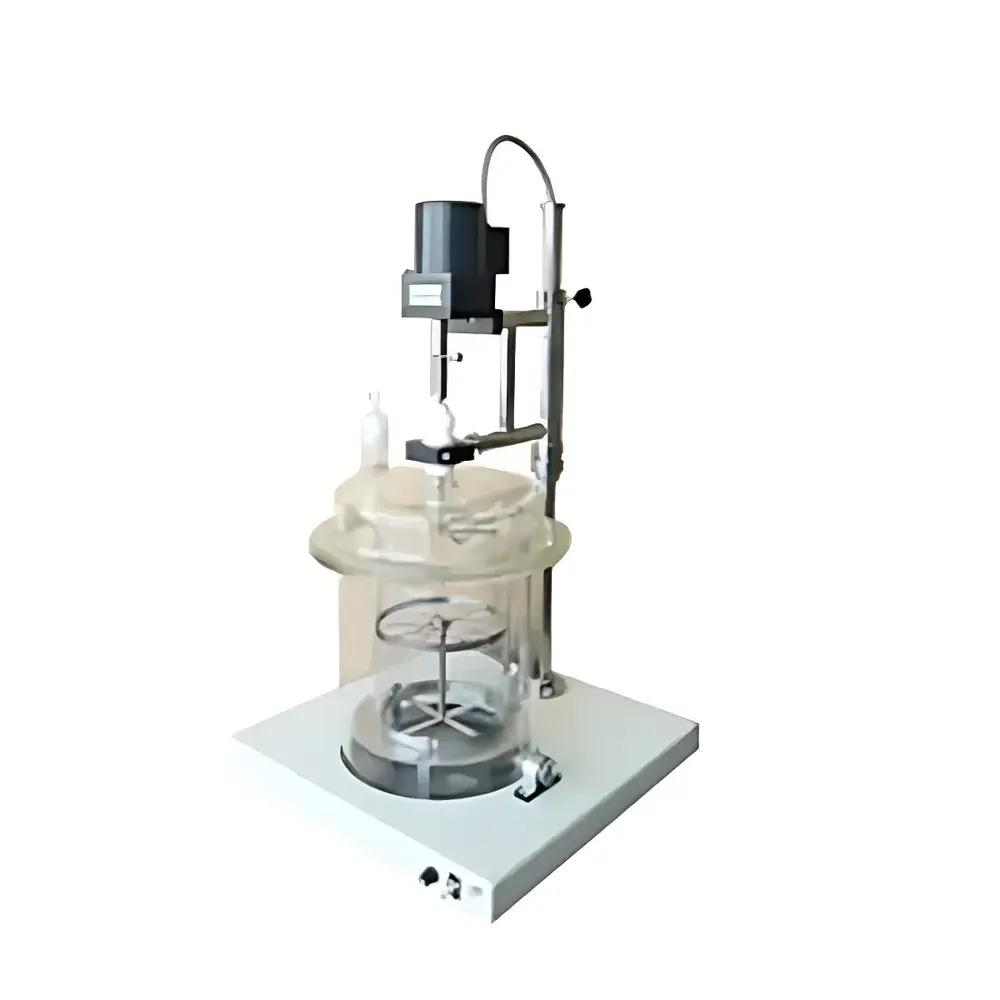
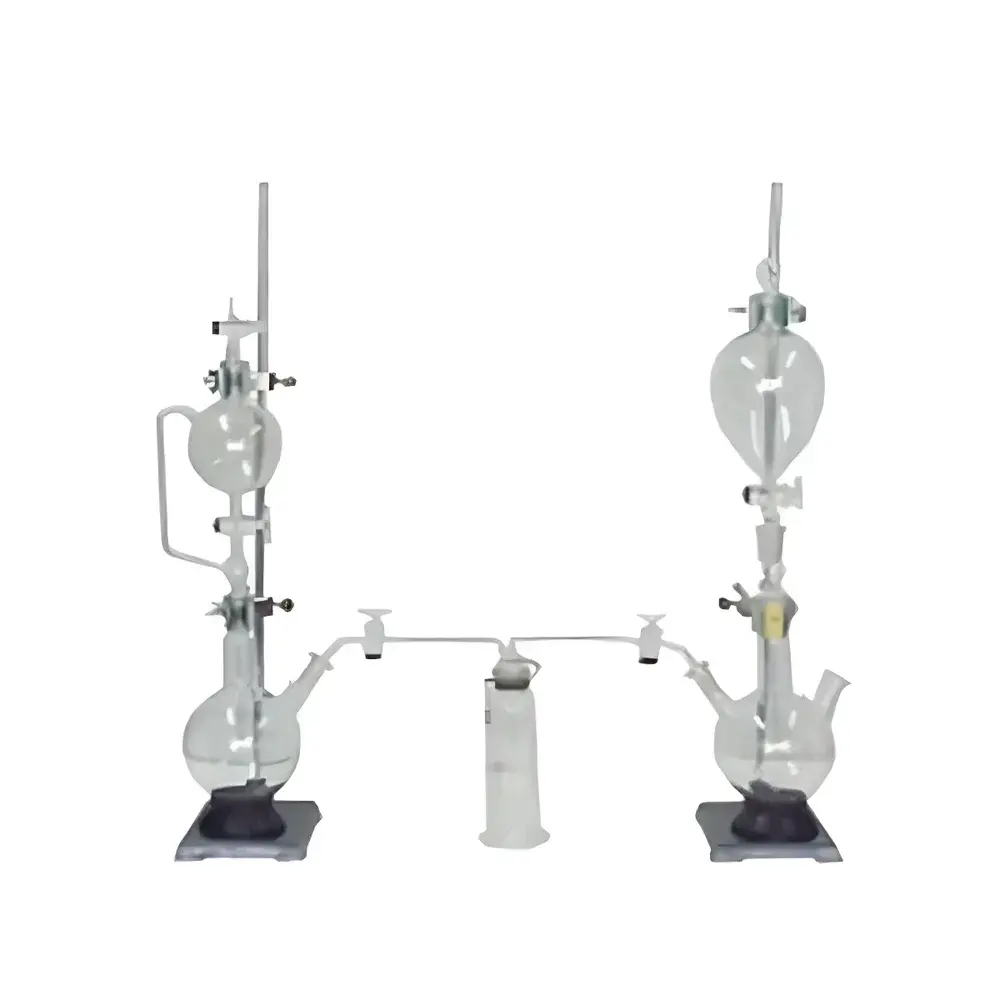
NYX DKS-2 Nitrogen Oxides Color Fastness Testing Apparatus
| Brand | NYX |
|---|---|
| Origin | Tianjin, China |
| Manufacturer Type | Direct Manufacturer |
| Country of Origin | China |
| Model | DKS-2 |
| Price Range | USD 1,400 – 4,200 |
| Test Chamber Volume | ~15 L (Ø250 mm × 340 mm) |
| Reaction Cylinder | Ø165 mm × 225 mm (H) |
| Impeller Diameter | 140 mm (Stainless Steel) |
| Impeller Speed | ~270 rpm |
| Sample Holders | Stainless Steel Clip Set (12 pieces) |
| Dimensions (L×W×H) | 46 × 46 × 77 cm |
| Power Supply | AC 220 V, 50 Hz, 25 W |
| Environmental Requirements | 20 ± 2 °C, 65 ± 2 % RH |
| Compliance Standards | JIS L 0855, ISO 105-G01, GB/T 11039.1–2005 |
Overview
The NYX DKS-2 Nitrogen Oxides Color Fastness Testing Apparatus is a precision-engineered instrument designed to evaluate the resistance of dyed textile materials to discoloration and staining when exposed to nitrogen oxides (NOx) under controlled environmental conditions. This apparatus operates on the principle of dynamic gas-phase exposure: nitrogen oxides—generated in situ via thermal decomposition of sodium nitrite in acidic medium within a calibrated glass reaction cylinder—are quantitatively transferred via syringe into a sealed, temperature- and humidity-regulated test chamber containing the mounted textile specimen. Continuous mechanical agitation by a stainless-steel impeller ensures homogeneous gas distribution and reproducible contact between NOx and fiber surfaces. The system is purpose-built for standardized accelerated aging protocols used in quality assurance laboratories, R&D departments, and third-party testing facilities serving global textile supply chains.
Key Features
- Modular glass construction: All critical components—including the 15 L main test chamber (Ø250 mm × 340 mm), reaction cylinder (Ø165 mm × 225 mm), and gas transfer tubing—are fabricated from borosilicate glass to ensure chemical inertness, optical clarity, and long-term stability during repeated NOx exposure.
- Precision-controlled agitation: A corrosion-resistant stainless-steel impeller (Ø140 mm), driven by a low-noise, brushless DC motor, rotates at a fixed speed of approximately 270 rpm to maintain uniform gas mixing without mechanical stress on specimens.
- Dedicated sample mounting system: Includes a set of 12 stainless-steel hanging clips with standardized geometry, enabling consistent specimen tension and orientation per ISO 105-G01 and JIS L 0855 requirements.
- Environmental integrity: Designed for operation only within tightly specified ambient conditions (20 ± 2 °C, 65 ± 2 % RH), ensuring compliance with standard preconditioning and testing clauses across all referenced methods.
- Low-power, lab-integrated design: Consumes only 25 W at 220 V / 50 Hz, allowing deployment on standard benchtop circuits without dedicated power conditioning.
Sample Compatibility & Compliance
The DKS-2 accommodates woven, knitted, nonwoven, and filament-based textile substrates—including cotton, polyester, nylon, wool, and blended fabrics—provided specimens conform to dimensional specifications outlined in ISO 105-G01 (100 mm × 40 mm) and JIS L 0855 (100 mm × 50 mm). Specimen mounting follows strict orientation rules (e.g., warp direction aligned vertically) to minimize edge effects and maximize inter-laboratory reproducibility. The apparatus fully supports test execution per three internationally harmonized standards: JIS L 0855 (Japanese Industrial Standard), ISO 105-G01 (Textiles — Tests for color fastness — Part G01: Colour fastness to nitrogen oxides), and GB/T 11039.1–2005 (Chinese National Standard, equivalent to ISO 105-G01). Documentation packages include traceable calibration records for chamber volume, impeller speed verification, and environmental monitoring logs—facilitating GLP-aligned audit readiness.
Software & Data Management
The DKS-2 is a manually operated, hardware-only platform with no embedded microcontroller or digital interface. All procedural parameters—including gas injection volume, exposure duration (typically 4–24 h), and environmental verification—are recorded externally using laboratory notebooks or LIMS-integrated templates. While the device does not feature automated data logging, its mechanical repeatability and adherence to ISO/IEC 17025–recommended practice enable full integration into validated workflows requiring 21 CFR Part 11–compliant electronic records when paired with certified external instrumentation (e.g., calibrated hygrometers, thermometers, and gas syringes). User manuals include detailed SOP templates aligned with ISO/IEC 17025 clause 7.2.2 (method validation) and ASTM E2500 guidance for equipment qualification.
Applications
This apparatus serves critical functions across textile manufacturing, regulatory testing, and academic research domains. It is routinely deployed to assess the durability of reactive dyes on cellulosic fibers exposed to urban air pollution; validate eco-friendly dye formulations intended for outdoor apparel; benchmark comparative performance of pigment-based vs. disperse dye systems on synthetic textiles; and support sustainability certifications requiring documented resistance to atmospheric pollutants. End users include QC laboratories at Tier-1 garment suppliers, national textile testing institutes (e.g., SGS, Bureau Veritas, CTI), and university departments conducting fiber degradation kinetics studies under simulated environmental stressors.
FAQ
Does the DKS-2 include an integrated NOx gas sensor or concentration monitor?
No. Quantitative NOx generation relies on stoichiometric reagent dosing (NaNO2/H2SO4) per ISO 105-G01 Annex A; real-time gas concentration measurement requires optional external analyzers (e.g., chemiluminescence NOx analyzer).
Can the apparatus be adapted for other reactive gases such as ozone or SO2?
Not without structural modification. The glass assembly, impeller dynamics, and gas injection protocol are specifically optimized for NOx generation and dispersion kinetics; alternative gases require separate validation per ISO 105-G03 (ozone) or G02 (sulfur dioxide).
Is the stainless-steel impeller resistant to nitric acid vapor corrosion?
Yes. The impeller is manufactured from AISI 316 stainless steel, which exhibits high resistance to nitric acid vapors at concentrations and temperatures typical of ISO 105-G01 test cycles.
What maintenance intervals are recommended for long-term reliability?
Glass components should be inspected for etching or microfractures after every 50 test cycles; impeller shaft bearings require lubrication every 6 months; all rubber gaskets and septa must be replaced annually or after visible swelling.
Does NYX provide method validation support for ISO/IEC 17025 accreditation?
Yes. NYX supplies IQ/OQ documentation templates, uncertainty budget worksheets, and on-site installation qualification services upon request—aligned with ILAC P15:2020 requirements for equipment used in accredited testing laboratories.





