
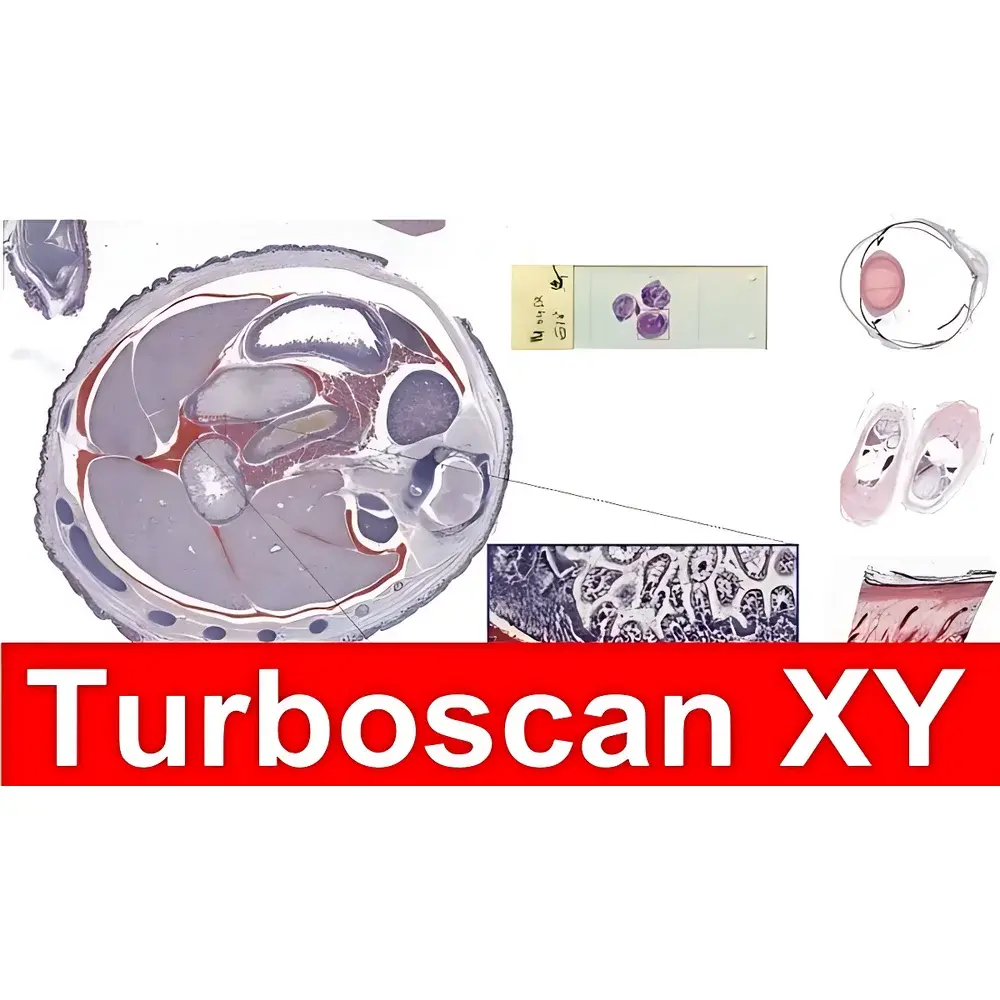
Objective Imaging TurboScan Rapid Slide Scanning Software Module
| Brand | Objective Imaging |
|---|---|
| Origin | United Kingdom |
| Model | TurboScan |
| Application | Digital Pathology Slide Scanning Automation |
| Compliance | Designed for ISO 13485-aligned laboratory workflows and compatible with FDA 21 CFR Part 11–ready LIMS/PACS environments |
Overview
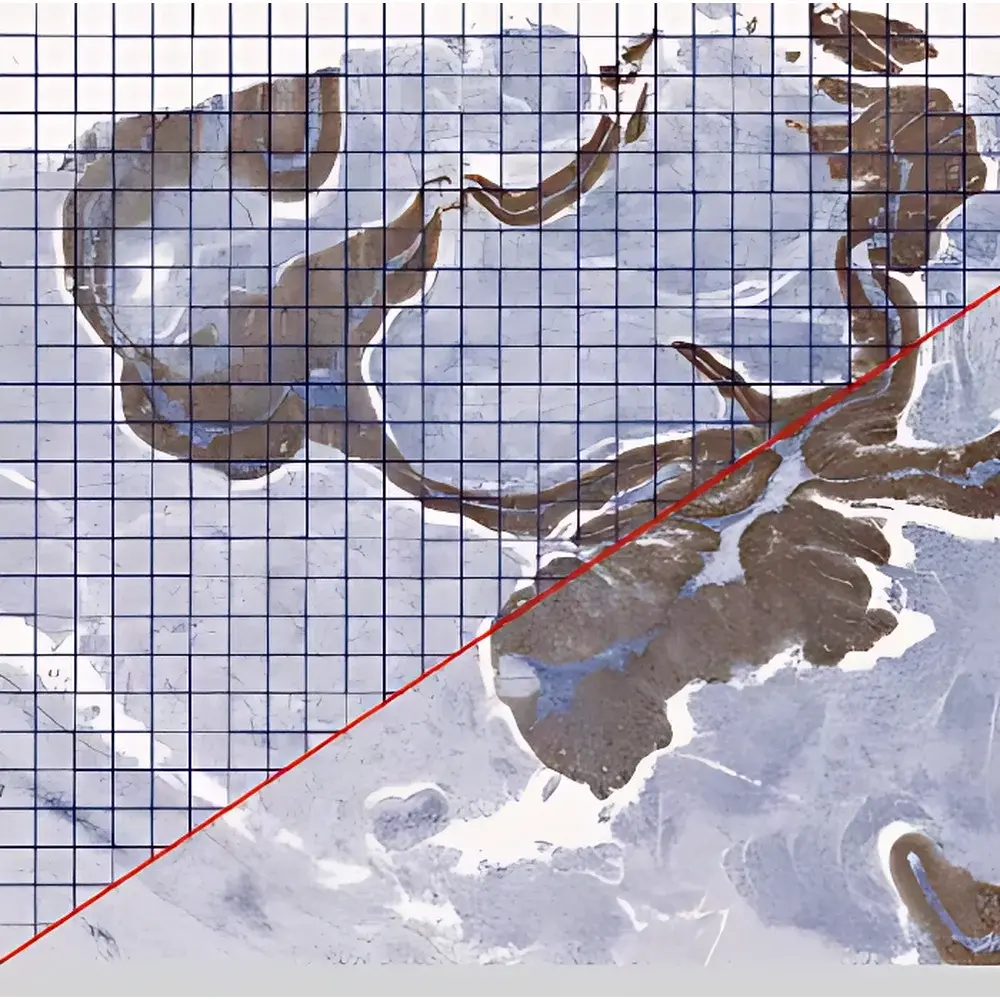
The Objective Imaging TurboScan Rapid Slide Scanning Software Module is a precision-engineered automation solution designed to integrate seamlessly with high-resolution upright and inverted microscopes equipped with Prior motorized stages and supported camera systems. TurboScan operates on the principle of hardware-synchronized acquisition—leveraging low-latency TTL trigger signals between the scientific CMOS or sCMOS camera and the Prior PL200 slide loader or other compatible motorized XY/Z stages. This synchronization eliminates frame drop, ensures pixel-perfect spatial registration during motion, and enables continuous acquisition at maximum sensor frame rates—even during high-speed stage translation. Unlike software-triggered scanning approaches that introduce timing jitter and stitching artifacts, TurboScan’s deterministic real-time control architecture delivers sub-micron positional repeatability across full-slide mosaics. It is engineered specifically for demanding digital pathology applications where morphological fidelity, scan reproducibility, and throughput consistency are critical for diagnostic validation, AI training dataset generation, and longitudinal tissue analysis.
Key Features
- Hardware-level camera-stage synchronization via TTL trigger interface for zero-frame-loss acquisition
- Real-time adaptive stage velocity profiling—dynamically adjusts translation speed to match camera exposure and readout timing
- Seamless whole-slide mosaic generation with sub-pixel alignment accuracy and intensity-normalized blending
- Intuitive point-and-click ROI definition: users select regions of interest directly on a low-magnification preview map; TurboScan auto-calculates optimal focus planes and tile boundaries
- Native integration with Objective Imaging’s OASIS Automation Controller for coordinated control of Prior PL200 dual-cassette slide loaders (200-slide capacity), autofocus modules, and filter wheels
- Batch scanning workflow support—including scheduled unattended operation, error-recovery resume, and metadata-embedded TIFF/OME-TIFF export
- Configurable Z-stack acquisition per tile for extended depth-of-field reconstruction in thick tissue sections or 3D cell cultures
Sample Compatibility & Compliance
TurboScan supports standard 1″ × 3″ (25 × 75 mm) glass microscope slides, including charged, polymer-coated, and conductive variants used in IHC, IF, H&E, and multiplexed staining protocols. It is validated for use with 20×, 40×, and 63× dry and oil-immersion objectives (NA ≥ 0.75), delivering diffraction-limited resolution across visible and near-UV spectral bands. The module complies with core requirements of ISO 20387:2018 (biobanking), ISO 15189:2022 (medical laboratories), and supports audit-trail generation required under GLP and GCP frameworks. When deployed with validated hardware stacks—including Prior ProScan III controllers and Hamamatsu ORCA-Fusion BT cameras—it meets the image quality benchmarks referenced in CAP Laboratory Accreditation Program checklists for digital pathology primary diagnosis.
Software & Data Management
TurboScan operates as a standalone Windows-based application (64-bit, Windows 10/11) with optional SDK access for custom integration into enterprise imaging platforms. All acquired tiles are saved in open-format OME-TIFF containers compliant with Bio-Formats and QuPath import specifications. Embedded metadata includes objective magnification, numerical aperture, exposure time, illumination intensity, stage coordinates, timestamp, and user-defined annotations. The software supports DICOM-SR structured reporting for selected regions and exports QC metrics—including focus score heatmaps, tile overlap variance, and SNR per field—for automated quality gatekeeping. Audit logs record every user action, parameter change, and system event with ISO 8601 timestamps and operator ID—fully traceable for FDA 21 CFR Part 11 compliance when paired with institutional electronic signature infrastructure.
Applications
- Digital pathology archive creation for retrospective cohort studies and clinical trial biobanking
- High-throughput screening of tissue microarrays (TMAs) in oncology biomarker discovery
- Whole-wafer defect mapping in semiconductor metrology labs using reflected-light brightfield microscopy
- Metallurgical grain structure analysis across large-area metallographic sections (e.g., ASTM E112 grain size quantification)
- Neuroscience connectomics preparation—rapid tiling of serial section TEM/SEM montages with precise inter-slice registration anchors
- Regulatory submission-ready image capture for IVD assay validation per ISO 13485 design history file requirements
FAQ
Does TurboScan require proprietary hardware, or can it run on third-party microscope platforms?
TurboScan is optimized for Objective Imaging–certified configurations (e.g., Prior ProScan stages + Hamamatsu/Andor cameras), but its trigger API supports custom integration with non-Prior motorized stages via TTL-compatible motion controllers.
Can TurboScan perform autofocus during scanning, and what algorithms are implemented?
Yes—when paired with Objective Imaging’s FocusMap module or compatible piezo Z-drives, TurboScan executes contrast-based or gradient-maximization autofocus before each tile acquisition, with configurable search range and step size.
Is raw data export supported for downstream AI model training?
All acquired tiles are saved losslessly in OME-TIFF format with embedded channel metadata, enabling direct ingestion into TensorFlow, PyTorch, or MONAI pipelines without intermediate conversion.
How does TurboScan handle overlapping tissue folds or air bubbles during high-speed scanning?
The software includes real-time focus confidence scoring per tile; regions failing preset sharpness thresholds are flagged for manual review or reacquisition with adjusted Z-range parameters.
What cybersecurity standards does the software adhere to in hospital network deployments?
TurboScan follows NIST SP 800-53 Rev. 5 controls for medical device software: TLS 1.2+ encrypted communications, role-based access control (RBAC), and local database encryption via Windows DPAPI—all documented in the vendor’s Security Technical Implementation Guide (STIG).
Related Products





