
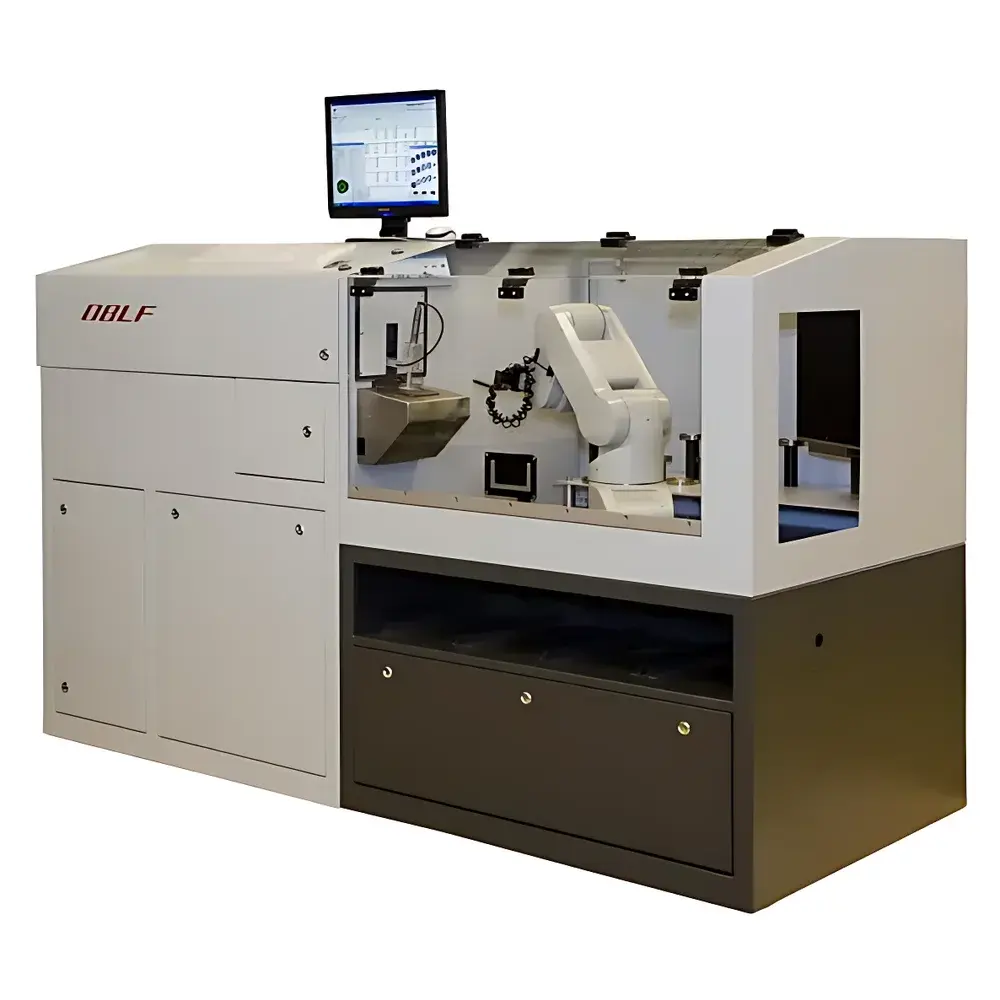
OBLF QSN/G 750-II R Fully Automated Direct-Reading Spark Emission Spectrometer
| Brand | OBLF |
|---|---|
| Origin | Germany |
| Model | QSN/G 750-II R |
| Instrument Type | Floor-Standing |
| Excitation Method | Spark Discharge |
| Detector Type | Photomultiplier Tube (PMT) |
| Focal Length | 750 mm |
| Grating Groove Density | 2400 lines/mm |
| Wavelength Range | 120–800 nm |
| Number of Simultaneous Channels | 64 |
Overview
The OBLF QSN/G 750-II R is a floor-standing, fully automated direct-reading spark emission spectrometer engineered for high-precision quantitative elemental analysis of solid metallic samples in industrial and metallurgical laboratories. It operates on the principle of optical emission spectroscopy (OES), where a controlled spark discharge vaporizes and excites atoms from the sample surface; the resulting element-specific spectral lines are dispersed by a high-resolution Czerny-Turner optical system and detected simultaneously across 64 dedicated PMT channels. With a 750 mm focal length Paschen-Runge mounting and 2400 lines/mm holographic grating, the instrument delivers exceptional spectral resolution and long-term optical stability—critical for trace-level detection (sub-ppm) and robust multi-element calibration across ferrous and non-ferrous alloys. Designed for integration into continuous production environments, the QSN/G 750-II R functions as the analytical core of an end-to-end automated analysis line, interfacing seamlessly with robotic sample handling, automated grinding/polishing stations, and LIMS or MES platforms.
Key Features
- Fully integrated robotic sample handling system enabling unattended operation for up to 200+ samples per shift, including automatic positioning, clamping, and spark gap optimization.
- OBLF’s proprietary self-cleaning spark stand with active argon purge and electrode wear compensation—minimizing maintenance intervals and ensuring consistent excitation conditions over extended runs.
- GDS (Gated Digital Spark) excitation source delivering programmable current/voltage waveforms, adjustable pre-spark cleaning phases, and real-time plasma monitoring for adaptive energy delivery per sample matrix.
- Dedicated PMT-based detection architecture with individually optimized high-voltage settings per channel—ensuring linear dynamic range > 10⁶ and low-noise signal acquisition even at UV wavelengths down to 120 nm.
- Embedded industrial PC running OBLF’s GONIO software suite with deterministic real-time OS, supporting dual-boot redundancy and secure firmware update protocols compliant with IEC 62443-4-2.
Sample Compatibility & Compliance
The QSN/G 750-II R accommodates standard metallic specimens (Ø 10–40 mm, thickness ≥ 5 mm) including cast iron, carbon steels, stainless steels, aluminum, copper, nickel, titanium, and superalloys. Sample surface preparation follows ISO 11084 and ASTM E407 guidelines; optional integration with automated milling/grinding units ensures repeatable flatness and oxide removal. The system meets CE marking requirements under the EU Machinery Directive 2006/42/EC and Electromagnetic Compatibility Directive 2014/30/EU. Optical path design complies with EN 61000-6-3 for radiated emissions. Data integrity controls—including audit trail logging, electronic signatures, and user role-based access—are implemented in accordance with FDA 21 CFR Part 11 and EU Annex 11 for regulated QA/QC environments.
Software & Data Management
GONIO software provides comprehensive method development, calibration management, and statistical process control (SPC) tools. Each analysis generates timestamped raw spectra, intensity values, certified reference material (CRM) traceability logs, and full metadata (operator ID, sample ID, environmental conditions). All data are stored in encrypted SQLite databases with SHA-256 checksums and support scheduled export to CSV, XML, or OPC UA endpoints. Version-controlled method files include calibration curve coefficients, interference correction matrices, and limit-of-detection (LOD) validation reports. Audit trails record all user actions—including parameter edits, calibration updates, and result overrides—with immutable timestamps and IP-address attribution.
Applications
- Real-time melt shop control: rapid analysis of ladle, tundish, and ingot samples for C, Si, Mn, P, S, Cr, Ni, Mo, V, Nb, Ti, Al, Cu, Sn, Pb, and B within 25–40 seconds per sample.
- Scrap sorting and alloy verification: identification of grade mismatches and contamination screening in recycling facilities using built-in classification algorithms.
- Quality assurance in forging, casting, and additive manufacturing: verification of compositional conformance to ASTM A743, ISO 17830, or AMS specifications.
- Research-grade metallurgical studies: high-accuracy quantification of microalloying elements and segregation profiling via spatially resolved spark mapping (optional).
FAQ
What sample preparation is required prior to analysis?
Standard metallic samples must be flat, clean, and free of oxides or coatings. Surface conditioning is typically performed via automated grinding or milling to achieve Ra ≤ 0.8 µm. No acid etching or chemical treatment is needed.
Can the system analyze coated or plated metals?
Yes—provided the coating thickness is ≤ 5 µm and composition differs significantly from the substrate; depth-resolved analysis requires sequential spark ablation with time-resolved intensity monitoring (enabled via optional GDS pulse profiling).
Is remote diagnostics and software support available?
OBLF provides secure TLS-encrypted remote access through the GONIO Remote Service Module (RSM), allowing authorized engineers to monitor system health, validate calibrations, and deploy patches without onsite visits.
How often does the optical system require recalibration?
Under stable environmental conditions (±1°C/hour, <50% RH), wavelength calibration remains valid for ≥ 6 months; intensity calibration is recommended before each analytical shift or after major maintenance events.
Does the system support custom spectral line selection beyond factory channels?
No—channel allocation is fixed at hardware level due to discrete PMT placement; however, software-defined virtual channels can be configured for background correction, inter-element ratioing, or secondary line validation using existing detector outputs.





