
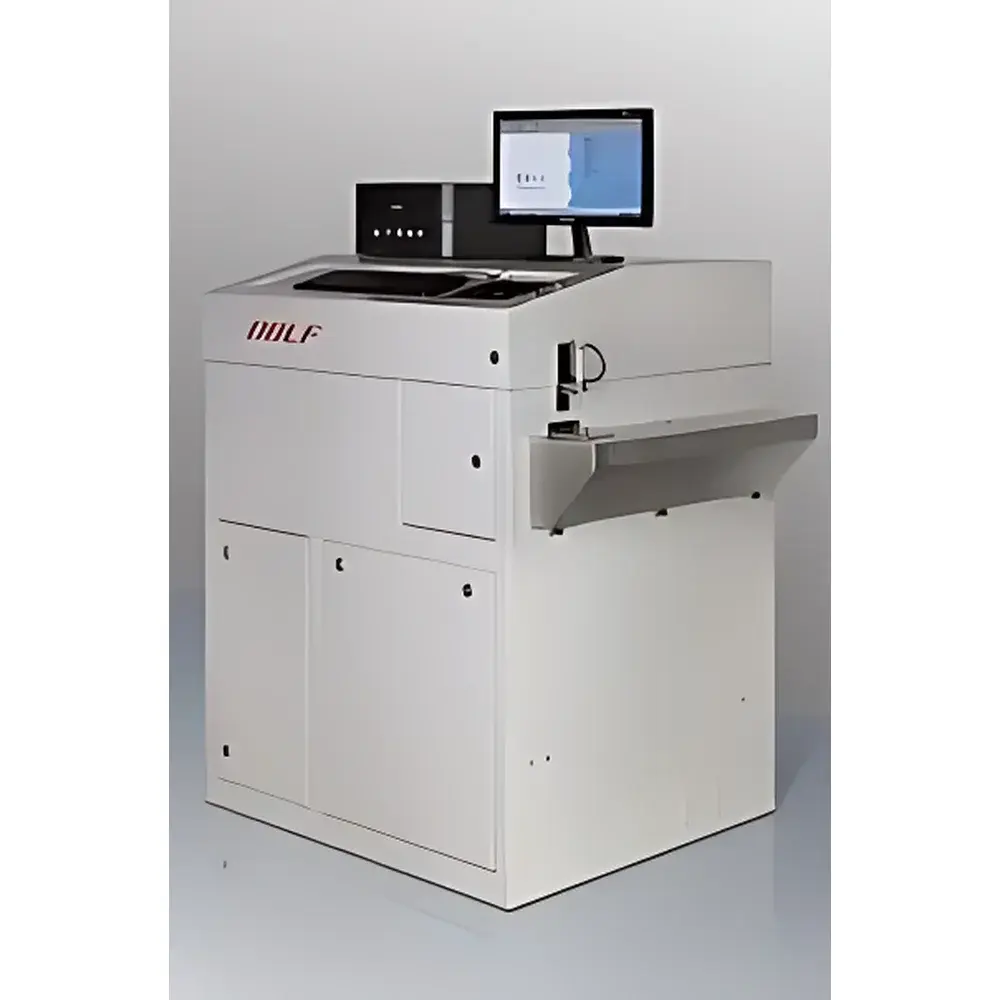
OBLF QSN750-II Direct Reading Spark Emission Spectrometer
| Brand | OBLF |
|---|---|
| Origin | Germany |
| Model | QSN750-II |
| Instrument Type | Floor-standing |
| Excitation Method | Spark |
| Detector Type | Photomultiplier Tube (PMT) |
| Focal Length | 750 mm |
| Grating Groove Density | 2400 lines/mm |
| Wavelength Range | 190–780 nm |
| Number of Analytical Channels | 60 |
| Optical Resolution (1st Order) | 0.55 nm/mm |
| Vacuum Pump Duty Cycle | <5% of total operating time |
| Spark Frequency | Up to 1000 Hz |
| Analysis Time (Steel Sample) | ~15 s |
| Operating Temperature | 12–35 °C |
| Dimensions (L×W×H) | 1040 × 900 × 1300 mm |
| Weight | 550 kg |
Overview
The OBLF QSN750-II is a high-performance, floor-standing direct reading spark emission spectrometer engineered for precise, rapid elemental analysis of solid metallic materials in industrial and laboratory environments. Based on the principle of optical emission spectroscopy (OES), it utilizes controlled spark discharge to atomize and excite sample surfaces, generating characteristic atomic emission spectra. These spectra are dispersed by a high-resolution Czerny-Turner optical system with a 750 mm focal length and 2400 lines/mm grating, enabling accurate wavelength separation across a broad spectral range (190–780 nm). The instrument’s vacuum-enclosed optical chamber—maintained at stable low pressure with minimal pump duty cycle (<5%)—ensures long-term signal stability and eliminates atmospheric absorption interference, particularly critical for UV-sensitive elements such as C, P, S, and N. Designed for multi-matrix capability, the QSN750-II supports simultaneous quantitative analysis of ferrous, non-ferrous, and superalloy samples without mechanical reconfiguration of electrodes or optics.
Key Features
- Gated Discharge Source (GDS) excitation technology: Fully solid-state, electrode-free spark generation with programmable pulse width and energy delivery—eliminating auxiliary electrodes and reducing maintenance intervals.
- Vacuum-optimized optical architecture: All critical optical components—including diffraction grating, mirrors, PMT detectors, and integrator boards—are housed within a sealed, continuously monitored vacuum chamber, ensuring immunity to ambient humidity, temperature drift, and dust contamination.
- Open-type argon-flushed spark stand with self-cleaning design: Enables analysis of irregularly shaped or oversized samples; argon flow is automatically suspended during standby, reducing consumption by up to 70% versus conventional continuous purge systems.
- High-speed spectral acquisition: Capable of 1000 Hz spark frequency and sub-15-second full-spectrum analysis for standard steel samples, with real-time integration over user-defined gating windows for improved signal-to-noise ratio.
- Multi-matrix flexibility: Single calibration framework accommodates Fe-, Al-, Cu-, Ni-, Mg-, Zn-, and Ti-based alloys; no hardware modification required when switching between matrices.
- Robust mechanical construction: 550 kg reinforced chassis with vibration-damping feet ensures operational stability in shared laboratory or production-floor environments.
Sample Compatibility & Compliance
The QSN750-II accepts solid metallic specimens up to 40 mm in height and 50 mm in diameter (standard spark stand configuration), including castings, forgings, rolled plates, and machined test coupons. Surface preparation requirements align with ISO 11577 and ASTM E415 standards for OES sampling. The instrument complies with IEC 61000-6-3 (EMC emissions), IEC 61000-6-2 (immunity), and meets CE marking requirements for safety and electromagnetic compatibility. Its analytical performance adheres to ISO 17025 traceability principles when operated under documented quality procedures, and data integrity features support compliance with FDA 21 CFR Part 11 and EU Annex 11 for regulated metallurgical QA/QC workflows.
Software & Data Management
Controlled via Windows-based OBLF GRACE software (compatible with Windows 10/11 LTSB editions), the system provides full method development, calibration management, spectral evaluation, and statistical process control (SPC) tools. All raw intensity values, background corrections, inter-element corrections, and recalibration logs are stored in an audit-trail-enabled database with timestamped operator authentication. Export formats include CSV, XML, and PDF reports compliant with LIMS integration protocols. Software modules support GLP/GMP-aligned workflows, including electronic signatures, version-controlled method storage, and automatic archiving of instrument status logs (vacuum pressure, lamp voltage, detector gain, spark energy).
Applications
- Primary and secondary metallurgy: Rapid grade identification, melt chemistry verification, and inclusion analysis support for steelmaking and foundry operations.
- Aerospace & power generation: Certification of high-alloy steels, nickel-based superalloys, and titanium grades per AMS, ASTM, and EN specifications.
- Automotive supply chain: Incoming material inspection for cast iron, aluminum die-castings, and copper-brass components against OEM PPAP requirements.
- Scrap recycling & metal trading: Sorting and valuation of mixed ferrous/non-ferrous scrap streams with certified detection limits for tramp elements (e.g., Sn, As, Pb).
- Research & development: High-reproducibility compositional mapping of experimental alloys, including nitrogen and oxygen quantification in stainless steels and tool steels.
FAQ
Does the QSN750-II require liquid nitrogen or external cooling for PMT operation?
No—PMTs are thermoelectrically stabilized within the vacuum chamber; no cryogenic cooling is necessary.
Can the instrument analyze coated or plated samples?
Yes, with optimized spark parameters and pre-ablation routines; surface layers up to 5 µm may be removed prior to bulk analysis.
Is remote diagnostics supported?
Yes—OBLF Remote Service (ORS) enables secure, encrypted technician access for firmware updates, spectral diagnostics, and parameter optimization.
What is the typical detection limit for carbon in low-alloy steel?
Under routine operating conditions, the 3σ detection limit is ≤15 ppm for C in Fe matrix, validated per ISO 11577 Annex B.
How often is vacuum system maintenance required?
With <5% pump duty cycle, oil change intervals exceed 12 months under continuous operation; full service recommended every 24 months or 5,000 operating hours.





