
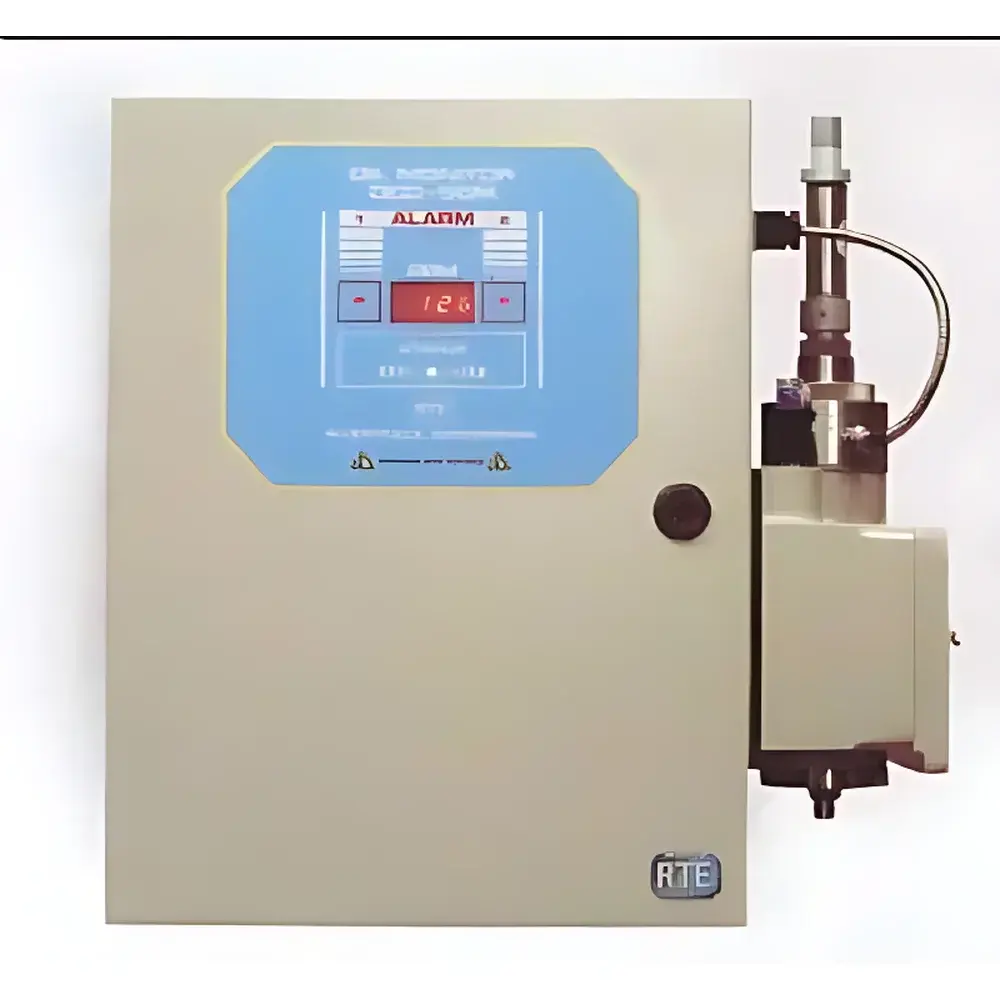
OCD50 Boiler Water Oil-in-Water Monitor
| Origin | UK |
|---|---|
| Manufacturer Type | Authorized Distributor |
| Origin Category | Imported |
| Model | OCD50 |
| Pricing | Upon Request |
Overview
The OCD50 Boiler Water Oil-in-Water Monitor is a precision optical instrument engineered for continuous, real-time quantification of hydrocarbon contamination in high-purity water streams used in steam generation and industrial cooling systems. It operates on the principle of ultraviolet (UV) fluorescence spectroscopy—specifically optimized for detecting mineral oils, synthetic lubricants, and hydrocarbon-based contaminants at trace concentrations. Unlike turbidity- or infrared-based alternatives, the OCD50 employs excitation at 254 nm and measures emitted fluorescence intensity in the 300–400 nm range, enabling selective discrimination of aromatic and aliphatic hydrocarbons while minimizing interference from organic particulates, dissolved iron oxides, or silica colloids commonly present in boiler feedwater and condensate return lines. Designed for integration into closed-loop thermal management infrastructure, it meets the stringent sensitivity and reliability requirements of power generation, marine propulsion, and pharmaceutical clean-steam applications where oil ingress—even below 1 ppm—can precipitate tube fouling, corrosion under deposit (CUD), or catastrophic boiler tube failure.
Key Features
- Trace-level detection capability: 0–10 ppm range for condensate (with 0.1 ppm display resolution) and extended 0–200 ppm range for cooling water circuits
- High-temperature optical path: Fused quartz windows and fluoropolymer-sealed optical chamber rated for continuous operation up to 90 °C sample temperature
- Automated maintenance cycle: Integrated compressed-air purge system (4–6 barG) cleans optical surfaces every 30 minutes by default; configurable cleaning interval and duration
- Ruggedized enclosure: IP55-rated housing with optional stainless-steel wetted components (flow cell, inlet/outlet fittings, sample reservoir) for compatibility with aggressive water chemistries
- Dual independent alarm outputs: Two programmable relay channels (5 A / 250 V AC) with user-defined thresholds and adjustable delay timers (0–60 s each), supporting fail-safe shutdown or pump interlock protocols
- Multi-format analog and digital output: Simultaneous 0–5 V DC (≥1 kΩ load), 4–20 mA loop-powered signal, and RS232 serial interface (optional) for connection to DCS, SCADA, or data loggers
Sample Compatibility & Compliance
The OCD50 accommodates a wide operational envelope: sample flow rates of 1–3 L/min, pressure tolerance from 0.1 to 10 bar, and ambient operating temperatures from –20 °C to +55 °C (non-condensing, ≤80% RH up to 31 °C). Its measurement accuracy is validated per Germanischer Lloyd (GL) Marine Equipment Directive requirements for oil-in-water monitoring in steam-cycle integrity assurance. While not certified to ISO 8573 or ASTM D7622 directly, its optical methodology aligns with the performance criteria outlined in EN 14014 for hydrocarbon detection in high-purity water systems. The instrument supports GLP-compliant data integrity when paired with audit-trail-enabled SCADA systems, and its analog/digital outputs facilitate compliance with IEC 61511 functional safety architecture for safety instrumented systems (SIS) in critical boiler protection loops.
Software & Data Management
The OCD50 operates as a standalone analyzer with local front-panel configuration and real-time numeric display. For centralized supervision, its 4–20 mA and RS232 outputs enable seamless integration into plant-wide asset monitoring platforms. When interfaced with compliant historian software (e.g., Siemens Desigo CC, Honeywell Experion PKS, or OSIsoft PI System), the device supports time-stamped trend logging, alarm event correlation, and automated report generation—including daily oil concentration summaries and exceedance incident logs. All parameter settings—including alarm thresholds, cleaning intervals, and output scaling—are stored in non-volatile memory and survive power loss. No embedded operating system or firmware updates are required during normal service life; calibration verification is performed via certified reference standards traceable to NPL (UK National Physical Laboratory).
Applications
- Monitoring condensate return lines for turbine lube oil leakage in fossil-fueled and nuclear power plants
- Early detection of heat exchanger tube rupture in marine main engine jacket water circuits
- Verification of demineralizer effluent purity prior to deaerator feed in pharmaceutical clean-steam generation
- Continuous surveillance of closed-loop cooling water in petrochemical process units where hydrocarbon cross-contamination poses fire or catalyst poisoning risks
- Compliance auditing for ISO 50001 energy management systems requiring documented control of boiler efficiency-degrading contaminants
FAQ
What is the primary measurement principle used by the OCD50?
It utilizes UV-induced fluorescence spectroscopy at 254 nm excitation wavelength, optimized for hydrocarbon-specific emission detection.
Does the OCD50 require routine calibration with standard oils?
Yes—initial factory calibration is performed using certified mineral oil standards; field verification is recommended quarterly using traceable reference solutions.
Can the OCD50 be installed in hazardous areas?
No—the unit is rated IP55 for general industrial environments but lacks ATEX or IECEx certification for Zone 1/2 locations.
Is the 4–20 mA output intrinsically safe?
No—it is non-isolated and must be connected through an approved signal isolator if routed into hazardous area instrumentation.
What maintenance is required beyond the automatic cleaning cycle?
Annual inspection of optical window integrity, verification of air filter condition, and validation of pressure regulator setpoint stability are recommended.
Related Products







