
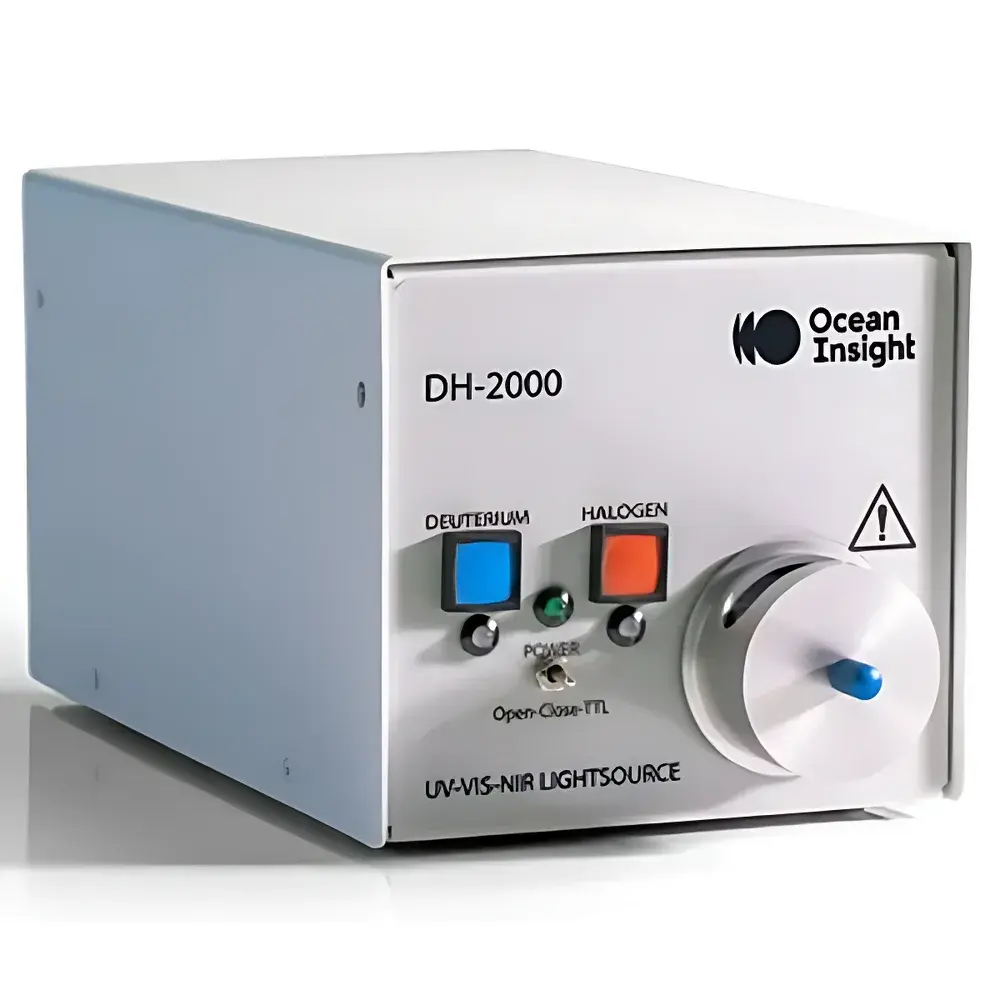
Ocean Optics DH-2000 Deuterium-Tungsten Halogen Combined Light Source
| Brand | Ocean Optics |
|---|---|
| Origin | USA |
| Model | DH-2000 |
| Light Source Type | Deuterium + Tungsten Halogen |
| Spectral Range | 215–2500 nm (DH-2000-DUV: 190–2500 nm) |
| Output Stability | <5 × 10⁻⁶ peak-to-peak (0.1–10.0 Hz) |
| Drift | <0.01% per hour |
| Warm-up Time | 25 min |
| Lamp Life | 1000 h |
| Power Consumption | ~78 VA |
| Dimensions (W×H×L) | 15 × 13.5 × 28.5 cm |
| Weight | 5 kg |
| Compliance | CE, RoHS, WEEE |
| Operating Temperature | 5–35 °C |
| Operating Humidity | 5–95% RH (non-condensing at 40 °C) |
Overview
The Ocean Optics DH-2000 is a high-stability, combined deuterium–tungsten halogen broadband light source engineered for demanding spectroscopic applications across the deep ultraviolet (DUV), visible, and near-infrared (NIR) spectral regions. Unlike single-source lamps, the DH-2000 integrates two independently optimized emitters—deuterium (D₂) for continuous UV output and tungsten halogen (W-Hal) for stable visible/NIR emission—within a single, collimated optical path. This dual-lamp architecture enables seamless spectral coverage from 215 nm to 2500 nm (or 190–2500 nm in the DH-2000-DUV variant), eliminating the need for mechanical source switching or spectral stitching during full-range absorbance, reflectance, transmittance, fluorescence excitation, or calibration measurements. The source employs precision thermal management and regulated current drivers to maintain long-term radiometric stability, making it suitable for quantitative benchtop, process monitoring, and portable OEM integration where repeatability and traceable intensity are critical.
Key Features
- Combined D₂ + W-Hal emission in a single collimated beam path, enabling uninterrupted spectral continuity from deep UV to NIR
- Ultra-low intensity noise: <5 × 10⁻⁶ peak-to-peak (0.1–10.0 Hz bandwidth), supporting high-dynamic-range detection in low-light applications
- Thermally stabilized housing with active airflow design ensures consistent output during extended operation (drift <0.01% per hour)
- Modular lamp design allows rapid field replacement of deuterium (DH-2000-BD/DH-2000-DUV-B) and tungsten halogen (DH-2000-BH) bulbs without realignment
- Select models include TTL-controlled electronic shutters (DH-2000-S, DH-2000-S-DUV-TTL, DH-2000-FHS) for precise UV exposure timing—critical for photolabile biological or polymer samples
- DH-2000-FHS integrates a front-mounted filter holder accommodating square (≤25 mm) or round (≤25 mm Ø) filters up to 4 mm thick, enabling pre-fiber spectral conditioning (e.g., UV cutoff, bandpass selection)
- Independent TTL control of D₂ and W-Hal lamps (DH-2000-S-DUV-TTL) supports time-resolved dual-excitation protocols and automated measurement sequences
Sample Compatibility & Compliance
The DH-2000 is routinely deployed in laboratories adhering to ISO/IEC 17025, ASTM E308 (colorimetry), USP (spectrophotometric system suitability), and FDA 21 CFR Part 11–compliant environments when integrated with validated software workflows. Its broad spectral output supports compliance-critical applications including pharmaceutical assay validation (e.g., dissolution testing per USP ), environmental water quality analysis (EPA Method 415.3), and food safety screening (AOAC 990.11). The source’s low UV-induced sample degradation—enabled by shuttered exposure control—ensures integrity of nucleic acid, protein, and pigment-based samples during kinetic absorbance or fluorescence studies. All units meet CE marking requirements for electromagnetic compatibility (EN 61326-1) and environmental safety (RoHS Directive 2011/65/EU, WEEE Directive 2012/19/EU).
Software & Data Management
While the DH-2000 operates as a hardware-level light source without embedded firmware, it is fully compatible with Ocean Insight’s OceanView™, OmniDriver™ SDK, and third-party platforms (LabVIEW, Python via PyOcean, MATLAB) for synchronized triggering, shutter actuation, and intensity logging. When paired with Ocean Optics spectrometers (e.g., QE Pro, Flame series), the system supports automated dark/light reference acquisition, intensity normalization, and spectral radiance calibration using NIST-traceable standards (e.g., LS-1-CAL, DH-2000CAL). Audit trails for lamp on-time, shutter cycles, and power settings can be recorded within LIMS or ELN systems compliant with GLP/GMP data integrity principles. Firmware-upgradable spectrometer controllers enable time-synchronized TTL handshaking for multi-source experiments requiring sub-millisecond lamp sequencing.
Applications
- Absorbance & Transmittance: Quantitative UV-Vis-NIR spectroscopy of pharmaceuticals, polymers, and nanomaterials; compliance with pharmacopoeial methods (USP, EP)
- Fluorescence Excitation: Broadband excitation profiling for quantum dot characterization, FRET assays, and autofluorescence suppression in tissue imaging
- Reflectance & Color Measurement: Diffuse and specular reflectance of coatings, textiles, and agricultural products per CIE and ASTM standards
- Calibration & Reference Standards: Radiometric calibration of spectrometers, integrating spheres, and hyperspectral cameras using calibrated reference lamps
- Environmental Monitoring: Field-deployable water quality sensors for nitrate, organic carbon, and turbidity via UV absorption signatures
- OEM Integration: Embedded illumination module in portable analyzers, microfluidic cytometers, and inline process spectrometers requiring stable, broadband excitation
FAQ
What is the difference between the DH-2000 and DH-2000-DUV models?
The DH-2000-DUV uses a specialized deep-UV deuterium lamp with enhanced quartz envelope transmission, extending usable output down to 190 nm—critical for aromatic compound quantification and protein secondary structure analysis via far-UV CD.
Can the deuterium and tungsten halogen lamps be operated simultaneously?
Yes. Both lamps are powered and thermally managed concurrently, producing a continuous, gap-free spectrum from 190–2500 nm. Independent TTL control (on DH-2000-S-DUV-TTL) permits selective activation for temporal separation of UV and Vis/NIR excitation.
Is the DH-2000 compatible with fiber-optic accessories from other manufacturers?
It features a standard SMA 905 connector and delivers optimal coupling into 60 µm core UV/VIS fibers. For non-Ocean fibers, alignment verification and power meter validation are recommended to ensure specified irradiance delivery.
How often should the lamps be replaced?
Rated lamp life is 1000 hours under nominal operating conditions. Output decay follows an exponential profile; routine intensity monitoring against a reference standard is advised after 500 hours to maintain measurement uncertainty budgets.
Does the DH-2000 require external cooling or forced air?
No external cooling is required. The unit incorporates passive heat sinks and controlled internal convection. Ambient airflow must remain unobstructed; operation in enclosed enclosures requires supplemental ventilation to maintain ≤35 °C internal temperature.





