
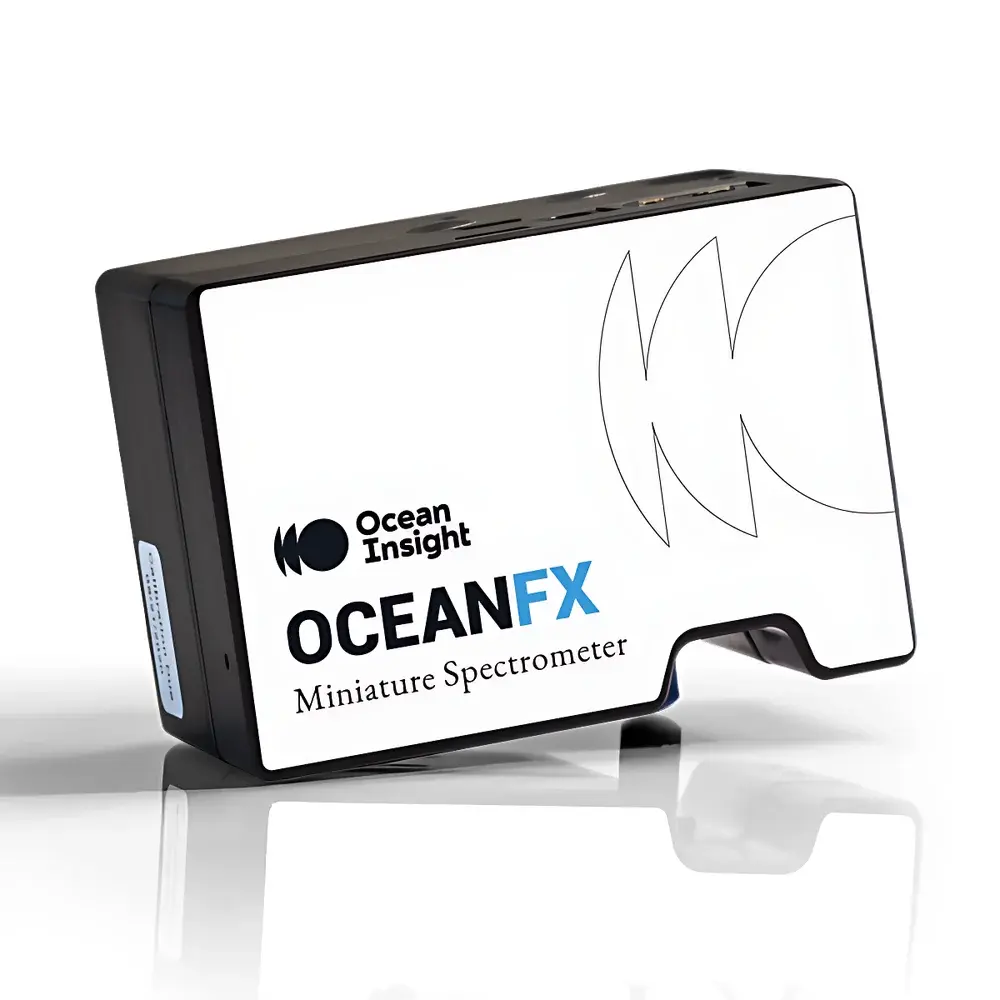
Ocean Optics Ocean-FX Fiber Optic Spectrometer
| Brand | Ocean Optics |
|---|---|
| Model | Ocean-FX |
| Spectral Range | 200–1100 nm |
| Optical Resolution | 0.8 nm (FWHM) |
| Detector | Hamamatsu S11639 CMOS |
| Slit Options | 5, 10, 25, 50, 100, or 200 µm (SMA 905 or FC connector) |
| Signal-to-Noise Ratio (single scan) | ~270:1 |
| Dynamic Range (single scan) | ~6400:1 |
| Integration Time | 10 µs – 10 s |
| Maximum Scan Rate | 3000 scans/s (host-dependent) |
| Stray Light | <0.08% at 600 nm |
| Thermal Drift | 0.11 pixels/°C |
| Onboard Buffer | 50,000 spectra with timestamping |
| Connectivity | Gigabit Ethernet, Wi-Fi 802.11n, USB 3.0 |
Overview
The Ocean Optics Ocean-FX Fiber Optic Spectrometer is a high-performance, next-generation benchtop spectrometer engineered for demanding UV-VIS-NIR applications requiring speed, stability, and spectral fidelity. Based on a back-thinned, scientific-grade Hamamatsu S11639 CMOS detector, the Ocean-FX delivers enhanced quantum efficiency—particularly in the ultraviolet region (200–350 nm)—enabling robust detection of low-light biological fluorophores, trace gas absorption features, and weak Raman signals. Its optical architecture employs fixed-grating monochromators with selectable slit widths and high-efficiency coatings optimized for broad spectral coverage (200–1100 nm). The instrument operates on the principle of fixed-grating dispersion coupled with linear-array CMOS detection, providing high linearity, low read noise, and excellent pixel-to-pixel uniformity. Designed for integration into automated analytical workflows, the Ocean-FX supports real-time spectral acquisition at up to 3000 full-spectrum scans per second under optimal host conditions, making it suitable for time-resolved studies, process monitoring, and high-throughput screening where temporal resolution is critical.
Key Features
- High-speed spectral acquisition: Capable of acquiring up to 3000 full-spectrum scans per second (dependent on host interface and buffer management), enabling millisecond-scale kinetic measurements and transient event capture.
- Enhanced UV sensitivity: Optimized CMOS detector with peak quantum efficiency >60% at 250 nm, significantly outperforming legacy CCD-based platforms in UV-absorption and fluorescence applications.
- Robust thermal stability: Optical alignment maintained within ±0.11 pixels/°C, minimizing wavelength drift during extended temperature-varying experiments—critical for long-duration environmental or industrial monitoring.
- Large onboard memory: Integrated 50,000-spectrum circular buffer with hardware timestamping ensures no data loss during high-speed acquisitions, even during host communication latency or system interrupts.
- Multi-modal connectivity: Native Gigabit Ethernet, IEEE 802.11n Wi-Fi, and USB 3.0 interfaces enable flexible deployment—whether embedded in OEM instrumentation, remotely supervised in cleanroom environments, or integrated into handheld field analyzers.
- Configurable optical path: Interchangeable slits (5–200 µm), optional gratings, and fiber-coupled input (SMA 905 or FC) support application-specific optimization across UV-Vis (200–850 nm), Vis-NIR (350–1000 nm), or wide-range (200–1025 nm) configurations.
Sample Compatibility & Compliance
The Ocean-FX accepts standard 200–600 µm core multimode silica fibers and is compatible with a wide range of sampling accessories—including cuvette holders, integrating spheres, reflection probes, flow cells, and gas cells—enabling direct analysis of liquids, solids, gases, and plasmas. Its optical design complies with ISO 17025-relevant performance verification protocols for spectroscopic instrumentation, and its digital output architecture supports audit-trail-capable data logging when paired with validated software environments. While not intrinsically certified for hazardous locations, the spectrometer meets IEC 61326-1 (EMC) and IEC 61010-1 (safety) standards for laboratory and light industrial use. For regulated environments (e.g., pharmaceutical QC), the device may be qualified under FDA 21 CFR Part 11-compliant software frameworks when deployed with appropriate electronic signature and data integrity controls.
Software & Data Management
Ocean Insight’s OceanView™ software provides native driver support for the Ocean-FX, offering real-time visualization, spectral math operations (e.g., baseline correction, peak integration, ratioing), and export to CSV, HDF5, or vendor-neutral JCAMP-DX formats. The SDK (available for Python, MATLAB, LabVIEW, C#, and C++) enables deterministic control of integration time, trigger modes (hardware TTL, software, or external sync), and buffer streaming—essential for custom automation and inline process analytics. All spectral metadata—including calibration coefficients, slit width, grating ID, temperature sensor readings, and precise timestamps—are embedded in each acquired spectrum. When used with compliant LIMS or ELN systems, the Ocean-FX supports traceable, ALCOA+ (Attributable, Legible, Contemporaneous, Original, Accurate, Complete, Consistent, Enduring, Available) data handling practices.
Applications
- Biomedical research: Real-time monitoring of enzymatic kinetics in cell lysates, DNA hybridization assays, and UV absorbance quantification of nucleic acids and proteins.
- Food & agriculture: Rapid sorting and quality grading via reflectance spectroscopy; detection of spoilage markers (e.g., volatile organic compounds) using UV gas-phase absorption.
- Industrial process control: In-line monitoring of chemical reaction progress (e.g., polymerization, catalytic synthesis), plasma emission profiling in semiconductor etching, and laser pulse characterization in manufacturing.
- Environmental sensing: Multi-component gas analysis (NO₂, SO₂, O₃) in open-path or extractive configurations; dissolved organic matter (DOM) profiling in wastewater streams.
- Academic spectroscopy labs: Teaching platform for fundamental optics, detector physics, and chemometrics; ideal for student-led projects involving spectral library development and machine learning model training.
FAQ
What is the minimum integration time supported by the Ocean-FX?
The Ocean-FX supports integration times as short as 10 microseconds, enabling capture of fast transient events such as pulsed laser emissions or rapid photochemical reactions.
Can the Ocean-FX operate without a connected computer?
Yes—the instrument includes an embedded Linux controller and can run autonomous acquisition scripts over Ethernet or Wi-Fi, storing spectra directly to internal flash or network-attached storage.
Is the spectral calibration NIST-traceable?
Each unit ships with factory calibration using NIST-traceable tungsten-halogen and mercury-argon sources; users may perform recalibration using optional calibration kits compliant with ISO/IEC 17025 requirements.
How does the 0.8 nm FWHM resolution vary with configuration?
Resolution is specified for the standard configuration (600 grooves/mm grating + 25 µm slit); narrower slits (e.g., 5 µm) improve resolution at the expense of throughput, while broader slits increase signal intensity with proportional resolution degradation.
Does the Ocean-FX support synchronized multi-instrument triggering?
Yes—it features dual hardware trigger inputs (TTL-compatible) and supports master-slave synchronization across multiple Ocean-FX or other Ocean Insight spectrometers via external clock distribution or PTP (Precision Time Protocol) over Ethernet.




