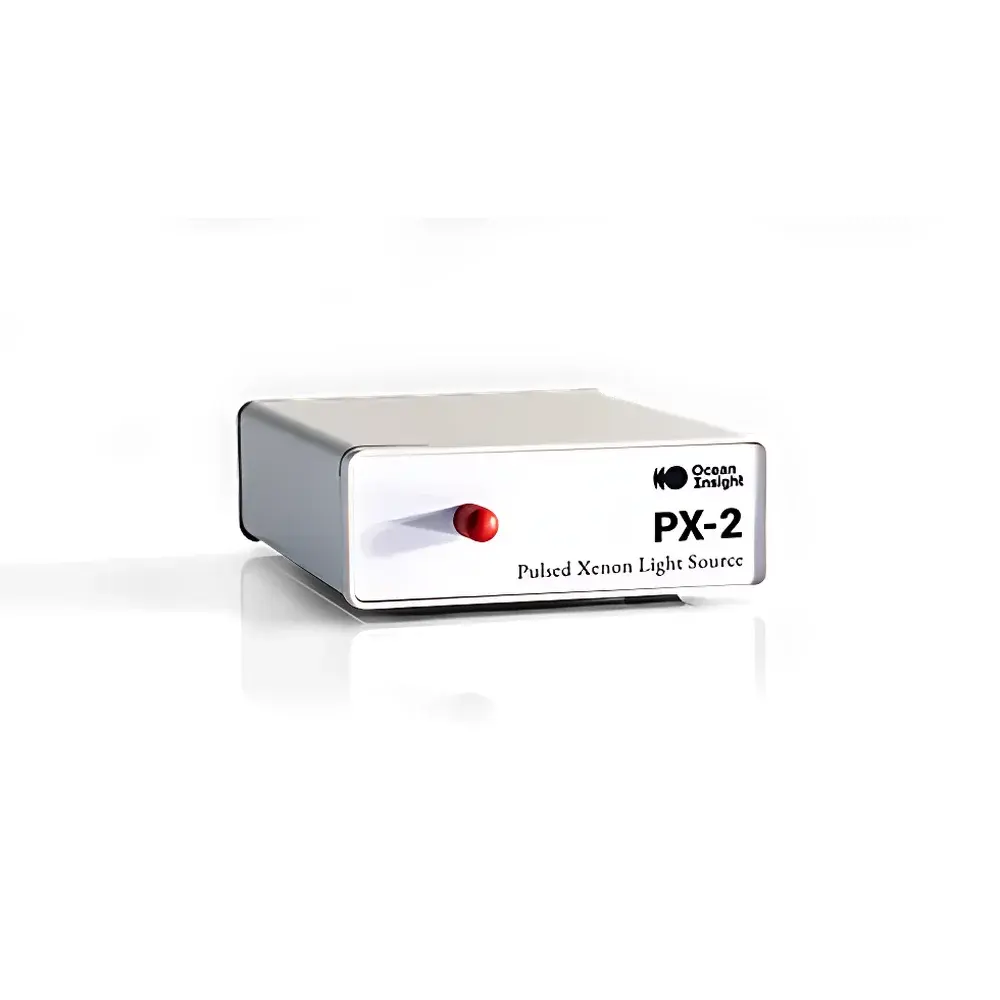
Ocean Optics PX-2 Pulsed Xenon Light Source
| Brand | Ocean Optics |
|---|---|
| Model | PX-2 |
| Light Source Type | Pulsed Xenon Lamp |
| Spectral Range | 220–750 nm |
| Pulse Duration | 5 µs (FWHM) |
| Max Pulse Repetition Rate | 220 Hz |
| Pulse Energy per Flash | up to 45 µJ |
| Average Lamp Power | 9.9 W |
| Trigger Input | TTL-positive via 15-pin D-sub connector |
| Output Coupling | SMA 905 fiber port |
| Dimensions | 14 × 10.5 × 4 cm (L×W×H) |
| Lamp Lifetime | 1×10⁹ pulses (≈230 days at 50 Hz) |
| Compliance | CE-marked, RoHS-compliant |
| Software Control | Dual-mode TTL triggering (single-channel & multi-channel synchronization) |
| Interface Compatibility | Fully integrated with Ocean Insight spectrometers (e.g., USB2000+, QE Pro, Flame series) and third-party DAQ systems |
Overview
The Ocean Optics PX-2 Pulsed Xenon Light Source is a compact, high-stability, short-arc pulsed xenon lamp engineered for demanding UV-Vis spectroscopic applications where thermal load, photodegradation, or temporal resolution are critical constraints. Unlike continuous-wave (CW) sources, the PX-2 delivers discrete, microsecond-duration light pulses—enabling time-gated detection, reduced sample heating, and elimination of photobleaching in light-sensitive biological, polymeric, or photochemical samples. Its spectral output spans 220–750 nm, with strong intensity in the deep UV (down to 220 nm), making it particularly suitable for absorbance, reflectance, fluorescence excitation, and phosphorescence lifetime studies. The device operates on the principle of capacitor-discharge-driven arc ignition, producing highly reproducible flash profiles with minimal pulse-to-pulse energy drift (<±1.5% over 1,000 pulses at 100 Hz). Its fixed 5 µs full-width-at-half-maximum (FWHM) pulse width ensures consistent photon delivery timing—essential for lock-in detection, kinetic measurements, and synchronized detector gating.
Key Features
- Stable pulsed output up to 220 Hz—software-selectable via TTL trigger modes
- Dual synchronization architecture: single-channel mode (1 flash per integration period) and multi-channel mode (fixed flash timing independent of spectrometer integration time)
- Integrated 15-pin D-sub interface for direct TTL communication with Ocean Insight spectrometers and external DAQ systems
- SMA 905 fiber-coupled output compatible with standard Ocean Optics sampling accessories (e.g., CUV-FL-DA cuvette holders, reflection probes, collimating lenses)
- No internal cooling fan—passively cooled design minimizes mechanical vibration and electromagnetic interference
- CE-marked and RoHS-compliant; designed for laboratory use under IEC 61010-1 safety requirements
- Lamp lifetime rated at 1×10⁹ flashes (equivalent to >230 days of continuous operation at 50 Hz)
Sample Compatibility & Compliance
The PX-2 is routinely deployed in analytical workflows involving thermally labile proteins, photosensitive dyes (e.g., fluorescein, rhodamine B), thin-film organic semiconductors, and UV-curable resins—where CW illumination induces irreversible degradation or baseline drift. Its pulsed nature suppresses negative afterglow effects below 260 nm, a known artifact in deep-UV absorbance measurements using conventional deuterium lamps. From a regulatory standpoint, the PX-2 supports GLP/GMP-aligned data acquisition when paired with spectrometers configured for FDA 21 CFR Part 11 compliance (audit trail, electronic signature, secure user access). It meets ISO/IEC 17025 requirements for instrument calibration traceability when used with NIST-traceable reference standards (e.g., SRM 2036 for spectral irradiance).
Software & Data Management
Ocean Insight’s OceanView and OmniDriver software fully support PX-2 configuration—including real-time selection of trigger mode, pulse rate adjustment, and hardware-level synchronization with spectrometer acquisition clocks. In multi-channel mode, the PX-2 maintains constant flash timing regardless of spectrometer integration time, ensuring uniform photon flux per scan—a requirement for quantitative reflectance mapping and differential absorbance kinetics. All trigger events and lamp status logs (pulse count, error flags, thermal warnings) are timestamped and exportable in CSV or HDF5 format. When integrated into automated platforms (e.g., robotic liquid handlers or environmental chambers), the PX-2 accepts external TTL signals from PLCs or LabVIEW-based controllers without latency or jitter.
Applications
- Time-resolved UV-Vis absorbance spectroscopy of transient intermediates in photochemical reactions
- High-fidelity reflectance measurement of OLED emissive layers and anti-reflective coatings
- Fluorescence excitation profiling of quantum dots and lanthanide-doped nanoparticles
- In-line monitoring of UV-curing processes in pharmaceutical film coating and 3D printing resins
- Calibration validation of UV-Vis spectrophotometers per ASTM E275 and ISO 6246
- Phosphorescence lifetime analysis in oxygen-sensitive sensor films (e.g., PtTFPP-doped polystyrene)
FAQ
What is the minimum integration time compatible with PX-2 in single-channel mode?
The minimum usable integration time is governed by the spectrometer’s readout speed—not the PX-2 itself. With Ocean Insight’s QE Pro, integration can be as low as 1 ms, allowing one flash per spectrum at up to 220 Hz.
Can the PX-2 be triggered externally by non-Ocean spectrometers?
Yes—any TTL-positive signal (3.3 V or 5 V logic level) delivered to pin 1 of the 15-pin D-sub connector will initiate a flash, provided ground reference is shared.
Is spectral output intensity uniform across the 220–750 nm range?
No—the PX-2 exhibits higher radiant intensity in the 250–400 nm region. Users should apply wavelength-specific correction factors derived from NIST-traceable calibration files for quantitative work.
How does PX-2 compare to HPX-2000 in terms of application suitability?
The PX-2 is optimized for pulsed, low-heat, time-resolved applications; the HPX-2000 (35 W CW xenon) is preferred for broadband steady-state measurements requiring higher average power and extended IR coverage (up to 2.2 µm).
Does PX-2 require warm-up or stabilization time before measurement?
No—unlike CW lamps, the PX-2 delivers stable pulse energy from first flash; no thermal drift or intensity ramp-up is observed.