
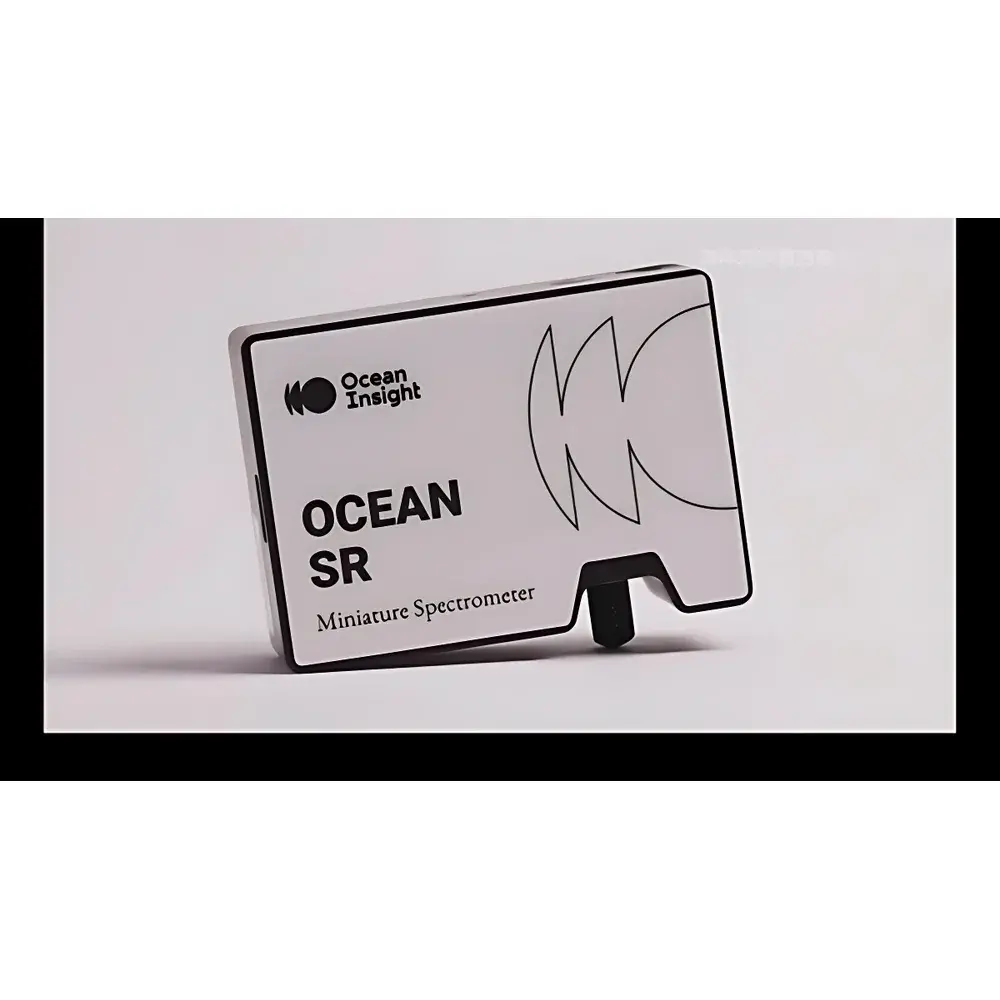
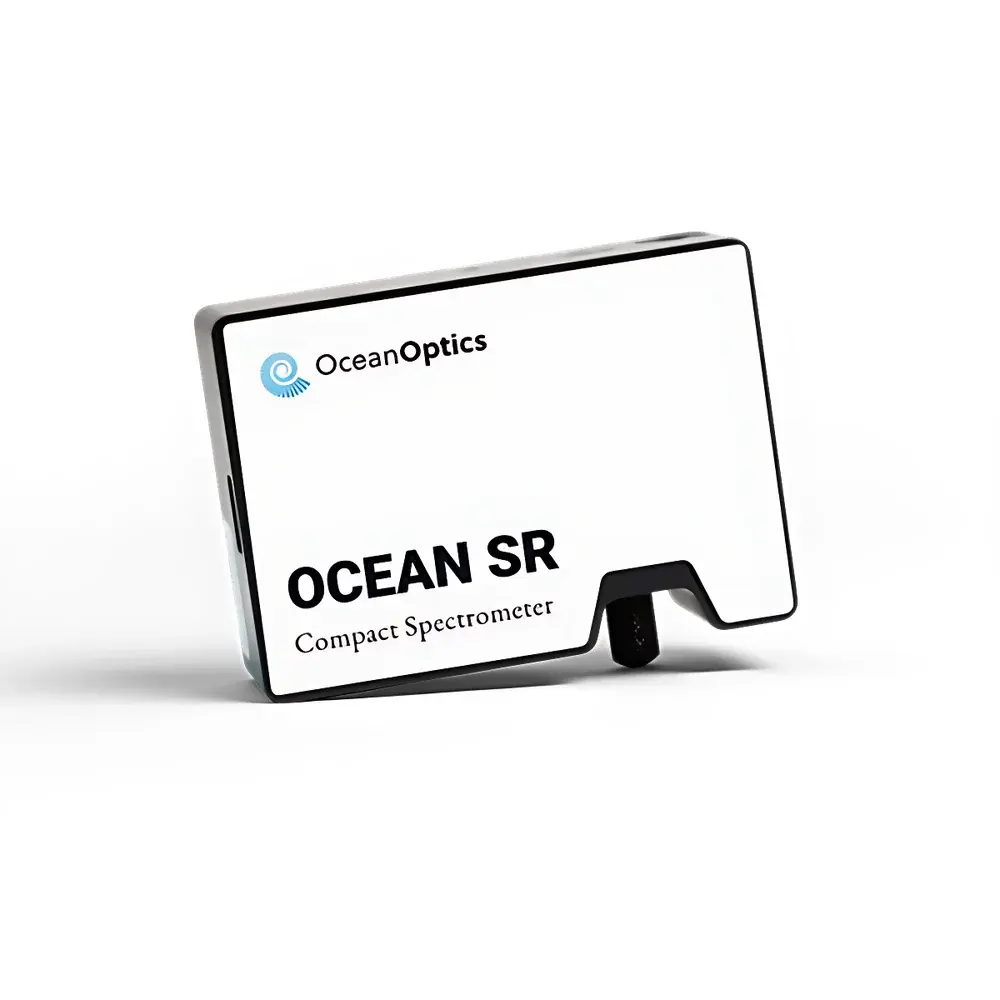
Ocean Optics SR2 / SR4 / SR6 UV-Vis-NIR Compact Fiber-Optic Spectrometers
| Brand | Ocean Optics |
|---|---|
| Origin | USA |
| Model Series | SR2, SR4, SR6 |
| Wavelength Range | 185–1100 nm (configurable) |
| Resolution (FWHM) | 0.28–11.52 nm (model- and grating-dependent) |
| Integration Time | 1 µs – 10 s (SR2: 1 µs–2 s |
| SR4 | 3.8 ms–10 s |
| SR6 | 7.2 ms–5 s) |
| Dynamic Range | 3400:1 (SR2) / 1300:1 (SR4) / 12000:1 (SR6) |
| SNR | 380:1 (SR2) / 3000:1 (SR4) / 3500:1 (SR6) |
| Detector | CMOS (SR2), 3648-pixel CCD (SR4), 2048-pixel CCD (SR6) |
| Interface | USB Type-C, SMA fiber port, 16-pin Samtec TFM, RS-232 |
| Dimensions | 88.1 × 63.5 × 31.45 mm |
| Weight | 275 g |
| Operating Temp. | 0–55 °C |
| Storage Temp. | −30–70 °C |
| Slit Options | 5, 10, 25, 50, 100, or 200 µm |
Overview
The Ocean Optics SR Series comprises three high-performance, modular fiber-optic spectrometers—SR2, SR4, and SR6—engineered for precision spectral measurement across the ultraviolet, visible, and near-infrared (UV-Vis-NIR) ranges (185–1100 nm). Based on the foundational principles of dispersive spectroscopy—where incoming light is collimated, diffracted by a ruled or holographic grating, and spatially resolved onto a linear photodetector array—each model leverages optimized optical path design, thermally stabilized mechanics, and low-noise electronics to deliver robust, repeatable data under variable environmental conditions. As pioneers in miniature spectrometer architecture since 1992, Ocean Optics designed the SR platform to support both laboratory-grade validation and demanding industrial deployment—including inline process monitoring, field-deployable environmental sensing, and OEM-integrated instrumentation. The series maintains strict adherence to fundamental radiometric traceability practices and supports calibration against NIST-traceable standards, enabling compliance-ready workflows in regulated environments.
Key Features
- Three-tiered performance architecture: SR2 prioritizes ultrafast acquisition (down to 1 µs integration) with high-speed signal fidelity; SR4 emphasizes high-resolution spectral discrimination via its 3648-pixel CCD detector and superior stray-light rejection; SR6 delivers the highest dynamic range (12,000:1) and thermal wavelength stability (<0.01 nm/°C drift), making it suitable for quantitative multi-wavelength assays and long-duration unattended operation.
- Modular slit selection (5–200 µm) enables precise control over optical throughput and resolution trade-offs—critical for balancing sensitivity in low-light fluorescence measurements versus resolving power in atomic emission line analysis.
- Integrated thermal management and factory-applied wavelength calibration ensure consistent spectral registration across operating temperatures (0–55 °C), satisfying requirements for GLP-compliant instrument qualification protocols.
- Ruggedized mechanical housing (aluminum alloy chassis) and conformal coating protect internal optics and electronics against humidity, vibration, and particulate exposure—validated per IEC 60529 IP20 specifications for laboratory and light industrial use.
- Cross-platform software compatibility: All models ship with OceanDirect SDK—a C/C++, Python, MATLAB, and LabVIEW-compatible API supporting full hardware control, real-time streaming, and firmware-upgradable functionality without proprietary lock-in.
Sample Compatibility & Compliance
The SR Series interfaces seamlessly with standard 400 µm core silica optical fibers (SMA 905 connector) and supports common sampling geometries including transmission cuvettes, integrating spheres, reflection probes, and fiber-coupled light sources. Its broad spectral coverage accommodates diverse sample types: aqueous biological matrices (DNA/protein absorbance at 260/280 nm), semiconductor thin-film reflectance (200–400 nm), agricultural NIR moisture analysis (900–1100 nm), and plasma emission diagnostics (300–800 nm). Instrument firmware and calibration files are digitally signed and version-controlled, supporting audit trails required under FDA 21 CFR Part 11 for electronic records in pharmaceutical QC labs. While not pre-certified for specific ISO/ASTM methods, the platform is routinely deployed in applications aligned with ASTM E308 (colorimetry), ISO 13406-2 (display spectral characterization), and USP (spectrophotometric system suitability).
Software & Data Management
OceanView spectral acquisition software provides intuitive GUI-based configuration, real-time plotting, spectral math (e.g., baseline correction, peak integration, ratioing), and export to CSV, TXT, or HDF5 formats. For automated or embedded deployments, the OceanDirect SDK enables deterministic timing control, hardware-accelerated spectral averaging (up to 1024 scans per frame), and memory-mapped buffer access—facilitating integration into custom LIMS, SCADA, or machine-vision pipelines. All spectral data include embedded metadata (timestamp, integration time, grating ID, slit width, calibration file hash), ensuring full experimental provenance. Firmware updates are delivered via signed OTA packages, preserving cryptographic integrity during field servicing.
Applications
- Laser pulse characterization and cavity mode analysis using SR2’s microsecond-level temporal resolution.
- Quantitative protein/DNA quantification and purity assessment (A260/A280 ratios) in life science labs using SR4’s high-SNR UV response.
- In-line monitoring of chemical reaction kinetics in flow reactors via dual-channel absorbance referencing (e.g., 254 nm + reference wavelength).
- Remote environmental sensing of water quality parameters (nitrate, dissolved organic carbon) using portable SR6-equipped UAV-mounted probe systems.
- OEM integration into handheld explosives detectors, food authenticity scanners, and medical point-of-care oximeters leveraging SR6’s wide dynamic range and thermal resilience.
FAQ
What distinguishes SR2, SR4, and SR6 in terms of detector technology and primary use cases?
SR2 employs a high-speed CMOS sensor optimized for transient event capture (e.g., laser pulses, plasma ignition); SR4 uses a 3648-pixel CCD ideal for high-resolution static emission/absorption profiling; SR6 integrates a 2048-pixel CCD with enhanced analog front-end circuitry, delivering the widest dynamic range and lowest thermal drift—suited for demanding quantitative applications requiring long-term stability.
Can the SR spectrometers be calibrated for absolute irradiance or radiance measurements?
Yes—when paired with Ocean Optics’ NIST-traceable calibration standards (e.g., HL-3-CAL, LS-1-CAL), users can perform relative or absolute radiometric calibration. Full calibration reports—including uncertainty budgets per GUM guidelines—are available upon request.
Is OceanDirect SDK compatible with Linux-based embedded systems?
Yes—the SDK provides native ARM64 and x86_64 binaries for Debian/Ubuntu distributions, along with complete documentation for cross-compilation targeting Yocto or Buildroot environments.
How is wavelength accuracy maintained across temperature fluctuations?
Each SR unit undergoes multi-point thermal calibration during manufacturing. Internal thermistor feedback adjusts pixel-to-wavelength mapping in real time, achieving <±0.02 nm repeatability from 0–50 °C without user intervention.
Do SR spectrometers support trigger synchronization with external devices?
All models feature TTL-compatible hardware trigger inputs (rising/falling edge selectable) and programmable delay generators, enabling precise synchronization with pulsed lasers, shutters, or motion stages—essential for time-resolved spectroscopy and pump-probe experiments.
Related Products






