
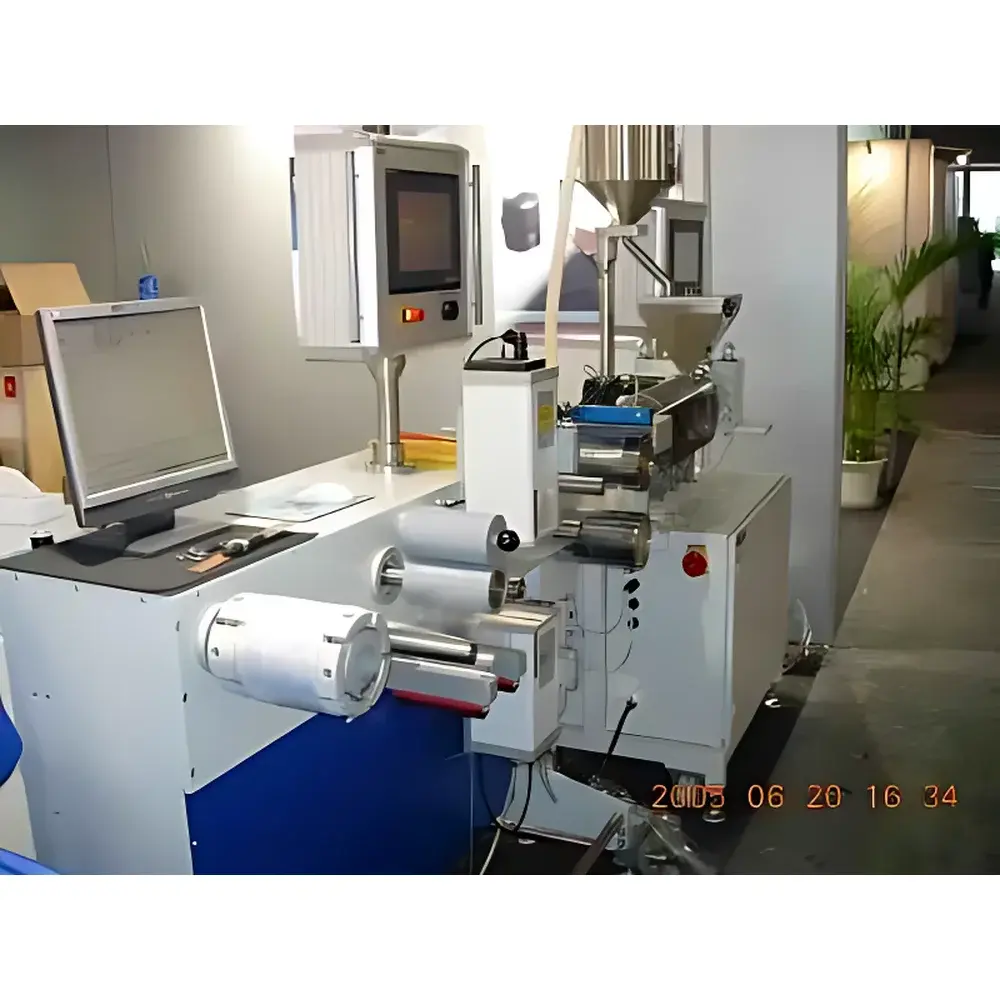
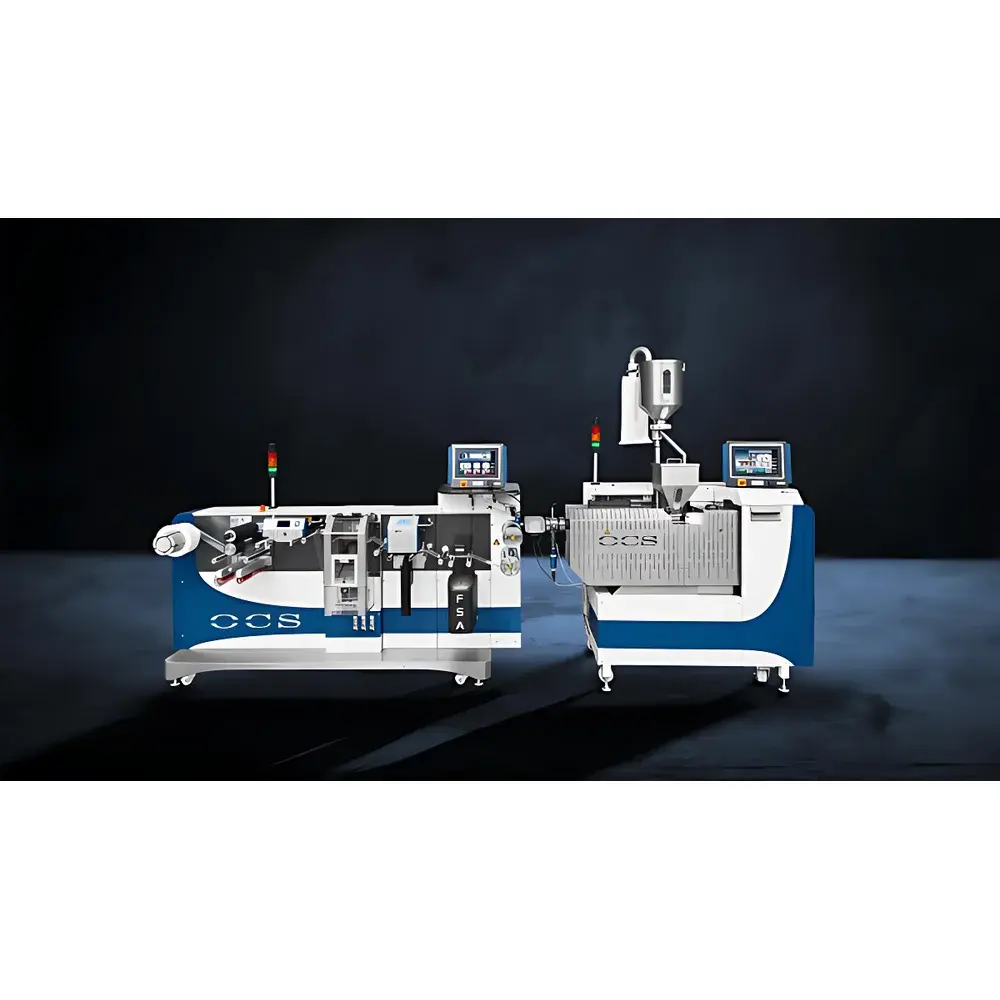
OCS ME-MFA Laboratory Cast Film Extrusion System
| Brand | OCS |
|---|---|
| Origin | Germany |
| Model | ME-MFA |
| Drive System | Frequency-controlled servo motors for all drive rollers |
| Control Interface | Dual independent LCD touch-screen HMI (extruder + winder) |
| Tension Control | Two-zone closed-loop tension control system |
| Data Integration | LIMS-compatible digital output (OPC UA & Modbus TCP), remote operation enabled |
| Certification Context | Designed to support ASTM D2673, ISO 1133, ISO 14389, and internal QC protocols aligned with ICH Q5, USP <1043>, and GMP Annex 15 traceability requirements |
Overview
The OCS ME-MFA Laboratory Cast Film Extrusion System is a precision-engineered benchtop extrusion platform developed in Germany for polymer characterization and quality assurance in R&D and QC laboratories. It operates on the principle of controlled melt extrusion followed by rapid quenching on a polished chrome-coated chill roll, enabling reproducible fabrication of uniform cast films from thermoplastic resins—including polyolefins (PP, PE), engineering plastics (PC, PA, PBT), and specialty polymers (TPU, EVOH, ionomers). Unlike generic lab extruders, the ME-MFA integrates metrologically traceable process control architecture specifically calibrated for correlation with industrial-scale film production lines. Its design conforms to the functional requirements of polymer morphology validation, additive dispersion assessment, and rheological behavior screening under defined thermal and mechanical boundary conditions.
Key Features
- Full-servo drive train: All critical motion axes—including screw rotation, chill roll surface velocity, and winder take-up—are independently driven by high-resolution servo motors with ±0.1 rpm speed stability across 0.1–100 rpm range.
- Dual HMI architecture: Separate 7-inch capacitive-touch LCD interfaces for extruder (temperature profiling, screw speed, torque monitoring) and winder (line speed, tension setpoint, winding diameter compensation) ensure operational decoupling and audit-ready parameter logging.
- Two-stage tension regulation: A primary load-cell-based feedback loop controls dancer arm position upstream of the chill roll; a secondary closed-loop system governs final winding tension via torque-controlled motor, maintaining ±0.5 N deviation over variable web widths (100–300 mm).
- Thermal management: Zone-controlled barrel heating (up to 400 °C, ±0.5 °C stability) with integrated melt pressure transducers (0–100 bar range) and real-time viscosity calculation based on capillary rheology models.
- Material compatibility: Equipped with interchangeable screw geometries (conveying, mixing, barrier) and die tooling (slot dies with adjustable gap 0.1–2.0 mm) to accommodate virgin pellets, regrind, masterbatches, and filled compounds.
Sample Compatibility & Compliance
The ME-MFA accommodates solid polymer feedstocks in granular or pellet form (diameter 2–5 mm), including hygroscopic resins requiring pre-drying integration (optional desiccant hopper module). Film thickness repeatability is validated per ISO 4593:2021 (plastics—film and sheet—determination of thickness), with typical coefficient of variation (CV) <1.8% across 100 mm width at 25 µm nominal thickness. The system supports compliance workflows required by ISO/IEC 17025-accredited labs: full parameter traceability (timestamped, user-ID-tagged), electronic signature capability, and audit trail generation meeting FDA 21 CFR Part 11 and EU Annex 11 expectations. All firmware and HMI software are CE-marked and conform to EN 61000-6-2/6-4 EMC standards.
Software & Data Management
Process data—including screw RPM, barrel zone temperatures, melt pressure, line speed, tension values, and calculated shear rate/shear stress—is streamed in real time via OPC UA server (IEC 62541 compliant) and Modbus TCP. Native drivers enable direct ingestion into LIMS platforms (e.g., Thermo Fisher SampleManager, LabVantage) without middleware. Historical datasets are stored in SQLite format with SHA-256 checksum integrity verification; raw binary logs include metadata headers compliant with ASTM E2500-13 (Standard Guide for Specification, Design, and Verification of Pharmaceutical and Biopharmaceutical Manufacturing Systems). Optional Python SDK allows custom scripting for automated report generation (PDF/CSV) and statistical process control (SPC) charting.
Applications
- Resin supplier qualification: Reproducing customer-specified film processing windows to validate batch-to-batch consistency of MFI, gel content, and optical haze.
- Additive migration studies: Fabricating multilayer cast films to evaluate antioxidant or slip agent diffusion kinetics under accelerated aging protocols.
- Blending homogeneity assessment: Quantifying dispersion quality of nanofillers (e.g., nano-clay, carbon black) via cross-sectional SEM imaging of cryo-fractured ME-MFA films.
- Regulatory submission support: Generating GMP-aligned film samples for extractables/leachables testing per USP and ISO 10993-12.
- Process window mapping: Constructing DoE-based response surfaces linking screw speed, melt temperature, and chill roll temperature to film crystallinity (DSC), tensile modulus (ASTM D882), and seal initiation temperature (ASTM F88).
FAQ
Does the ME-MFA support nitrogen-purged processing for oxygen-sensitive polymers?
Yes—integrated gas purge ports (ISO-KF25) are standard on the feed throat and die manifold, enabling continuous N₂ or Ar blanket with flow metering and O₂ residual monitoring (optional sensor).
Can the system be integrated with an in-line FTIR or NIR spectrometer?
Absolutely—the winder frame includes DIN-rail mounting and analog/digital I/O expansion slots (0–10 V, 4–20 mA, RS485) for third-party spectroscopic modules with synchronized data timestamp alignment.
Is validation documentation provided for IQ/OQ/PQ protocols?
OCS supplies a complete URS-compliant validation package, including FAT/SAT reports, calibration certificates (traceable to PTB), and template protocols for installation, operational, and performance qualification per ISO/IEC 17025 and GAMP5 guidelines.






