
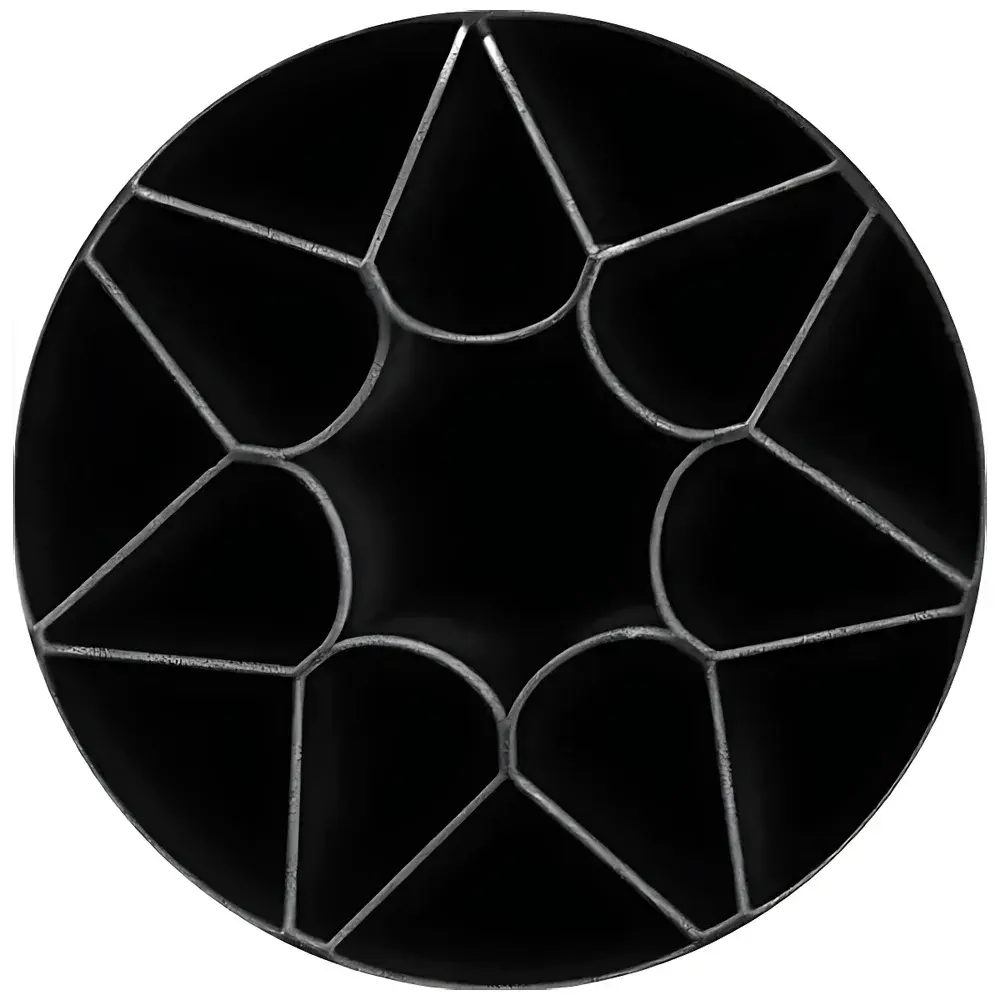
OETECH OBF-07-221119 Single-Turn Hollow-Core Anti-Resonant Fiber
| Brand | OETECH |
|---|---|
| Origin | Beijing, China |
| Model | OBF-07-221119 |
| Core Diameter | ~25 µm |
| Cladding Hole Diameter | ~12 µm |
| Bare Fiber OD | ~145 µm |
| Coated Fiber OD | ~260 µm |
| Transmission Band | 550–1100 nm |
| Transmission Loss | <0.2 dB/m |
| Low-Loss Point | ~0.013 dB/m @ 655 nm |
| Loss @ 920 nm | ~0.05 dB/m |
| Material | Pure Fused Silica |
| Coating | Acrylate (Single-Coated) |
| Component Category | Optical Element |
Overview
The OETECH OBF-07-221119 Single-Turn Hollow-Core Anti-Resonant Fiber is a precision-engineered microstructured optical fiber designed for low-loss, high-fidelity guidance of light within a hollow core. It operates on the principle of inhibited coupling via anti-resonant reflection—where light propagates through an air-filled central core surrounded by a thin-walled silica capillary array arranged in a single-turn (single-ring) geometry. This architecture suppresses higher-order mode coupling and minimizes confinement loss across a broad spectral range, distinguishing it from conventional solid-core fibers and multi-ring anti-resonant designs. Engineered for demanding photonic applications, the fiber delivers exceptional modal stability, reduced nonlinear interaction, and high laser damage resistance—making it particularly suitable for ultrafast pulse delivery, gas-phase nonlinear optics, and trace-gas sensing platforms where material absorption and dispersion must be rigorously controlled.
Key Features
- Broadband Transmission Window: Supports guided propagation from deep visible (550 nm) to near-infrared (1100 nm), enabling compatibility with Ti:sapphire oscillators, frequency-doubled Nd:YAG sources, supercontinuum generators, and tunable diode lasers.
- Ultra-Low Propagation Loss: Achieves <0.2 dB/m average attenuation across the operational band, with a minimum of ~0.013 dB/m at 655 nm and ~0.05 dB/m at 920 nm—values consistent with state-of-the-art single-ring anti-resonant fiber performance.
- Suppressed Nonlinearity & Chromatic Dispersion: The predominantly air-guided mode reduces Kerr nonlinearity by over three orders of magnitude relative to standard SMF-28, while maintaining low group velocity dispersion (<50 ps/(nm·km) typical in the 700–900 nm range), preserving temporal pulse integrity.
- Quasi-Single-Mode Guidance: Designed to support fundamental LP01-like mode dominance with effective M2 < 1.3 across the band, minimizing intermodal interference and simplifying beam coupling into downstream free-space or waveguide systems.
- High Laser Damage Threshold: With pure fused silica cladding walls and absence of doped glass in the light path, the fiber exhibits intrinsic resistance to thermal loading and photoinduced degradation—validated for peak intensities exceeding 1 GW/cm² under femtosecond pulse conditions.
Sample Compatibility & Compliance
The OBF-07-221119 is compatible with standard FC/PC, SMA-905, or custom ferrule-based terminations for integration into OEM laser delivery systems, spectroscopic gas cells, and vacuum-compatible optical benches. Its acrylate coating meets IEC 60793-2-50 specifications for mechanical reliability under controlled laboratory environments (23 °C, 50% RH). While not certified for medical or aerospace-grade qualification, the fiber adheres to general optical component handling standards per ISO 10110-7 for surface quality and ASTM F1717 for fiber tensile strength testing protocols. For GLP/GMP-aligned installations, documentation of lot-specific attenuation spectra and mode field diameter measurements is available upon request.
Software & Data Management
As a passive optical component, the OBF-07-221119 requires no embedded firmware or driver software. However, its performance characterization data—including spectral loss profiles, bend-induced loss curves (tested at radii ≥15 cm), and polarization extinction ratio (PER > 18 dB over 600–1000 nm)—are provided in standardized CSV and MATLAB .mat formats. These datasets are structured to interface directly with common optical simulation tools (e.g., Lumerical MODE, COMSOL Multiphysics Wave Optics Module) for system-level modeling of beam propagation, dispersion compensation, and gas-light interaction length optimization.
Applications
- Ultrafast Laser Delivery: Enables dispersion-managed transport of sub-100-fs pulses from amplified Ti:sapphire or Yb-fiber systems to target chambers without pulse broadening or self-phase modulation artifacts.
- Gas-Phase Nonlinear Optics: Serves as the gain medium and resonator element in hollow-core fiber-based Raman lasers, parametric oscillators, and high-harmonic generation setups using noble gases or molecular vapors.
- Mid-IR Spectroscopy Pre-Alignment: Functions as a low-loss, alignment-tolerant waveguide in benchtop Fourier-transform infrared (FTIR) spectrometers operating up to 1100 nm, facilitating rapid system commissioning prior to transition to longer-wavelength hollow-core fibers.
- Optical Gas Sensing: Integrated into Herriott-type multipass cells or compact absorption cells for parts-per-trillion detection limits in methane, ammonia, or hydrogen sulfide monitoring—leveraging extended interaction lengths (>10 m effective path) and minimal background absorption.
FAQ
What distinguishes a single-turn anti-resonant fiber from multi-ring designs?
The single-turn geometry reduces inter-capillary coupling and manufacturing complexity while maintaining robust higher-order mode suppression—ideal for applications prioritizing simplicity, reproducibility, and cost-effective scaling over extreme bandwidth extension.
Can this fiber be spliced to standard SMF-28?
Yes, fusion splicing is feasible using optimized arc parameters and core-alignment techniques; typical splice loss is 0.3–0.6 dB per joint when matched to SMF-28 at 780 nm, with post-splice annealing recommended to mitigate stress-induced birefringence.
Is the acrylate coating suitable for vacuum environments?
The standard single acrylate layer is not vacuum-rated due to outgassing concerns; for UHV applications (<10⁻⁷ mbar), hermetic metal or carbon-based coatings are recommended—and available as a custom option.
How does bending affect transmission loss in this fiber?
Bend-induced loss remains below 0.1 dB/m for coil radii ≥20 cm at 800 nm; tighter bends increase higher-order mode leakage and should be avoided in high-fidelity pulse delivery configurations.
Are spectral loss data available for custom wavelengths outside 550–1100 nm?
Extended characterization (e.g., down to 400 nm or up to 1300 nm) can be performed upon request using calibrated broadband ASE sources and high-resolution optical spectrum analyzers, subject to additional lead time and validation fees.



