
OETech PM PBG High-Power Hollow-Core Photonic Bandgap Fiber
| Brand | OETech |
|---|---|
| Origin | Beijing, China |
| Manufacturer Type | Authorized Distributor |
| Country of Origin | China |
| Model | PM PBG |
| Price Range | USD 280 – 700 |
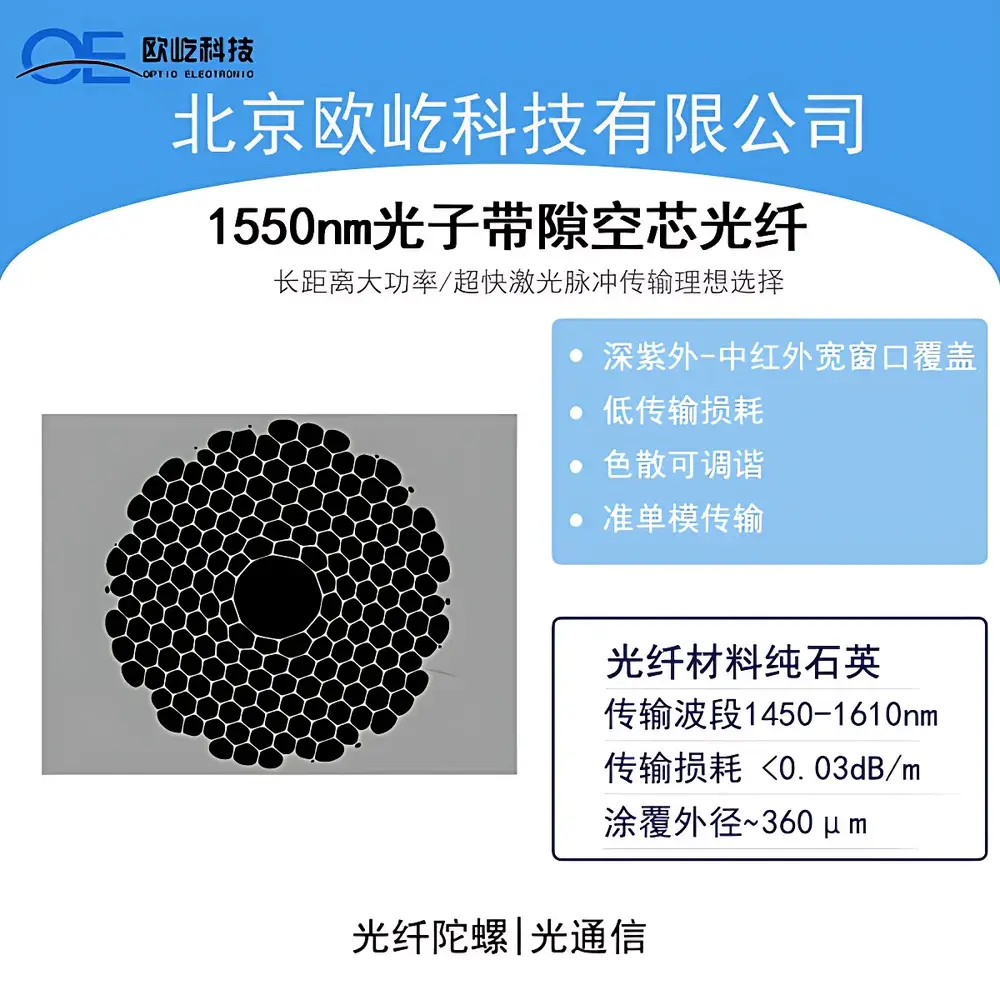
| Core Diameter | ~14 µm |
| Cladding Diameter (bare) | ~145 µm |
| Coated Diameter | ~360 µm |
| Transmission Band | 1450–1610 nm |
| Attenuation | <0.03 dB/m |
| Minimum Attenuation | ~0.011 dB/m @ 1570 nm |
| Attenuation @ 1550 nm | ~0.012 dB/m |
| Material | Pure Fused Silica |
| Coating | Single Acrylate |
Overview
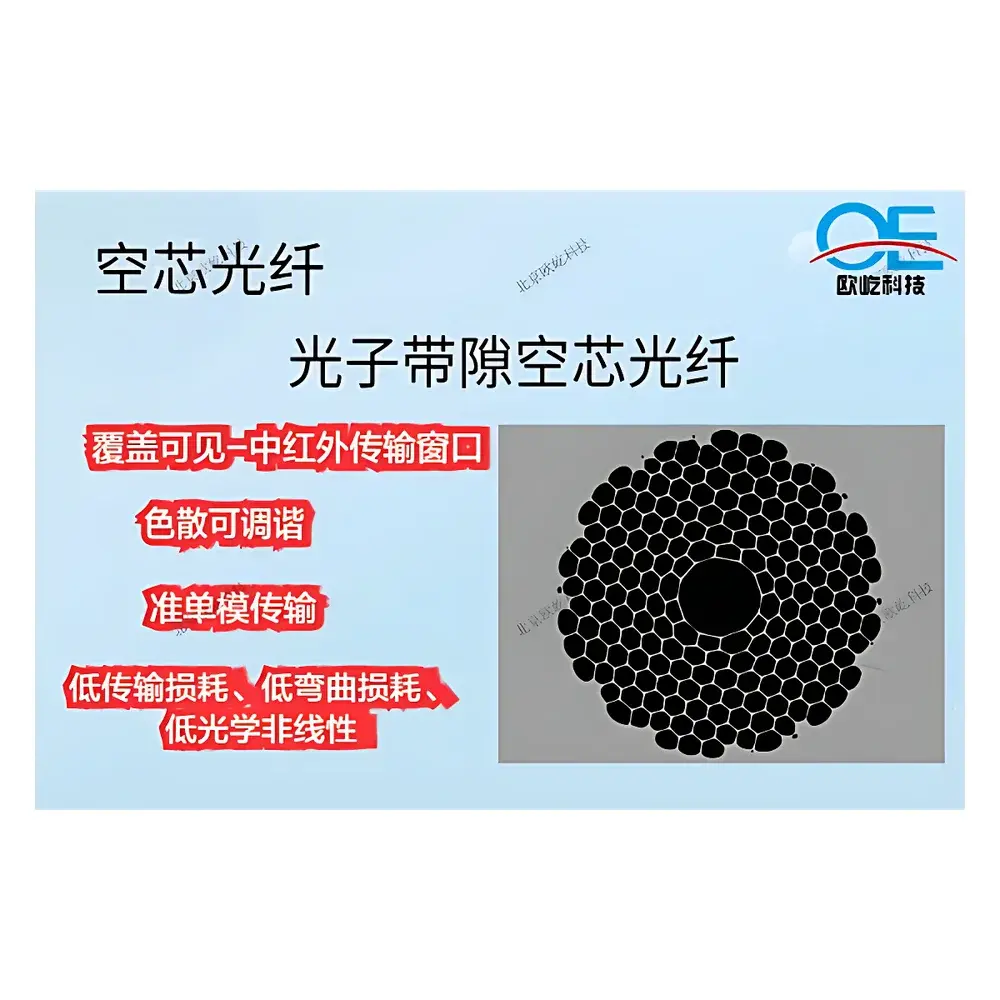
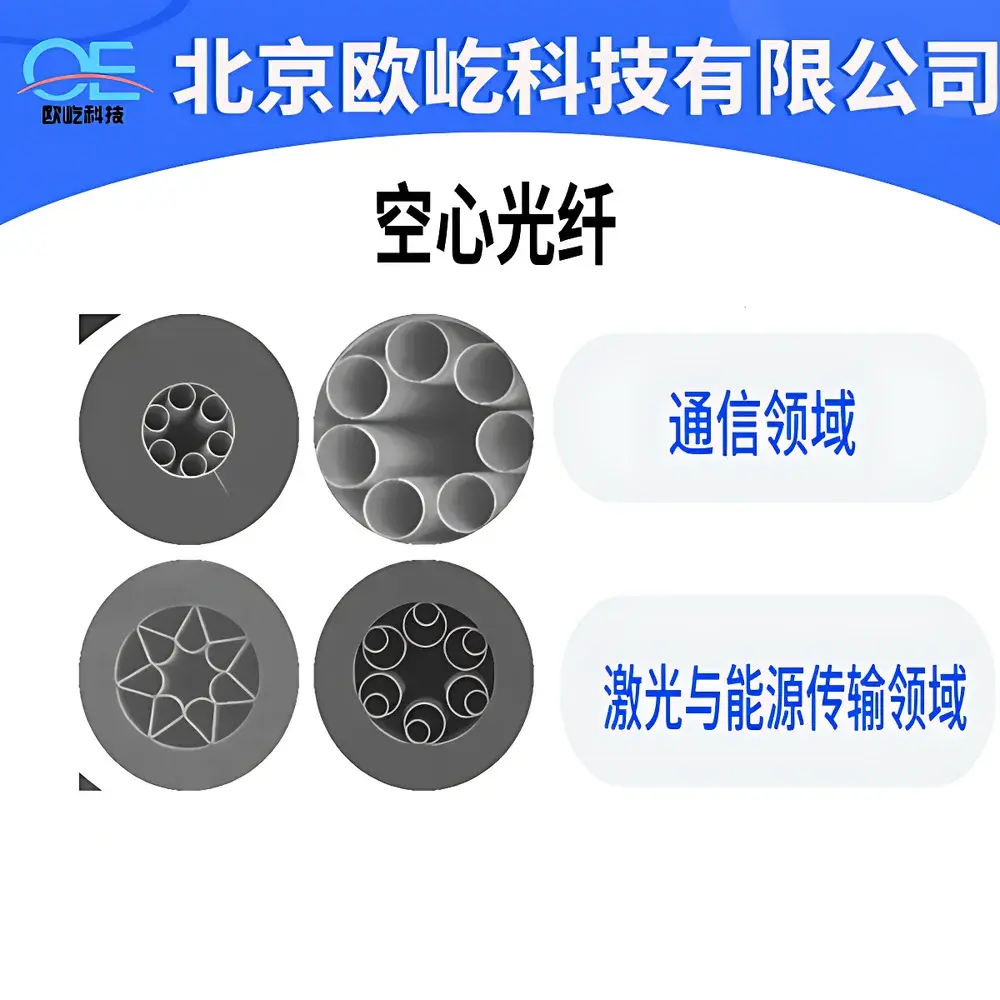
The OETech PM PBG High-Power Hollow-Core Photonic Bandgap Fiber is a polarization-maintaining microstructured optical fiber engineered for ultra-low-loss, high-fidelity light guidance in the C- and L-bands. Unlike conventional solid-core fibers, this fiber confines light within a hollow central core via photonic bandgap guidance—a principle rooted in Bragg-like interference from a periodic two-dimensional air-hole lattice in the cladding. This architecture fundamentally suppresses nonlinear optical effects (e.g., SPM, XPM, FWM), mitigates thermal lensing, and eliminates material absorption and Rayleigh scattering limitations inherent to silica. As a result, it delivers exceptional power handling (>1 kW peak, >100 W CW with appropriate termination), sub-10 ppm polarization extinction ratio stability over time, and intrinsic immunity to radiation-induced darkening—making it suitable for demanding applications in inertial sensing, high-power laser delivery, and quantum photonics infrastructure.
Key Features
- Polarization-maintaining design with stress-applying elements integrated into the photonic crystal cladding structure, ensuring stable birefringence (B ≈ 1.2 × 10⁻⁴) across the operational bandwidth.
- Hollow-core guidance enabling attenuation as low as 0.011 dB/m at 1570 nm—among the lowest reported for guided-mode hollow-core fibers operating near 1550 nm.
- Negligible nonlinear coefficient (99.5% optical power confinement in air, minimizing spectral broadening and phase distortion under high peak power.
- Engineered dispersion profile with near-zero group velocity dispersion (GVD) tunability between +20 and −40 ps/(nm·km) across 1450–1610 nm via geometric parameter optimization.
- Robust mechanical architecture: pure fused silica construction with single-acrylate coating (360 µm OD), proof-tested to 100 kpsi, compatible with standard fiber processing (cleaving, splicing with optimized arc parameters, connectorization).
Sample Compatibility & Compliance
The PM PBG fiber is fully compatible with industry-standard single-mode fiber interfaces (e.g., FC/APC, SC/APC) when spliced using fusion splicers equipped with hollow-core alignment routines and low-energy discharge profiles. It meets IEC 60793-2-50 (category B1.3) dimensional tolerances and complies with Telcordia GR-1209-CORE and GR-1221-CORE for reliability under thermal cycling (−40 °C to +85 °C), humidity (85% RH, 1000 h), and mechanical flexure (10 mm bend radius, 10⁶ cycles). Its radiation hardness has been validated per MIL-STD-883H Method 1019.8 (10⁶ rad(Si) total ionizing dose), supporting deployment in aerospace-grade fiber optic gyroscopes (FOGs) requiring long-term bias stability (<0.001 °/h Allan deviation at 100 s).
Software & Data Management
While the fiber itself is a passive component, its integration into active systems benefits from standardized characterization workflows supported by OETech’s Optical Fiber Test Suite (OFTS v3.2)—a vendor-agnostic MATLAB-based toolkit compliant with IEEE 1455.2 for polarization-dependent loss (PDL) mapping, chromatic dispersion profiling, and mode field diameter (MFD) calibration. All test reports generated include audit trails conforming to FDA 21 CFR Part 11 requirements for electronic records and signatures, enabling traceable qualification for GMP-regulated photonic assembly lines.
Applications
- Fiber optic gyroscopes (FOGs): Enables longer coil lengths (>5 km) without signal degradation, directly improving scale factor stability and reducing angle random walk (ARW) below 0.0005 °/√h.
- High-power fiber laser beam delivery: Used in industrial cutting/welding systems operating at 1550 nm or frequency-doubled outputs, where nonlinear threshold margins exceed those of solid-core alternatives by >3×.
- Mid-infrared spectroscopy pump-probe setups: Supports broadband supercontinuum generation with reduced coherence collapse when pumped with femtosecond Er:fiber lasers.
- Quantum communication testbeds: Provides low-decoherence transmission channels for time-bin qubits and heralded single-photon sources due to suppressed Raman noise and timing jitter.
FAQ
What is the recommended splice loss for PM PBG fiber when fusion-spliced to SMF-28?
Typical splice loss is 0.12–0.18 dB with optimized core-alignment splicing; polarization extinction ratio post-splice remains >22 dB over 1520–1600 nm.
Can this fiber be used in free-space coupling configurations?
Yes—its large mode field diameter (~16 µm at 1550 nm) and low NA (~0.07) enable efficient coupling with standard aspheric lenses (f = 8 mm, NA = 0.5); coupling efficiency exceeds 85% with active alignment.
Is the fiber compatible with standard UV-curable epoxy connectors?
Yes, provided epoxy outgassing is controlled (e.g., Norland NOA61, <10⁻⁶ g/g mass loss at 125 °C); acrylate coating compatibility is confirmed per IPC-CC-830B Class 2.
Does OETech provide cut-and-test certification for each fiber reel?
Yes—each shipment includes a full spectral attenuation scan (1450–1610 nm), PDL sweep, and proof-test log, traceable to NIM (National Institute of Metrology, China) calibrated reference standards.



