
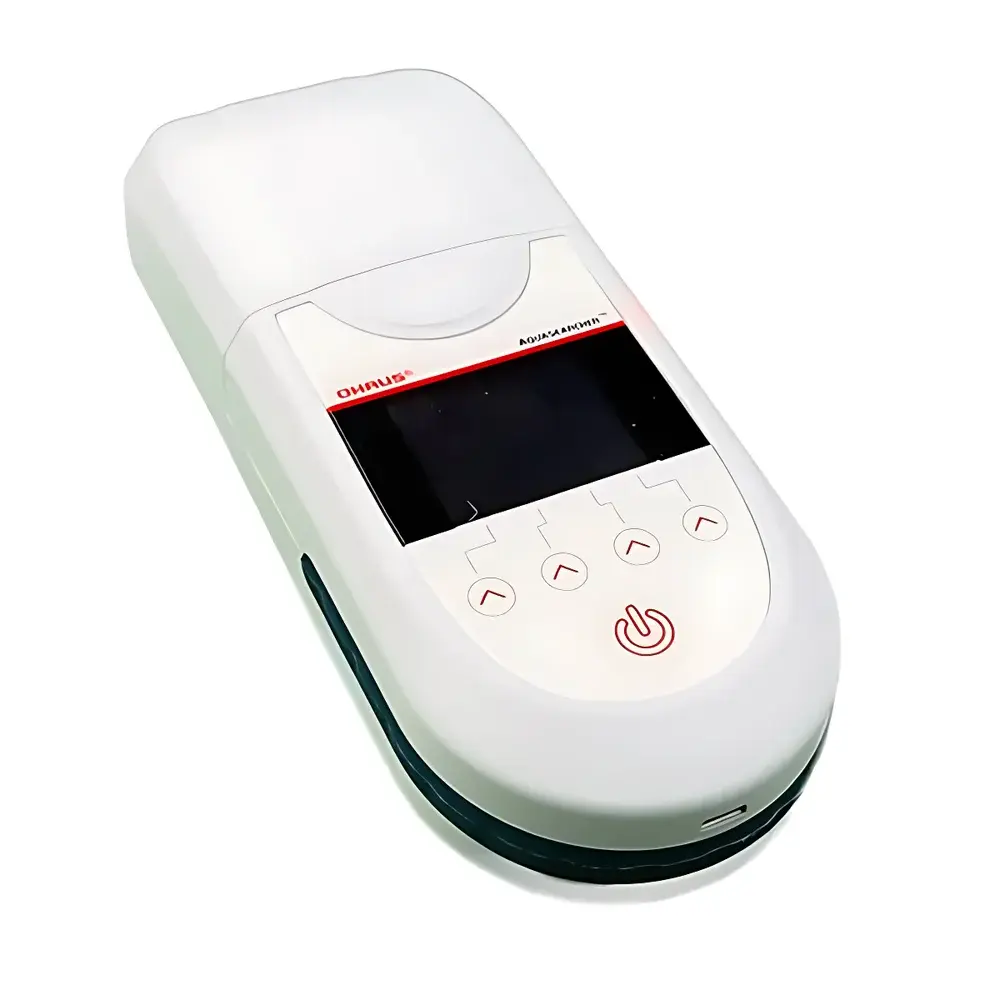
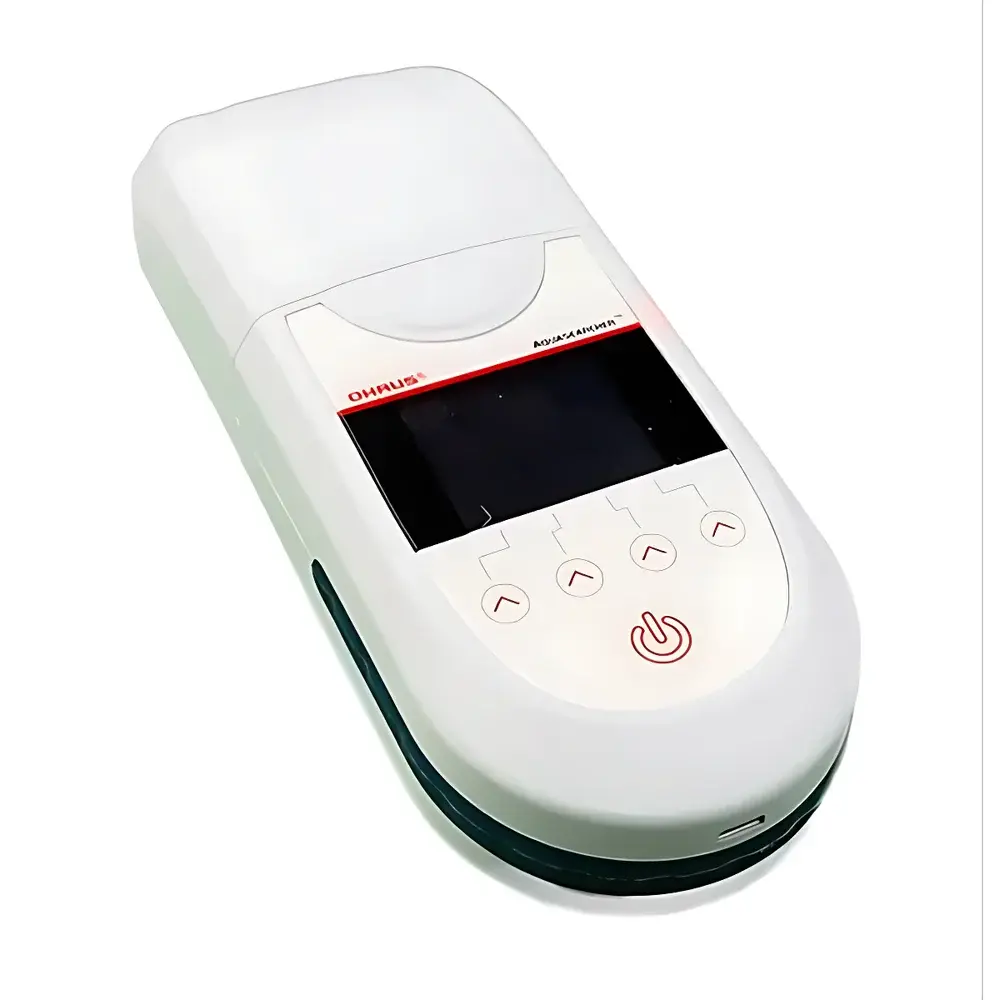
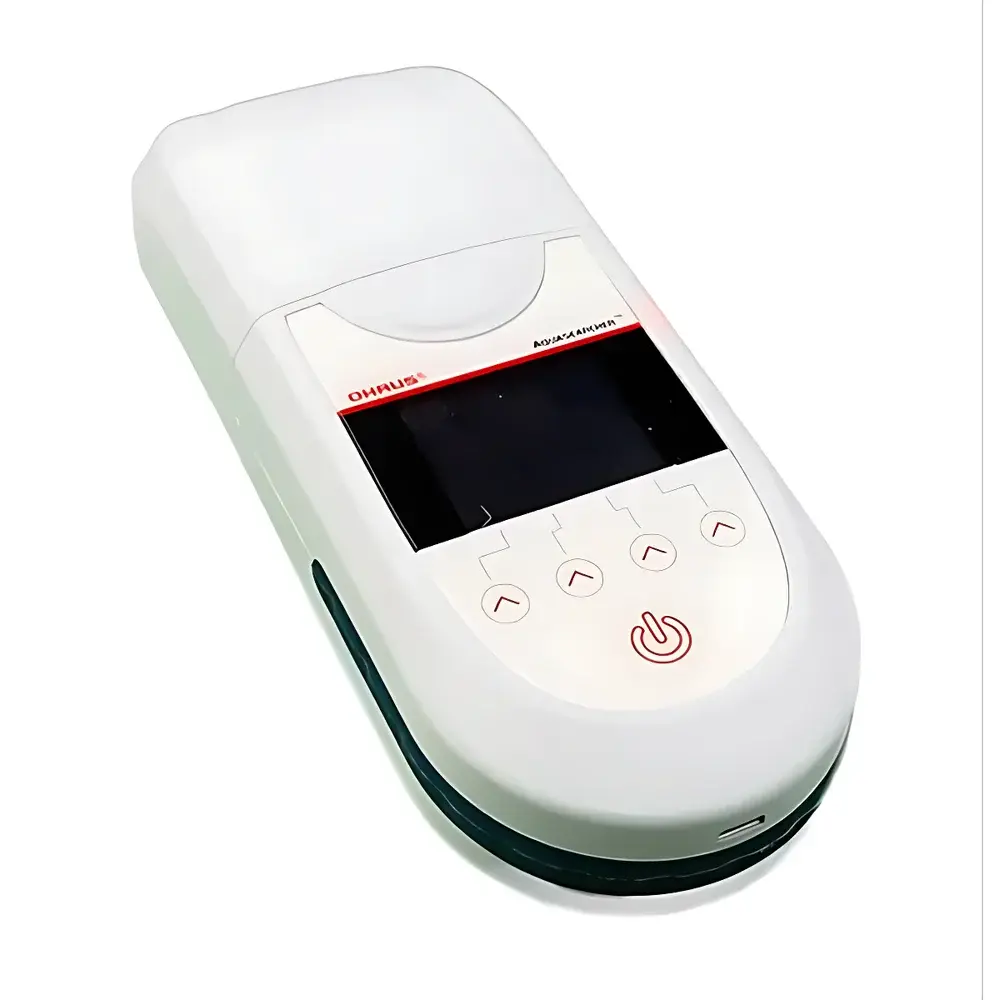
OHAUS AP30 Portable Turbidimeter
| Brand | OHAUS |
|---|---|
| Origin | Shanghai, China |
| Product Type | Portable |
| Model | AP30 |
| Measurement Range | 0–1000 NTU |
| Compliance | ISO 7027 |
| Detection Principle | Dual-optical-path nephelometry with integrated transmission compensation |
| Light Source | Near-infrared LED (850 nm) |
| Display | Full-color high-brightness LCD |
| Data Storage | Up to 5,000 measurements with timestamp |
| Interface | USB Type-A for data export |
| Power Supply | Rechargeable Li-ion battery (≥10 hours continuous operation) |
| Enclosure Rating | IP67 dust- and water-resistant housing |
Overview
The OHAUS AP30 Portable Turbidimeter is an engineered field-deployable instrument designed for reliable, on-site turbidity quantification in accordance with ISO 7027:2016. It employs a dual-optical-path measurement architecture—simultaneously detecting 90° scattered light (nephelometric mode) and forward-transmitted light—to compensate for color interference and suspended particle absorption effects. This dual-signal acquisition strategy ensures metrological robustness across heterogeneous samples, including colored effluents, surface waters, and process streams where chromaticity would otherwise bias conventional single-detector turbidimeters. The near-infrared (850 nm) light source minimizes spectral interference from natural organic matter and dye-based contaminants, enhancing measurement fidelity in real-world environmental and industrial applications.
Key Features
- Dual-detector optical system with automatic range switching across 0–1000 NTU, eliminating manual gain adjustment and reducing operator-induced variability.
- Integrated factory calibration traceable to NIST-traceable formazin standards; user-accessible verification and recalibration routines via built-in calibration check mode.
- Full-color, sunlight-readable LCD display with intuitive icon-driven interface and multilingual on-screen prompts—designed for zero-training deployment by field technicians or QA personnel.
- Rugged IP67-rated enclosure with shock-absorbing rubber overmold, enabling operation in humid, dusty, or intermittently wet environments typical of wastewater plants, food processing facilities, and remote monitoring sites.
- Onboard rechargeable lithium-ion battery supporting ≥10 hours of continuous measurement cycles, with USB-C charging and battery-level indicator.
Sample Compatibility & Compliance
The AP30 accommodates standard 25 mm round glass vials (10 mL volume) and accepts optional adapter sleeves for alternative cuvette geometries. Its optical design mitigates errors induced by sample color, small-particle scattering anisotropy, and low-conductivity matrix effects—making it suitable for drinking water compliance checks (per EPA Method 180.1 and ISO 7027), pre- and post-filtration validation in pharmaceutical water systems, and routine turbidity screening in HVAC cooling tower management. Instrument firmware supports audit-ready data logging compliant with GLP and GMP documentation requirements, including immutable timestamps, operator ID fields (via optional alphanumeric input), and tamper-evident storage architecture.
Software & Data Management
Measurement records—including NTU value, date/time stamp, calibration status flag, and vial identification code—are stored in non-volatile memory with cyclic overwrite protection. Export is performed via standard USB mass-storage protocol: no proprietary drivers required. Data files are generated in CSV format with UTF-8 encoding, compatible with LIMS integration, Excel-based trending, and statistical process control (SPC) software. Firmware updates are delivered through signed binary packages verified via SHA-256 checksums, ensuring integrity during field maintenance.
Applications
- Drinking water distribution network monitoring (source-to-tap turbidity profiling)
- Wastewater treatment plant effluent verification prior to discharge reporting
- In-process quality control in beverage bottling lines and dairy pasteurization units
- Environmental field surveys assessing sediment resuspension in rivers and reservoirs
- Pharmaceutical purified water (PW) and water-for-injection (WFI) system validation per USP and EU Annex 1
FAQ
Does the AP30 require annual recalibration by an accredited lab?
No—field recalibration using certified formazin or AMCO AEPA standards is supported per ISO 7027 Annex B. However, periodic verification against traceable reference standards is recommended every 6 months for regulated environments.
Can the AP30 measure samples with high dissolved color, such as tea or fruit juice extracts?
Yes—the dual-optical-path compensation algorithm corrects for absorbance-related signal attenuation, delivering stable NTU readings even in strongly colored matrices where single-beam instruments exhibit significant negative bias.
Is the USB data export function compatible with macOS and Linux systems?
Yes—CSV export uses standard USB Mass Storage Class (MSC) protocol; no OS-specific drivers are needed.
What is the minimum detectable turbidity level under optimal conditions?
The instrument achieves a practical detection limit of ≤0.5 NTU at the 0–10 NTU sub-range, validated using StablCal™ primary standards and confirmed per ISO 7027 repeatability criteria (RSD ≤2% at 1 NTU).
Does the AP30 support GLP-compliant electronic signatures?
While it does not implement full 21 CFR Part 11 electronic signature workflows, its audit trail includes immutable metadata (timestamp, calibration state, operator-assigned ID) sufficient for internal GLP audits and ISO/IEC 17025 laboratory assessments.







