
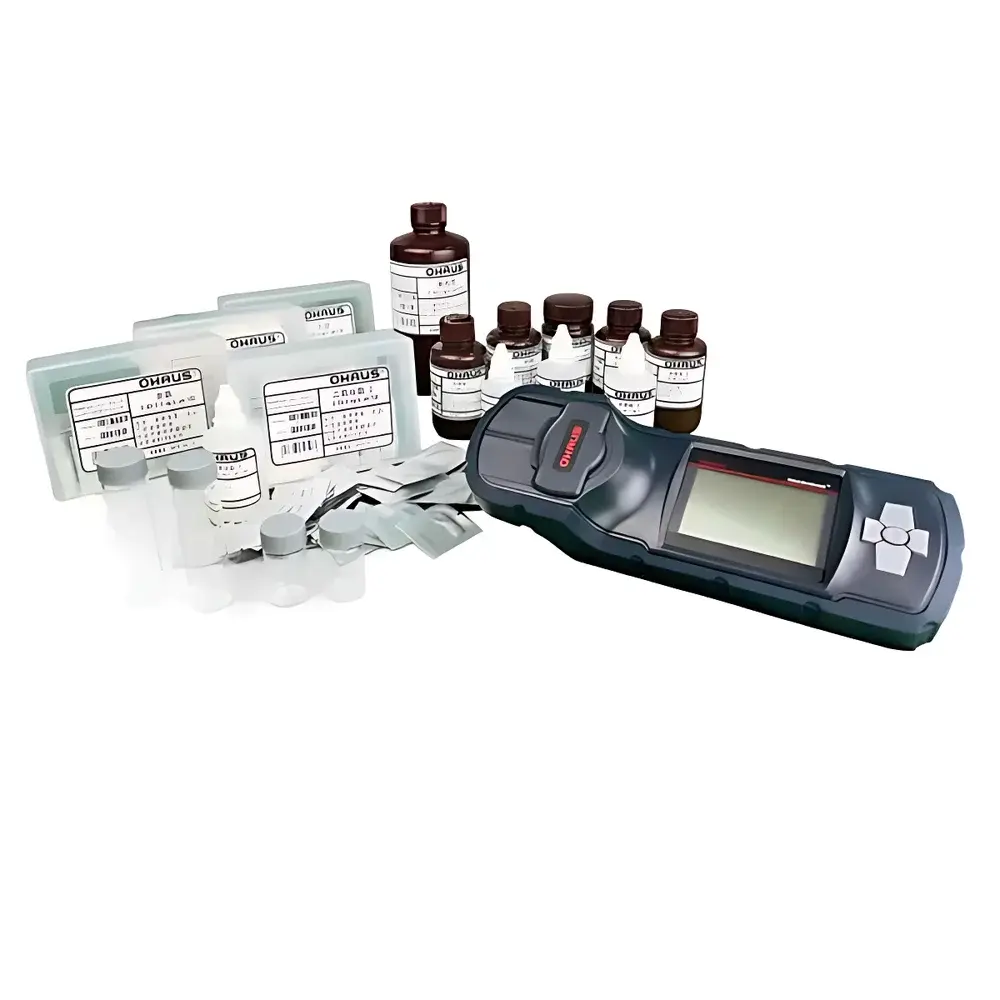
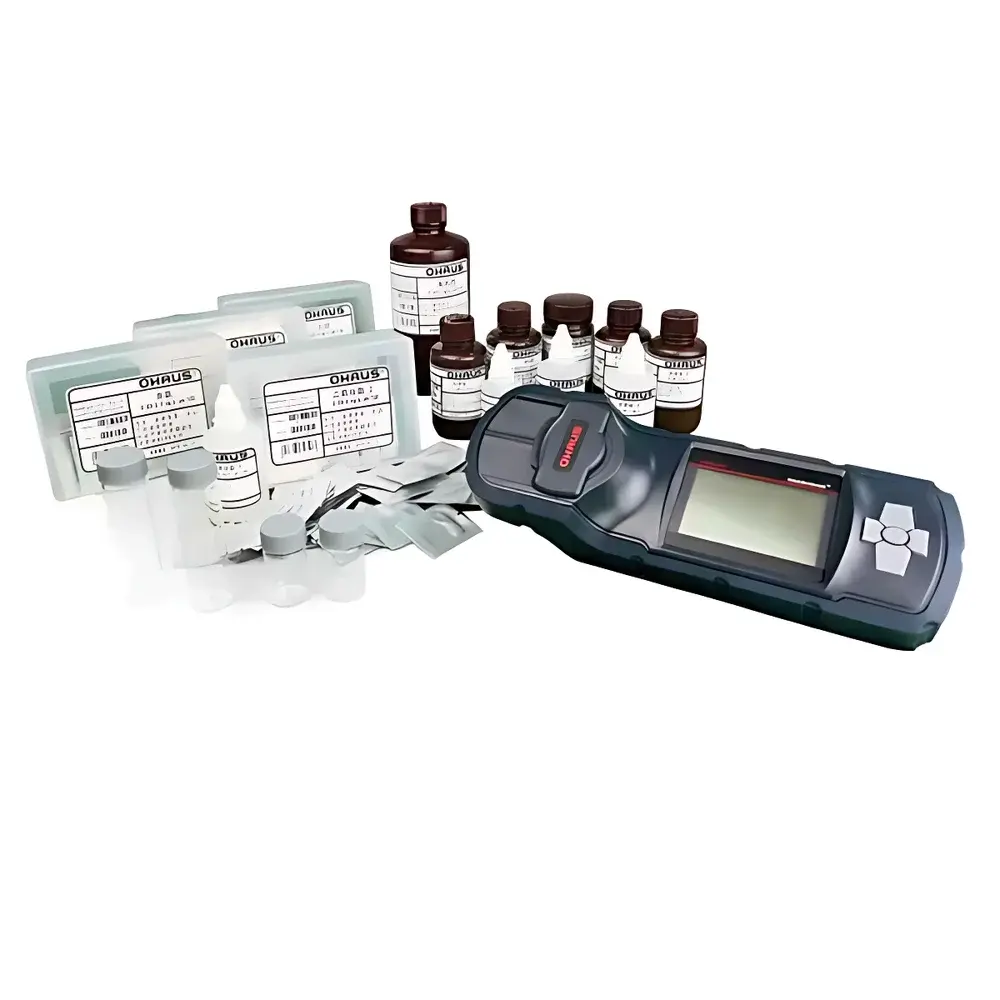
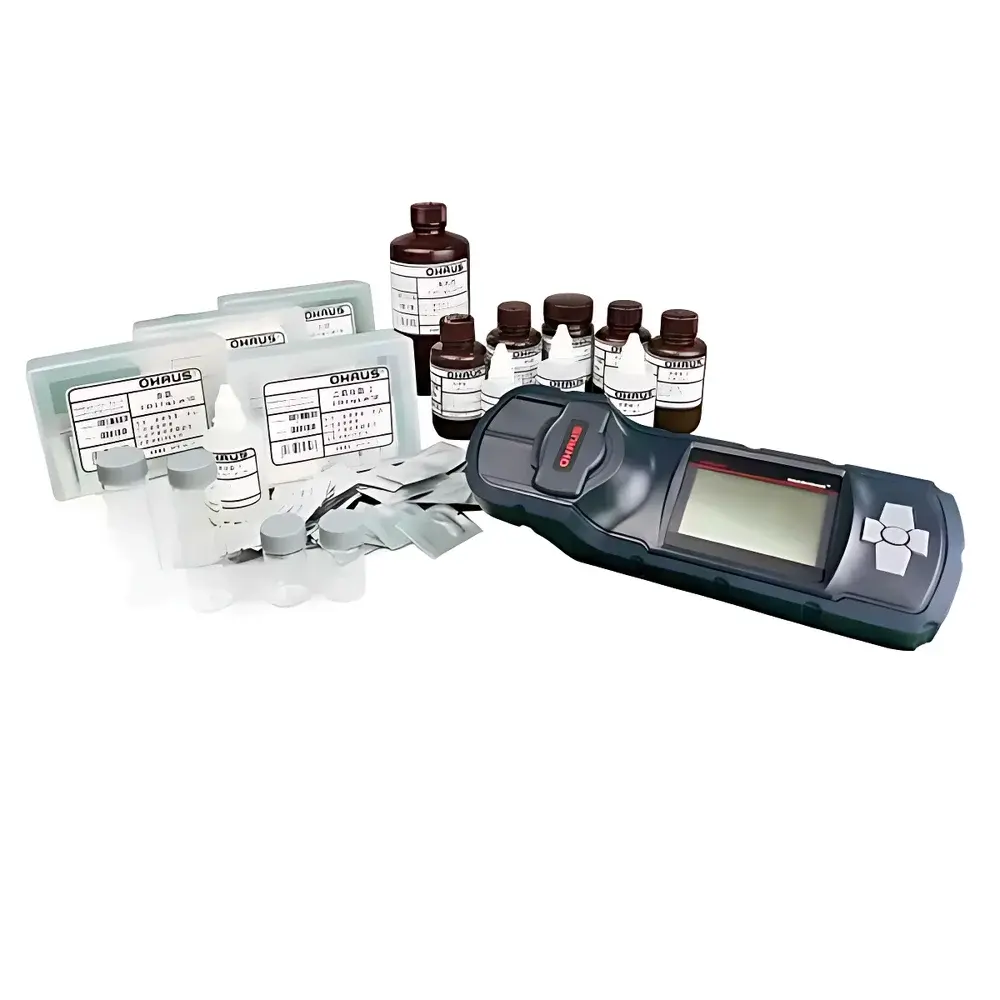
OHAUS AP50MM Portable Multi-Parameter Colorimeter & Turbidimeter
| Brand | OHAUS |
|---|---|
| Model | AP50MM |
| Measurement Principle | Nephelometric Turbidity (90° Scattered Light) & Absorbance-Based Colorimetry |
| Wavelengths | 7 Fixed LED Sources (420, 470, 520, 560, 610, 660, 850 nm) |
| Display | 160 × 240 Pixel Backlit LCD, Sunlight-Readable |
| Data Storage | 30,000 Measurements with Timestamp (Date/Time) |
| Power Supply | 4 × AA Alkaline Batteries (≈200 hrs continuous use) |
| Compliance | ISO 7027 (Turbidity), ISO 6226 / EPA 180.1 (Colorimetric Methods), GLP-Compliant Audit Trail |
| Enclosure Rating | IP67 (Dustproof & Waterproof to 1 m for 30 min) |
| Dimensions | 210 × 105 × 55 mm |
| Weight | 480 g (with batteries) |
Overview
The OHAUS AP50MM Portable Multi-Parameter Colorimeter & Turbidimeter is an integrated field-deployable optical analyzer engineered for simultaneous quantitative assessment of turbidity and colorimetric analytes in aqueous matrices. It operates on two distinct photometric principles: nephelometric turbidity measurement per ISO 7027 using a 90° scattered light detection geometry with an 850 nm infrared LED source to minimize interferences from sample coloration; and absorbance-based colorimetry across seven discrete, factory-aligned LED wavelengths (420–850 nm) optimized for common water quality parameters including nitrate, phosphate, iron, chlorine, COD, ammonia, and total hardness. Its dual-mode optical architecture eliminates the need for external calibration standards during routine operation—each method leverages pre-programmed, NIST-traceable calibration curves stored in non-volatile memory. Designed for rugged field use, the instrument features a sealed IP67-rated housing, sunlight-readable monochrome LCD, and low-power electronics enabling >200 hours of continuous operation on standard alkaline cells.
Key Features
- Seven independently controlled LED light sources with narrow-band spectral output (FWHM < 15 nm), each matched to absorption maxima of key water quality indicators
- Integrated dual-detector system: silicon photodiode for turbidity (90° scatter), and precision photodiode with temperature-compensated analog front-end for absorbance measurements
- Preloaded library of 50+ validated analytical methods compliant with ISO, EPA, and ASTM standard test procedures—including Method 2130B (turbidity), Method 4500-Cl G (free chlorine), and Method 4500-P E (orthophosphate)
- GLP-compliant data management: automatic timestamping (RTC), user ID assignment, measurement metadata logging (lot number, reagent expiry, calibration status), and encrypted internal storage for 30,000 records
- Ergonomic single-hand operation with tactile keypad, integrated carry handle, and drop-tested polycarbonate chassis rated to 1.2 m height
- Auto-wavelength selection logic: instrument identifies optimal LED channel based on selected parameter and automatically engages corresponding optical path and calibration curve
Sample Compatibility & Compliance
The AP50MM accepts standard 13 mm, 16 mm, and 25 mm round glass or plastic cuvettes (including Hach, Thermo Fisher, and Merck formats) via its spring-loaded universal adapter. Sample volume requirements range from 5 mL (for high-sensitivity assays) to 25 mL (for turbidity validation per ISO 7027). All onboard methods adhere to regulatory frameworks governing environmental monitoring and drinking water safety: turbidity measurements meet ISO 7027 Class 1 performance criteria (repeatability ≤ ±0.5 NTU at 100 NTU); colorimetric assays satisfy EPA Method equivalency requirements for wastewater discharge reporting (40 CFR Part 136). The firmware supports 21 CFR Part 11-compliant electronic signatures when paired with OHAUS LabLink Pro software (sold separately), enabling audit-ready data export in CSV and PDF formats with full chain-of-custody metadata.
Software & Data Management
Data retrieval and instrument configuration are managed via OHAUS LabLink Pro PC software (Windows/macOS), which provides secure USB-C or Bluetooth 5.0 connectivity. The software enables batch export of measurement histories with embedded calibration logs, generation of customizable compliance reports (e.g., daily QA/QC summaries per ISO/IEC 17025), and remote firmware updates. All stored entries include immutable fields: measurement ID, parameter name, numeric result, unit, operator ID, location tag (manually entered), ambient temperature, battery voltage, and real-time clock stamp. Internal memory employs wear-leveling flash technology with cyclic redundancy check (CRC-32) validation to prevent data corruption under thermal or mechanical stress.
Applications
The AP50MM serves as a primary field instrument across regulated and industrial water management workflows: real-time monitoring of coagulant dosing efficacy in municipal potable water plants; verification of disinfectant residual stability in distribution networks; process control of biological nutrient removal in activated sludge systems; validation of membrane integrity in tertiary filtration; rapid screening of heavy metal leaching in electroplating rinse waters; and routine surveillance of recirculating cooling tower chemistry. Its portability and battery autonomy make it suitable for unattended deployment in remote watershed sampling stations, where GPS-tagged measurements can be synchronized with geographic information systems (GIS) for spatial trend analysis.
FAQ
Does the AP50MM require annual recalibration by an accredited laboratory?
No—factory calibration is stable for 24 months under normal operating conditions. Users perform daily verification using supplied formazin or StablCal standards; full recalibration is only required after physical shock, exposure to condensation, or deviation exceeding ±2% of certified reference material values.
Can custom methods be uploaded to the device?
No—method libraries are fixed at time of manufacture to ensure regulatory traceability. However, users may define custom reporting templates and calculation formulas within LabLink Pro for post-acquisition data transformation.
Is the instrument compatible with third-party reagents?
Yes, provided reagents conform to published reaction stoichiometry and spectral response profiles. OHAUS validates performance only with its own AQ-AP series reagent kits; use of alternate chemistries voids ISO 7027 and EPA method compliance claims.
What is the minimum detectable turbidity level?
The lower limit of quantitation (LLOQ) is 0.05 NTU (standard deviation ≤ 0.01 NTU over 10 replicates) using the 850 nm channel and 10-mm pathlength cuvette.
How does the auto-diagnostic calibration function operate?
Prior to each measurement cycle, the system performs LED intensity self-check, detector dark-current baseline validation, and optical path obstruction detection via reference beam monitoring—flagging anomalies before data acquisition begins.






