
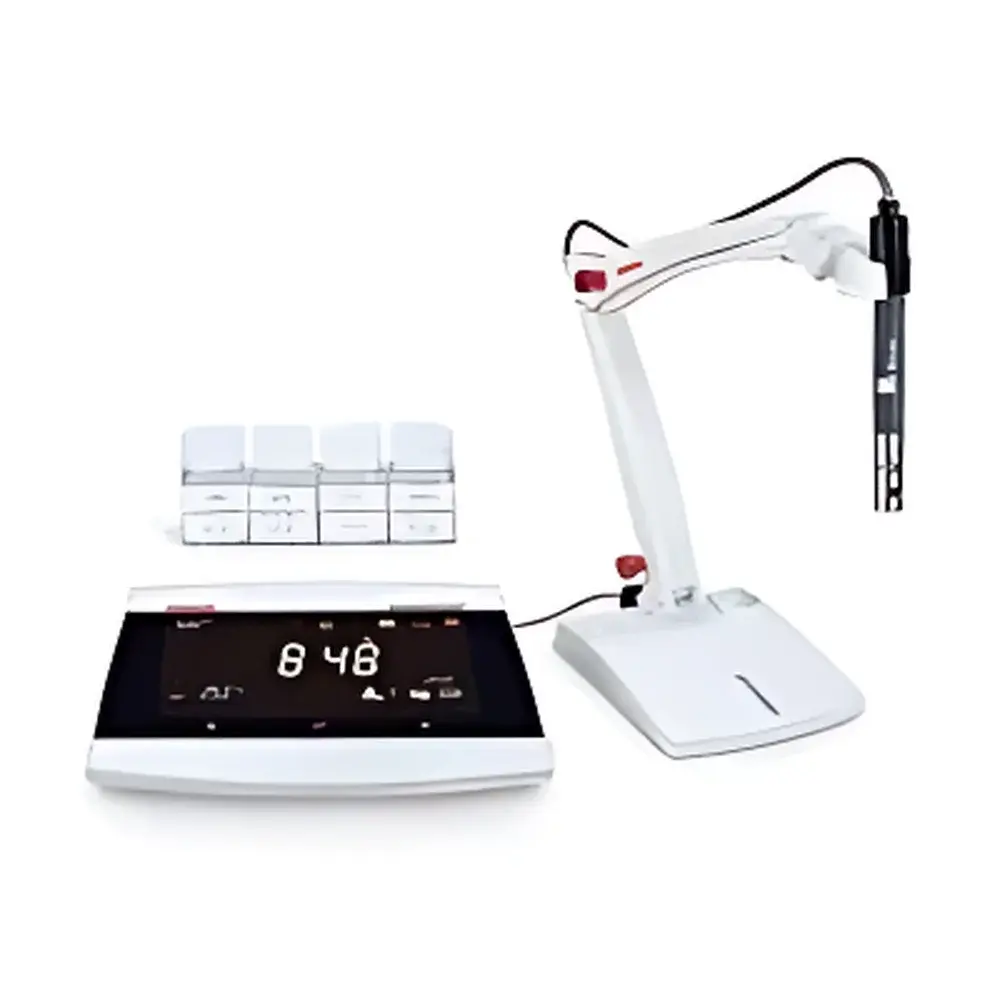
OHAUS AQUASEARCHER™ AB33EC Benchtop Conductivity Meter
| Brand | OHAUS |
|---|---|
| Model | AB33EC-F |
| Type | Benchtop Conductivity/TDS/Salinity/Resistivity/Temperature Meter |
| Origin | Jiangsu, China |
| Manufacturer | OHAUS (China) Co., Ltd. |
| Measurement Parameters | Conductivity (0.001 μS/cm – 1000 mS/cm), TDS (0.01 mg/L min, auto-ranging), Resistivity (1 – 100 MΩ·cm), Salinity (0 – 100 PSU), Temperature (−5.0 to 110.0 °C) |
| Accuracy | ±0.5% of reading ±2 digits |
| Minimum Resolution | 0.001 μS/cm (conductivity), auto-ranging |
| Display | 6.5-inch backlit segmented & dot-matrix LCD with capacitive touch keys |
| Data Storage | 1000 measurement records |
| Calibration Management | i-Steward intelligent calibration monitoring with expiry alert |
| Connectivity | RS232 and USB |
| Power | AC adapter included |
| Operating Environment | 5–40 °C, ≤80% RH (non-condensing) |
| Dimensions (H×L×W) | 51 × 210 × 142 mm |
| Net Weight | 0.5 kg |
| Housing | ABS enclosure with integrated electrode stand |
| Electrode | Not included |
Overview
The OHAUS AQUASEARCHER™ AB33EC Benchtop Conductivity Meter is a multi-parameter electrochemical analyzer engineered for precision and operational consistency in laboratory, quality control, and educational environments. It employs four-electrode or two-electrode conductivity measurement principles—configurable per application—to deliver stable, temperature-compensated readings across an exceptionally wide dynamic range. Its core architecture supports simultaneous acquisition and display of conductivity, total dissolved solids (TDS), salinity (PSU), resistivity, and temperature—each calculated using industry-standard conversion algorithms aligned with ASTM D1125 and ISO 7888. Designed as the latest evolution of the OHAUS STARTER series, the AB33EC integrates i-Steward—a firmware-based calibration integrity system that logs calibration events, tracks electrode performance trends, and issues proactive alerts when calibration validity approaches expiration. This feature directly supports GLP-compliant workflows by enabling traceable, auditable calibration history without external software dependency.
Key Features
- 6.5-inch capacitive touch-enabled LCD with segmented + dot-matrix hybrid display for simultaneous multi-parameter visualization and intuitive navigation
- i-Steward intelligent calibration management: real-time electrode health assessment, automatic calibration due-date tracking, and configurable alert thresholds
- Auto-ranging conductivity measurement from 0.001 μS/cm to 1000 mS/cm with ±0.5% accuracy (±2 digits) and 0.001 μS/cm minimum resolution at lowest range
- Integrated temperature compensation (ATC or manual) using built-in NTC or Pt1000 sensor inputs; temperature range extends from −5.0 to 110.0 °C
- 1000-point internal data storage with timestamp, parameter ID, and operator tag support—exportable via RS232 or USB to LIMS or spreadsheet applications
- Rugged ABS housing with integrated electrode stand and cable management; compact footprint (51 × 210 × 142 mm) optimized for benchtop space efficiency
- Compliance-ready design: supports 21 CFR Part 11–compatible audit trail generation when paired with OHAUS DataBridge software (optional)
Sample Compatibility & Compliance
The AB33EC is validated for aqueous samples across diverse matrices—including ultrapure water, process streams, wastewater effluents, brines, and biological buffers—provided appropriate electrode selection (e.g., stainless steel, graphite, or platinum cell) is applied. Its resistivity range (1–100 MΩ·cm) meets ASTM D5127 requirements for high-purity water monitoring in semiconductor and pharmaceutical manufacturing. The salinity function adheres to PSS-78 (Practical Salinity Scale) conventions, ensuring compatibility with oceanographic and aquaculture standards. All measurement algorithms are traceable to NIST-certified reference solutions. The instrument’s firmware architecture supports IQ/OQ documentation templates and is designed for integration into GMP-regulated environments where calibration traceability, data integrity, and user access control are mandatory.
Software & Data Management
Data export is natively supported through ASCII-formatted RS232 serial output or USB virtual COM port emulation, enabling direct ingestion into Excel, LabArchives, or custom SCADA systems. Optional OHAUS DataBridge software provides enhanced functionality: automated report generation (PDF/CSV), electronic signature capture, calibration certificate printing, and full 21 CFR Part 11 compliance—including role-based user permissions, immutable audit trails, and electronic record retention. All stored measurements include embedded metadata: date/time stamp, measured parameter, temperature value, calibration status flag, and operator ID (if configured). No cloud connectivity or proprietary drivers are required for basic operation.
Applications
- Pharmaceutical water system validation (PW, WFI, purified water) per USP and EP 2.2.38
- Environmental monitoring of surface water, groundwater, and wastewater per EPA Method 120.1 and ISO 17294-2
- Food & beverage QC for brine concentration, syrup density estimation, and cleaning-in-place (CIP) rinse verification
- Academic teaching labs requiring robust, student-proof instrumentation for electrochemistry fundamentals
- Industrial boiler feedwater and cooling tower chemistry management
- Research in marine biology and limnology where field-deployable benchtop stability is critical
FAQ
Does the AB33EC include a conductivity electrode?
No—the AB33EC meter body does not include an electrode. Compatible electrodes (e.g., OHAUS COND-101, COND-201, or COND-301) must be ordered separately based on sample conductivity range and chemical compatibility.
Can the instrument perform automatic temperature compensation (ATC)?
Yes—when used with a temperature-compensated conductivity probe (e.g., integrated ATC sensor), the AB33EC applies linear or non-linear (NaCl or KCl) compensation per user selection. Manual temperature entry is also supported.
Is the data storage capacity expandable?
No—internal memory is fixed at 1000 records. However, continuous streaming via RS232 or scheduled USB exports enables indefinite archival in external systems.
What calibration standards are recommended?
NIST-traceable KCl standard solutions (e.g., 84 μS/cm, 1413 μS/cm, 12.88 mS/cm) are recommended. The i-Steward system validates calibration slope and offset against stored reference values to detect electrode drift or contamination.
Does the AB33EC meet IP rating requirements for wet lab environments?
The unit carries no formal IP rating; however, its sealed ABS enclosure and elevated front-panel layout provide resistance to incidental splashes and routine lab humidity when operated within specified environmental limits (5–40 °C, ≤80% RH non-condensing).





