
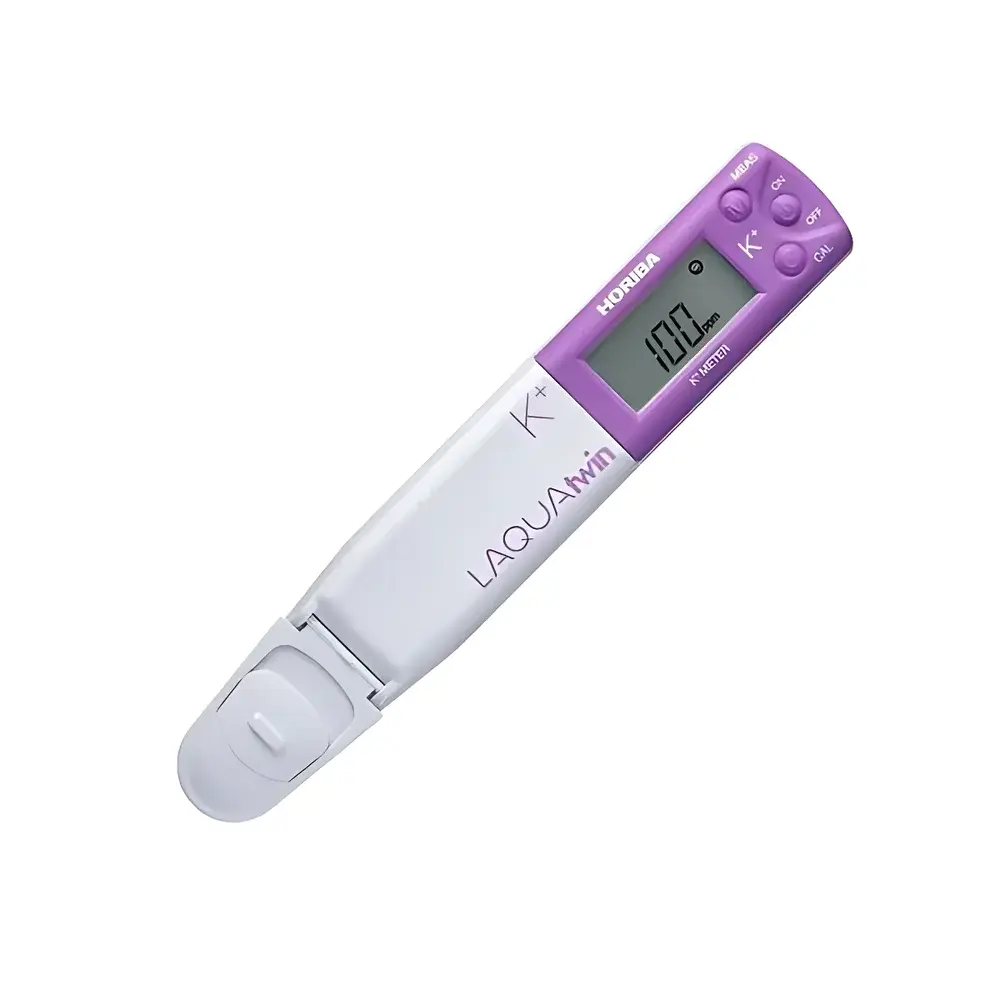
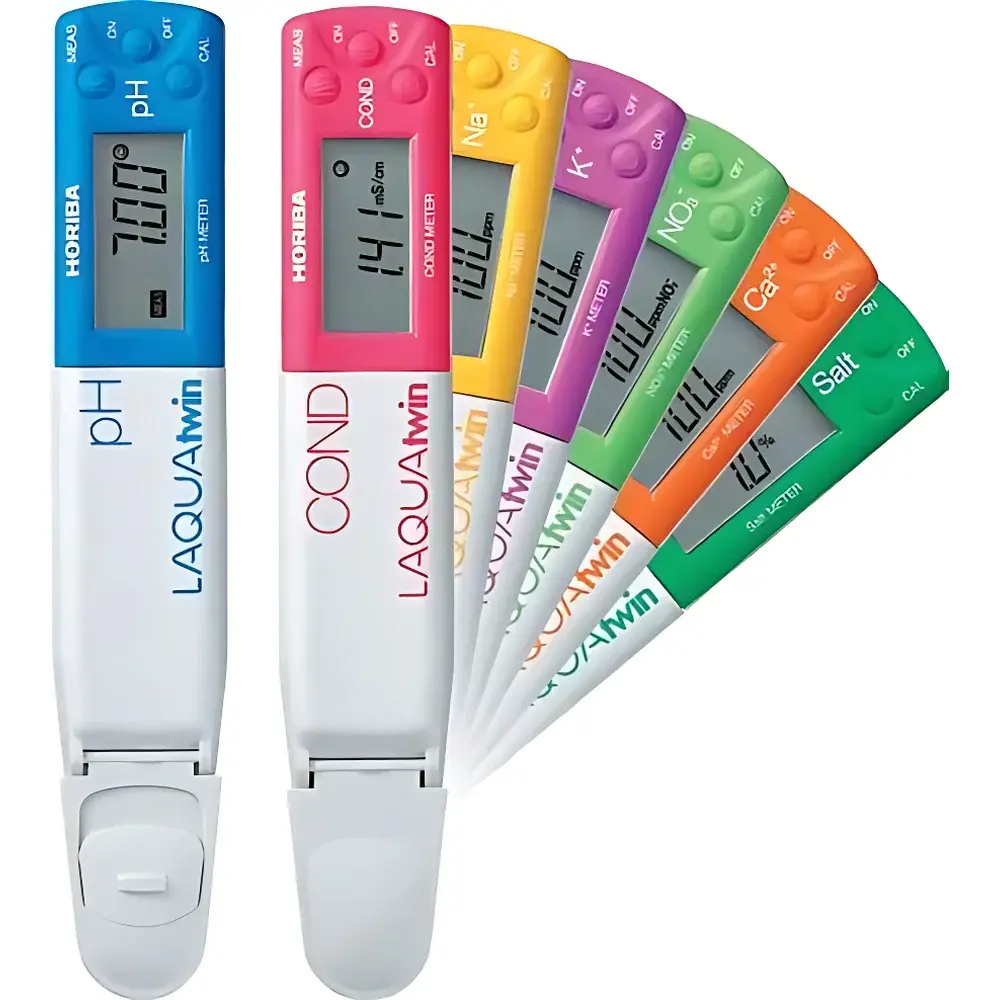
HORIBA LAQUAtwin B-731 Potassium (K⁺) Ion Meter
| Brand | HORIBA |
|---|---|
| Origin | Japan |
| Model | B-731 |
| Instrument Type | Portable Ion Meter |
| Measurement Range | 39–3900 ppm (mg/L) |
| Accuracy | ±10% of reading |
| Operating Temperature | 5–40°C, ≤85% RH (non-condensing) |
| IP Rating | IP67 |
| Sensor Principle | Solid-State Ion-Selective Electrode (ISE) |
| Minimum Sample Volume | 0.05 mL (with Sampling Sheet B) |
| Display | Custom monochrome LCD with auto-hold and smiley indicator |
| Power | 2×CR2032 batteries (~400 hours lifetime) |
| Dimensions | 164 × 29 × 20 mm |
| Weight | ~50 g (instrument only) |
Overview
The HORIBA LAQUAtwin B-731 Potassium (K⁺) Ion Meter is a compact, field-deployable ion-selective electrode (ISE)-based instrument engineered for rapid, on-site quantification of potassium concentration in aqueous and semi-solid matrices. Unlike conventional benchtop ISE systems requiring bulky reference electrodes and complex calibration protocols, the B-731 integrates a miniaturized, flat-panel solid-state K⁺-selective sensor chip—less than 1 mm thick—within a fully sealed, handheld housing. Its operational principle relies on the Nernstian response of a membrane-based ion-selective transducer to K⁺ activity, with built-in temperature compensation (5–40°C) and automatic range switching to maintain signal linearity across four decades of concentration (39–3900 mg/L). Designed for environmental monitoring, agricultural soil testing, food quality control, and aquaculture management, the B-731 delivers laboratory-grade electrochemical measurement fidelity without infrastructure dependency.
Key Features
- IP67-rated enclosure: Fully dust-tight and submersible up to 1 m for 30 minutes—enabling reliable use in humid field conditions, rain exposure, or rinse-cleaning without sensor degradation.
- Multi-mode sampling flexibility: Supports six validated sample introduction methods—drop dispensing (0.1 mL), micro-sampling with Sheet B (0.05 mL), immersion (beaker/bucket), scooping (river water), wipe analysis (skin/surface residues), direct solid placement (food, soil paste), and powder reconstitution (add pure water to dry samples).
- Intuitive user interface: Monochrome LCD displays real-time readings with auto-hold activation; a smiley icon confirms stable potential equilibrium, eliminating subjective endpoint judgment.
- Two-point calibration workflow: Uses supplied high/low K⁺ standard solutions (14 mL each); supports multiplicative correction factors (0.01–9.90) or additive offsets (−1000 to +1000) for matrix-matched calibration in complex media such as soil extracts (1:5 w/v ratio).
- Integrated environmental compensation: Automatic temperature compensation (ATC) referenced to built-in thermistor ensures consistent mV-to-concentration conversion across the full operating range (5–40°C, ≤85% RH, non-condensing).
- Low-power architecture: Dual CR2032 coin cells provide approximately 400 hours of continuous operation; auto-shutdown after 15 minutes of inactivity conserves battery life without compromising readiness.
Sample Compatibility & Compliance
The B-731 is validated for direct measurement in liquid samples (e.g., irrigation water, nutrient solutions, beverage extracts), semi-solids (e.g., homogenized fruit tissue, soil slurry at 1:5 dilution), and dry powders (e.g., fertilizer blends, feed supplements) following standardized reconstitution. Its solid-state sensor exhibits minimal interference from common cations (Na⁺, Ca²⁺, Mg²⁺) within typical environmental and agri-food matrices, per HORIBA’s published selectivity coefficients (log KK,Na ≈ −2.1). While not certified to ISO/IEC 17025 or ASTM D1293 for regulatory reporting, the instrument meets functional requirements for GLP-aligned field screening, internal QC verification, and trend monitoring where traceability to NIST-traceable K⁺ standards is maintained via documented calibration logs. Its design adheres to IEC 60529 (IP67) and RoHS Directive 2011/65/EU compliance criteria.
Software & Data Management
The B-731 operates as a standalone meter with no Bluetooth, USB, or PC connectivity—intentionally omitting digital interfaces to maximize ruggedness, simplify validation, and eliminate cybersecurity or firmware update dependencies. All measurement data remain on-device only; users manually record results alongside contextual metadata (sample ID, time, location, calibration status) in field notebooks or LIMS-compatible spreadsheets. The included quick guide and instruction manual detail Good Laboratory Practice (GLP)-aligned documentation procedures, including mandatory recording of calibration dates, standard lot numbers, and observed smiley stabilization time. For audit readiness, laboratories may implement supplementary paper-based or electronic logbooks that capture instrument ID, battery status, and environmental conditions per ISO/IEC 17025 clause 7.7.
Applications
- Environmental water monitoring: Rapid assessment of K⁺ in surface water, groundwater, and wastewater effluents to evaluate nutrient loading and support Total Maximum Daily Load (TMDL) modeling.
- Agricultural soil testing: Quantification of exchangeable K⁺ in 1:5 soil:water extracts for fertility evaluation and fertilizer recommendation alignment with FAO guidelines.
- Food & beverage QA/QC: Verification of potassium content in juices, dairy products, processed meats, and dietary supplements—supporting label claim accuracy per FDA 21 CFR Part 101.9.
- Aquaculture & hydroponics: Real-time monitoring of K⁺ in recirculating aquaculture systems (RAS) and nutrient film technique (NFT) solutions to prevent deficiency or toxicity in sensitive crops and finfish.
- Health & wellness screening: Semi-quantitative analysis of K⁺ in sweat, oral rinses, or urine spot samples for nutritional status triage in field clinics or sports medicine settings.
FAQ
Does the B-731 require a separate reference electrode?
No—the integrated solid-state sensor combines both ion-selective membrane and pseudo-reference elements into a single planar chip, eliminating external reference junctions and associated maintenance.
Can it measure potassium in undiluted soil?
No—soil must be extracted at a defined ratio (typically 1:5 w/v with deionized water) and filtered prior to measurement; direct solid contact is only valid for moist pastes or homogenates.
What is the shelf life of the included K⁺ standard solutions?
Unopened, the 14 mL high/low standards retain stability for 12 months when stored at 15–25°C; discard if turbidity or precipitate forms.
Is sensor replacement possible?
Yes—the sensor module is a field-replaceable unit (HORIBA P/N: 9501-20B); replacement requires recalibration but no tooling or service technician.
How does temperature affect accuracy outside the 5–40°C range?
Operation below 5°C or above 40°C may cause drift exceeding ±10% due to altered membrane potential kinetics and electrolyte viscosity; measurements are not specified or validated beyond this envelope.
Related Products







