
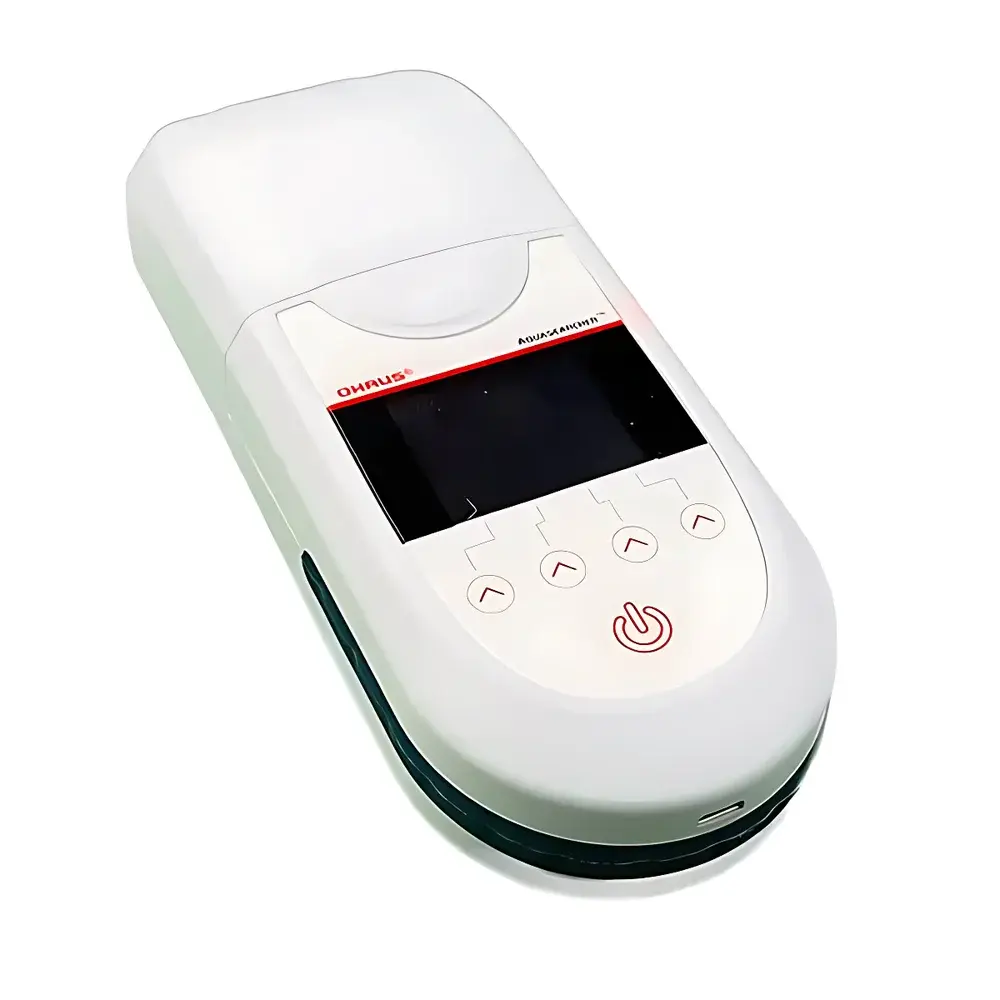
OHAUS Aquasearcher™ AP30 Series Portable Turbidimeter
| Brand | OHAUS |
|---|---|
| Origin | Jiangsu, China |
| Manufacturer Type | Manufacturer |
| Product Origin | Domestic (China) |
| Model | AP30 Series Portable Turbidimeter |
| Measurement Range | 0–1000 NTU |
| Detection Principle | Nephelometric (90° scattered light) and Absorptiometric (transmitted light) dual-mode |
| Compliance | ISO 7027:2016 |
| Display | Full-color high-brightness LCD with guided text interface |
| Data Storage | Up to 5,000 measurement records with automatic timestamping |
| Connectivity | USB port for data export |
| Calibration | Factory-calibrated with user-accessible zero and span calibration points |
| Power | Rechargeable Li-ion battery (≥12 hours continuous operation) |
Overview
The OHAUS Aquasearcher™ AP30 Series Portable Turbidimeter is an engineered solution for field- and lab-based turbidity quantification in water quality monitoring, environmental assessment, wastewater treatment, and process control applications. It operates on the dual-detection principle defined in ISO 7027:2016—simultaneously measuring 90° scattered light (nephelometry) and transmitted light (absorptiometry) using a stable near-infrared (NIR) LED source (850 nm). This dual-path architecture mitigates optical interference from sample coloration, dissolved organic matter, or particulate absorption—common sources of bias in single-detector turbidimeters—thereby enhancing measurement fidelity across heterogeneous aqueous matrices. Designed for operational robustness, the AP30 series integrates optical path stabilization, temperature-compensated photodetectors, and internal reference normalization to ensure reproducibility within ±2% of reading over its full 0–1000 NTU range.
Key Features
- Dual-optical-path detection system: Independent nephelometric and absorptiometric channels with synchronized signal acquisition and real-time algorithmic cross-validation.
- Near-infrared (850 nm) light source: Minimizes interference from natural water color and reduces photodegradation of light-sensitive samples.
- Auto-ranging capability: Seamless switching between low-range (0–10 NTU), mid-range (10–200 NTU), and high-range (200–1000 NTU) modes without manual intervention.
- Full-color graphical LCD with contextual text prompts: Eliminates reliance on symbol-only interfaces; supports multistep procedural guidance (e.g., cuvette insertion confirmation, calibration verification, unit selection).
- Integrated rechargeable lithium-ion battery: Rated for ≥12 hours of continuous measurement cycles under typical ambient conditions (20–25°C); supports hot-swap charging via micro-USB during operation.
- IP67-rated enclosure: Dust-tight and submersible up to 1 m for 30 minutes—validated per IEC 60529—enabling reliable deployment in outdoor, industrial, or humid environments.
Sample Compatibility & Compliance
The AP30 series accommodates standard 25 mm round glass or quartz cuvettes (10 mm path length), as well as disposable plastic vials compliant with ASTM D6508 and ISO 7027:2016 dimensional tolerances. It maintains accuracy across samples exhibiting moderate to high color (up to 500 Pt-Co units) and suspended solids concentrations up to 1000 mg/L, provided particles remain non-settling during measurement (<30 s dwell time). Instrument validation documentation includes factory traceable calibration against formazin and AMCO-AE standards. Regulatory alignment extends to EPA Method 180.1 (for drinking water), ISO 7027:2016 (instrument performance criteria), and GLP-compliant data integrity requirements—supporting audit-ready record retention and electronic signature readiness when used with validated software workflows.
Software & Data Management
All measurements are automatically timestamped and stored with metadata including operator ID (user-defined), cuvette ID (optional barcode input), temperature (integrated sensor, ±0.3°C), and measurement mode (nephelometric/absorptiometric/ratio-derived). The onboard memory retains up to 5,000 entries with cyclic overwrite protection. Data export occurs via USB 2.0 connection to Windows/macOS systems using OHAUS Turbidity Manager v3.2—a secure desktop application supporting CSV/Excel export, statistical summaries (mean, SD, CV%), trend visualization, and configurable report generation. Software enforces 21 CFR Part 11–compliant audit trails: all calibration events, parameter changes, and data deletions are logged with user ID, timestamp, and reason code.
Applications
- Drinking water distribution networks: Rapid verification of filtration efficiency and disinfection byproduct precursor removal.
- Wastewater treatment plants: Monitoring effluent clarity pre-discharge and evaluating clarifier performance.
- Environmental field surveys: In-situ assessment of surface water turbidity in rivers, lakes, and estuaries under variable lighting and temperature conditions.
- Pharmaceutical water systems: USP purified water and WFI point-of-use checks where color-corrected turbidity serves as a surrogate for particulate load.
- Educational laboratories: Teaching core principles of light scattering theory, Beer-Lambert law limitations, and metrological traceability in optical sensing.
FAQ
Does the AP30 series require annual recalibration?
No scheduled annual recalibration is mandated; however, users must perform zero and span verification before each measurement session or after transport-induced shock, per ISO 7027:2016 Section 8.2. Factory calibration remains valid for two years under documented storage conditions (15–30°C, <70% RH).
Can the instrument measure samples with bubbles or foam?
Bubbles and foam introduce non-particulate scattering artifacts. The AP30 includes a built-in de-bubbling delay (5–15 s configurable) and recommends centrifugation or settling for highly aerated samples prior to analysis.
Is the NIR source compliant with laser safety standards?
Yes—the 850 nm LED is Class 1 IEC 62471 compliant and poses no ocular or skin hazard under normal operating conditions.
What cuvette cleaning protocol is recommended?
Use lint-free optical wipes moistened with 70% isopropyl alcohol followed by deionized water rinse; avoid abrasive cleaners or ultrasonic baths that may etch glass surfaces.
How does the dual-detection algorithm handle highly colored, low-turbidity samples?
The firmware computes a weighted ratio of scattered-to-transmitted intensity normalized against a stored chromaticity correction matrix, reducing color-induced error to <±0.5 NTU in samples with absorbance ≤1.2 at 450 nm.





