
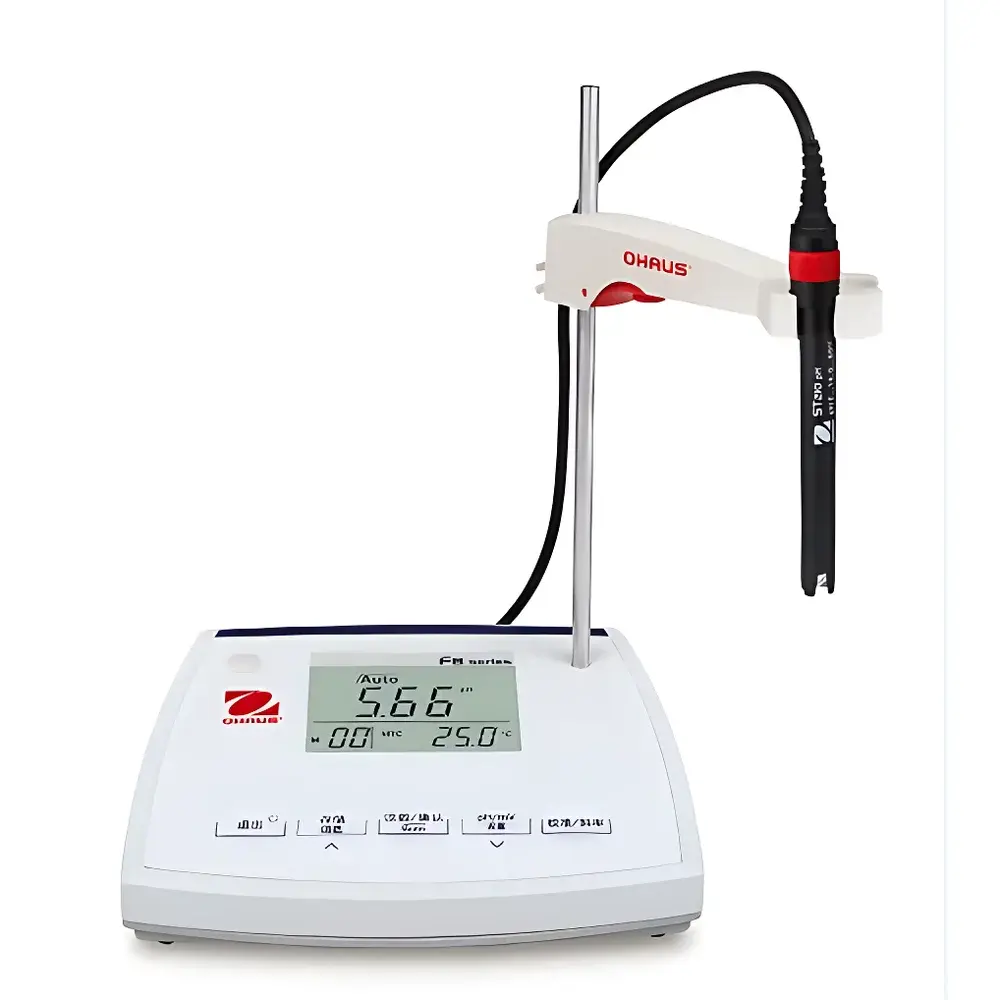
OHAUS FB2200 Benchtop pH Meter
| Brand | OHAUS |
|---|---|
| Origin | Jiangsu, China |
| Manufacturer Type | Manufacturer |
| Product Category | Domestic |
| Model | FB2200 |
| Instrument Type | Benchtop |
| Parameter Types | Multi-parameter (pH, mV, Temperature) |
| Measurement Accuracy | ±0.01 pH |
| Measurement Range | pH 0.00–14.00 (device display range) |
| Resolution | 0.01 pH / 0.1 mV / 0.1 °C |
| Accuracy (Temperature) | ±0.3 °C |
| Calibration | Auto-buffer recognition for pH 4.00, 6.86, and 9.18 |
| Temperature Compensation | Automatic (ATC) with integrated temperature sensor |
| Calibration Standard Traceability | NIST-traceable buffer solutions |
| Display | 3.5-inch backlit segmented & dot-matrix LCD |
| Power Supply | Included AC adapter |
| Enclosure | ABS anti-contamination housing with membrane keypad |
| Electrode Mount | Integrated adjustable electrode stand |
| EMC Compliance | CE, FCC |
| Electrical Safety & EMI | EN 61326-1 |
Overview
The OHAUS FB2200 Benchtop pH Meter is a precision electrochemical instrument engineered for routine pH and redox potential (mV) measurement in academic, quality control, and industrial laboratory environments. Based on potentiometric measurement principles, it determines hydrogen ion activity in aqueous solutions using a glass pH electrode and reference junction, generating a millivolt signal proportional to the logarithmic concentration of H⁺ ions (per the Nernst equation). Designed to meet ISO/IEC 17025-aligned operational expectations, the FB2200 delivers stable, reproducible readings across standard laboratory temperature ranges (0–50 °C), with built-in automatic temperature compensation (ATC) eliminating manual correction errors. Its architecture supports traceable calibration workflows compliant with GLP documentation requirements—particularly when used with NIST-traceable pH buffer standards (4.00, 6.86, and 9.18 at 25 °C)—ensuring metrological continuity from calibration to sample analysis.
Key Features
- Precision 0.01-pH resolution with ±0.01 pH accuracy across the full operational range (pH 0.00–14.00), validated per manufacturer specifications under controlled lab conditions.
- Auto-buffer recognition system that identifies and applies correct slope and offset values upon immersion in certified pH 4.00, 6.86, or 9.18 buffers—reducing operator error and standardizing calibration procedures.
- Intelligent endpoint detection algorithm ensures stable, repeatable measurements by freezing the displayed value only after signal drift falls below 0.01 pH/10 s for ≥3 seconds—critical for low-conductivity or viscous samples.
- Integrated ATC via built-in thermistor eliminates external probe handling; compensates for thermal effects on electrode response in real time, referenced to the NIST ITS-90 scale.
- Dedicated electrode status indicator provides visual feedback on calibration integrity—displaying “OK”, “CAL?”, or “ERR” based on slope deviation (>5 mV/pH unit) and asymmetry potential thresholds.
- Robust ABS enclosure with chemical-resistant surface finish and sealed membrane keypad meets IP20 environmental rating for general lab use; includes fixed-position electrode stand for ergonomic, vibration-damped operation.
Sample Compatibility & Compliance
The FB2200 is validated for aqueous and low-ionic-strength solutions typical in environmental water testing, beverage QC, educational labs, and basic pharmaceutical formulation support. It is not intended for non-aqueous solvents, high-viscosity slurries, or aggressive HF-containing media. All electrical safety and electromagnetic compatibility testing conforms to EN 61326-1:2013 (industrial environment), including radiated and conducted emissions, electrostatic discharge (±8 kV contact), and fast transient burst immunity (±2 kV). While the device does not embed FDA 21 CFR Part 11 audit trail functionality, its calibration logs—including date/time stamps, buffer IDs, slope (%), and offset (mV)—can be manually recorded in bound lab notebooks satisfying GLP record-keeping protocols.
Software & Data Management
The FB2200 operates as a standalone instrument without proprietary PC software or Bluetooth/Wi-Fi connectivity. All calibration and measurement data remain on-device only; no internal memory or export capability is provided. This design prioritizes operational simplicity, cybersecurity hygiene, and regulatory neutrality—making it suitable for facilities where data sovereignty, IT infrastructure constraints, or audit scope limitations prohibit network-connected instrumentation. Users are advised to document calibration events and critical measurements in accordance with organizational SOPs, referencing the device’s serial number and batch-specific NIST buffer lot numbers.
Applications
- Environmental monitoring: Surface water, wastewater effluent, and drinking water pH verification per ASTM D1293 and ISO 10523.
- Food & beverage QA: Batch consistency checks for dairy, juice, and brewing processes where pH correlates with microbial stability and enzymatic activity.
- Educational laboratories: Undergraduate electrochemistry experiments involving buffer preparation, electrode characterization, and Nernstian behavior validation.
- Pharmaceutical excipient testing: Preliminary pH screening of aqueous formulations prior to HPLC or dissolution testing (aligned with USP guidance).
- Industrial process support: Monitoring of cleaning solution alkalinity, plating bath acidity, and neutralization reaction endpoints.
FAQ
Does the FB2200 support three-point calibration?
No. The instrument is designed for 1-point verification or 2-point bracketing calibration using any two of the three recognized NIST buffers (pH 4.00, 6.86, 9.18). Three-point calibration is not implemented in firmware.
Can I use non-OHAUS pH electrodes with this meter?
Yes—any BNC-compatible, refillable or gel-filled combination pH electrode with standard Ag/AgCl reference system will function, though slope performance and lifetime may vary depending on electrode quality and maintenance.
Is temperature measurement independent of the pH electrode?
No. The FB2200 uses the integrated temperature sensor within the supplied combination electrode for ATC. A separate temperature probe is not supported.
What is the warranty coverage for the FB2200?
OHAUS provides a 2-year limited warranty covering defects in materials and workmanship under normal laboratory use, excluding electrodes, consumables, and damage from misuse or unauthorized modification.
How often should I recalibrate during continuous use?
Calibration frequency depends on application stringency. For GLP-compliant work, recalibrate before each analytical session and after every 2 hours of continuous operation—or immediately following measurement of samples with extreme pH (12) or high protein/fat content.



