
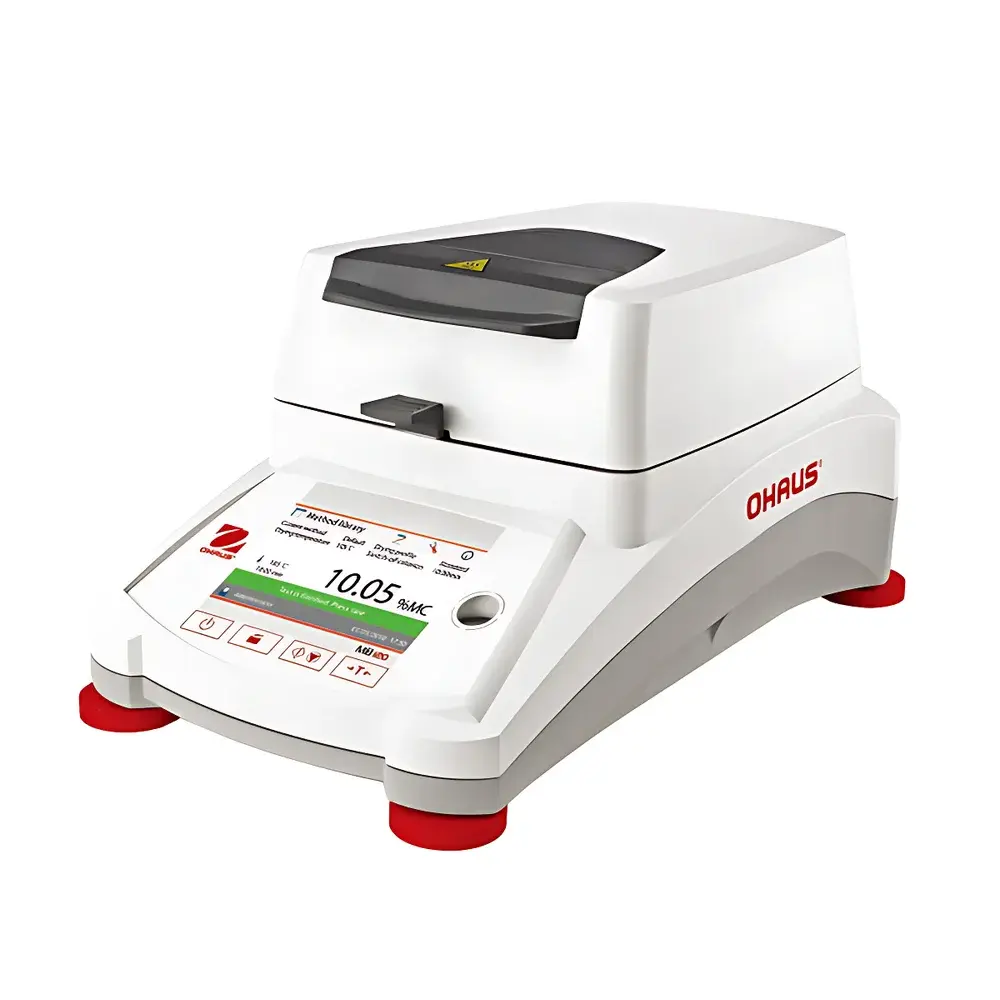
OHAUS MB120 Infrared Moisture Analyzer
| Brand | OHAUS |
|---|---|
| Origin | Jiangsu, China |
| Manufacturer Type | Original Equipment Manufacturer (OEM) |
| Product Category | Domestic |
| Model | MB120 |
| Heating Source | Halogen Lamp |
| Maximum Heating Temperature | 230 °C |
| Drying Modes | 4 configurable (Standard, Rapid, Step, Gentle) |
| Shut-off Criteria | Customizable (Time-based, Slope-based, Fixed Weight Loss, or Final Moisture Target) |
| Method Storage Capacity | Up to 100 user-defined methods |
| Result Storage Capacity | Up to 1,000 measurement records |
| Data Export | USB flash drive export to CSV/Excel-compatible format |
| User Management | 4-tier role-based access control (Administrator, Supervisor, Technician, Operator) |
| Compliance Support | Designed to support GLP/GMP documentation workflows |
Overview
The OHAUS MB120 Infrared Moisture Analyzer is a halogen-heated thermogravimetric instrument engineered for rapid, reproducible moisture content determination across solid and semi-solid samples in quality control, R&D, and production environments. It operates on the principle of loss-on-drying (LOD): sample mass is continuously monitored during controlled thermal drying, and moisture content is calculated as the percentage mass loss relative to the initial dry weight. Unlike conventional oven-drying methods requiring hours, the MB120 achieves typical analysis times between 2–15 minutes—enabled by high-intensity, uniform halogen lamp heating and real-time microbalance integration (0.1 mg readability). Its design adheres to core thermogravimetric standards referenced in ASTM D4442, ISO 712, and USP <921>, supporting method equivalence validation against reference oven procedures.
Key Features
- Halogen heating system delivering precise, uniform thermal energy up to 230 °C—with rapid thermal response and minimal overshoot for improved repeatability.
- Four programmable drying modes: Standard (constant temperature), Rapid (dynamic ramping), Step (multi-segment temperature profiles), and Gentle (low-temperature stabilization for heat-sensitive materials).
- SmartGuide™ methodology assistant—guides users through empirical method development using historical drying curves and slope analysis, minimizing trial-and-error while promoting consistency with forced-air oven results.
- Configurable termination criteria: time-based, slope-based (e.g., ≤0.1 mg/min over 60 s), fixed mass-loss threshold, or target final moisture %—enabling optimization for diverse matrices including polymers, pharmaceutical granules, food powders, and agricultural commodities.
- Integrated 4-level user management system with password protection, role-specific permissions (Administrator, Supervisor, Technician, Operator), and protected method/result editing rights—supporting data integrity requirements under ISO/IEC 17025 and GxP frameworks.
Sample Compatibility & Compliance
The MB120 accommodates samples ranging from 0.5 g to 120 g (depending on pan size and density), with compatibility validated for organic powders, tablets, pellets, slurries, pastes, and granular solids. Its open-chamber design allows straightforward loading and residue removal—critical for routine cleaning in regulated labs. All firmware and interface logic are designed to support traceability: each result logs timestamp, operator ID, method name, calibration status, ambient conditions (if external sensor connected), and full drying curve metadata. When deployed within validated laboratory informatics systems, the MB120 supports ALCOA+ data principles (Attributable, Legible, Contemporaneous, Original, Accurate, Complete, Consistent, Enduring, Available) and facilitates audit-ready documentation per FDA 21 CFR Part 11 and EU Annex 11 expectations.
Software & Data Management
Internal memory stores up to 100 customizable test methods—including temperature ramps, hold times, shut-off logic, and display preferences—and retains 1,000 complete measurement records with full metadata. Data export occurs via standard USB-A port to FAT32-formatted flash drives; outputs are comma-separated values (CSV) files compatible with Microsoft Excel, LabWare LIMS, and custom QA dashboards. No proprietary software installation is required for basic operation or reporting. Optional OHAUS Connect™ software (sold separately) enables remote method deployment, centralized result aggregation, statistical process control (SPC) charting, and electronic signature capture—extending compliance readiness for multi-site QC networks.
Applications
The MB120 serves critical roles in raw material release (e.g., excipients, resins, flour), in-process monitoring (tablet granulation, spray-dried powder consistency), finished product verification (capsule moisture, lyophilized vial residual water), and stability study support. It is routinely applied in food safety labs (AOAC-compliant moisture screening), polymer manufacturing (resin drying validation prior to extrusion), and contract pharmaceutical development (ICH Q5C moisture specification testing). Its robustness, ease of qualification (IQ/OQ/PQ protocols available), and low maintenance profile make it suitable for both ISO 17025-accredited testing laboratories and cGMP production floors.
FAQ
Does the MB120 comply with FDA 21 CFR Part 11?
The instrument supports Part 11 compliance when integrated into a validated ecosystem—including electronic signatures, audit trails, and secure user authentication—though standalone hardware does not auto-certify; formal validation remains the responsibility of the end-user lab.
Can I validate the MB120 against my existing oven method?
Yes—SmartGuide™ and slope-based shut-off facilitate correlation studies per ASTM E1868; OHAUS provides application notes and comparative protocol templates for equivalence demonstration.
What maintenance is required for long-term accuracy?
Routine calibration with certified weights and temperature verification using NIST-traceable PT100 probes every 3–6 months is recommended; halogen lamps typically exceed 5,000 hours of service life.
Is the MB120 suitable for volatile organic compounds (VOCs)?
It measures total volatile loss—not exclusively water—so for VOC-rich samples, coupling with headspace GC-MS or Karl Fischer titration is advised for speciation.
How does the 4-tier user system enforce data governance?
Each level restricts access to calibration functions, method modification, result deletion, and system configuration—ensuring segregation of duties aligned with ISO 9001 and EU GMP Annex 11 risk assessments.






