
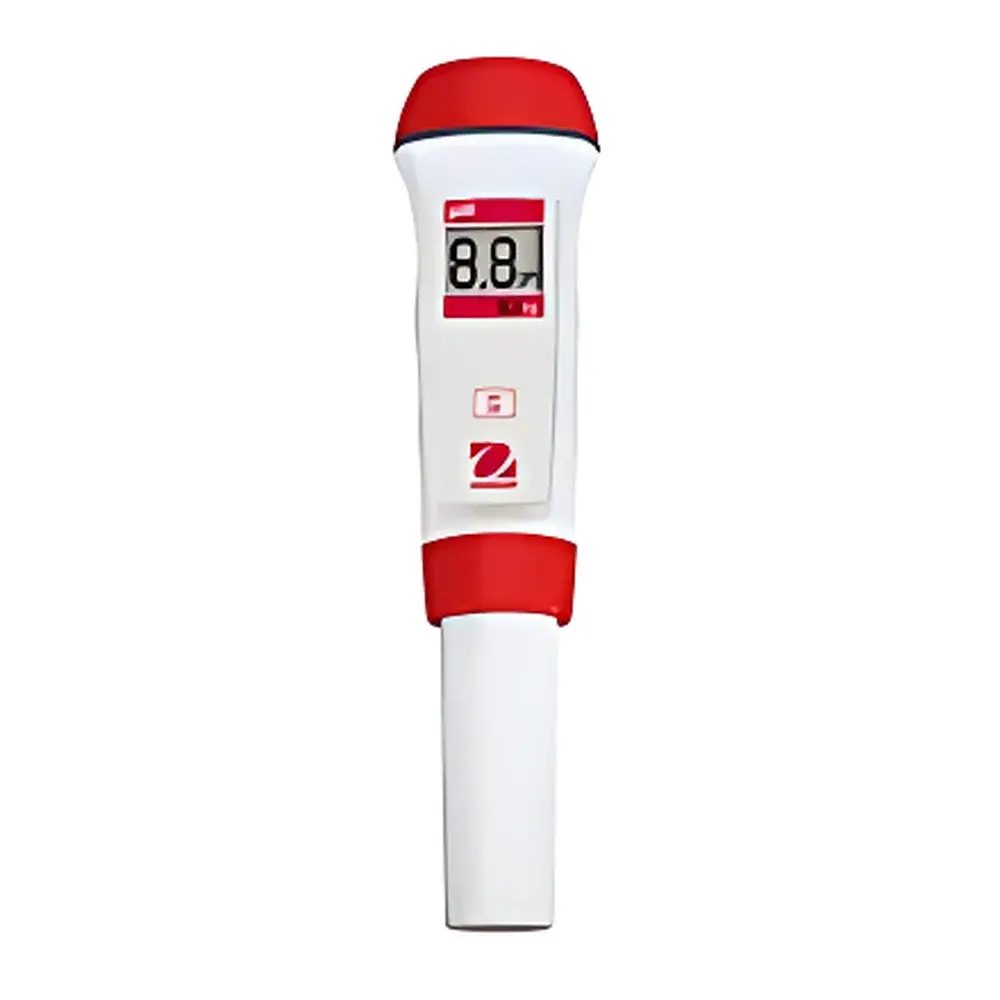
OHAUS ST10 and ST20 Portable pH Test Pens
| Brand | OHAUS |
|---|---|
| Model | ST10, ST20 |
| Origin | USA |
| Instrument Type | Portable pH Meter |
| Parameter Type | Single-Parameter (pH) |
| pH Measurement Range | 0.00–14.00 |
| pH Resolution | 0.1 pH (ST10), 0.01 pH (ST20) |
| pH Accuracy | ±0.1 pH (ST10), ±0.05 pH (ST20) |
| Temperature Measurement Range (ST20 only) | 0.0–99.0 °C |
| Temperature Accuracy (ST20 only) | ±0.5 °C |
| Calibration | None (ST10), 1–3 point auto-temperature-compensated calibration (ST20) |
| Buffer Sets | 4.01, 7.00, 10.01 pH |
| Display | Single-line LCD (ST10), Dual-line LCD (ST20) |
| Power | 4 × 1.5 V alkaline button cells |
| Auto-Off | 6 minutes of inactivity |
| IP Rating | IP67 |
| Electrode Type | Replaceable glass pH electrode |
| Storage Requirement | Hydrated in 3 M KCl solution |
| Compliance | Designed for general laboratory, field, and educational use per IEC 60529 (IP67), ASTM D1293 (pH of water), and ISO 7888 (water quality — determination of pH) |
Overview
The OHAUS ST10 and ST20 Portable pH Test Pens are compact, handheld electrochemical instruments engineered for rapid, reliable pH measurement in non-regulated or semi-quantitative environments. Based on potentiometric principle, these devices utilize a combination glass pH electrode to generate a voltage proportional to hydrogen ion activity in aqueous solutions. The measured potential is converted to pH units using the Nernst equation, with automatic temperature compensation (ATC) implemented exclusively in the ST20 model via an integrated thermistor. Unlike benchtop meters, the ST series prioritizes operational simplicity and ruggedness over advanced data logging or GLP-compliant audit trails—making them suitable for routine checks in education labs, aquaculture, hydroponics, pool maintenance, food preparation areas, and field-based environmental screening where portability and immediate readability outweigh regulatory documentation requirements.
Key Features
- IP67-rated enclosure ensures full protection against dust ingress and immersion in water up to 1 meter for 30 minutes—ideal for humid, outdoor, or splash-prone workspaces.
- Pre-installed batteries and factory-hydrated electrode housed within a protective cap enable immediate deployment without setup delay.
- ST20 model includes dual-line LCD display showing simultaneous pH and temperature values, along with readout hold functionality for stable recording under variable lighting or awkward angles.
- Electrode replacement is tool-free and requires no recalibration of internal circuitry—users simply unscrew the probe housing and install a new OHAUS-certified glass electrode (e.g., part #30073975).
- Automatic power-off after six minutes of inactivity extends battery life and reduces risk of unintended discharge during storage.
- ST20 supports 1-, 2-, or 3-point calibration using standard NIST-traceable buffers (pH 4.01, 7.00, 10.01), enabling traceable adjustment across the full measurement range.
Sample Compatibility & Compliance
These pens are validated for use with aqueous liquid samples exhibiting conductivity ≥50 µS/cm and temperature between 0 °C and 99 °C (ST20). They are not recommended for non-aqueous solvents, highly viscous media, or suspensions containing particulates that may coat the junction. While not certified to FDA 21 CFR Part 11 or ISO/IEC 17025, the ST series conforms to mechanical and environmental standards including IEC 60529 (IP67), and supports method compliance with ASTM D1293 (Standard Test Method for pH of Water) and ISO 7888 (Water Quality — Determination of pH) when operated per manufacturer instructions and calibrated regularly. For regulated QC/QA workflows requiring electronic records, audit trails, or multi-parameter correlation, OHAUS recommends upgrading to the Starter Pro or Ranger series.
Software & Data Management
The ST10 and ST20 operate as standalone instruments with no embedded memory, USB interface, or Bluetooth connectivity. All measurements are displayed in real time and must be manually recorded. No proprietary software or drivers are required—or provided—for operation. This architecture eliminates firmware update dependencies and cybersecurity concerns associated with connected devices, aligning with IT policies in secure facilities. However, it also means no exportable data files, no timestamped logs, and no integration with LIMS or ELN platforms. Users requiring digital data capture should consider pairing the ST20 with external documentation tools (e.g., voice memos, photographic logging, or spreadsheet entry) while maintaining calibration records separately per internal SOPs.
Applications
- Educational laboratories: Demonstrating acid-base concepts, titration endpoint estimation, and electrode fundamentals.
- Aquaculture and aquarium management: Monitoring pond, tank, or recirculating system pH to maintain optimal biological conditions.
- Hydroponic nutrient solution control: Ensuring pH remains within 5.5–6.5 range for maximum nutrient availability.
- Food service and catering: Verifying rinse water pH post-sanitization or checking brine acidity in pickling operations.
- Field environmental assessment: Preliminary screening of surface water, runoff, or soil leachates prior to lab-based analysis.
- Small-scale brewing and winemaking: Tracking mash or must pH during fermentation staging.
FAQ
How often should I calibrate the ST20?
Calibration frequency depends on usage intensity and required accuracy. For daily use in critical applications, perform a 2-point calibration (pH 7.00 + one bracketing buffer) at start-up. For occasional use, calibrate before each session.
Can I use non-OHAUS calibration buffers?
Yes—any high-purity, NIST-traceable pH 4.01, 7.00, or 10.01 buffer certified for room temperature use is compatible. Avoid expired or contaminated solutions.
Why does my ST10 show lower resolution than the ST20?
The ST10 displays pH to the nearest 0.1 unit due to its simplified analog-to-digital converter and single-line display architecture; this reflects its design intent for qualitative trend monitoring rather than quantitative reporting.
What happens if the electrode dries out?
A desiccated glass membrane develops slow response, drift, and reduced slope (<95% of theoretical 59.16 mV/pH at 25 °C). Rehydration in 3 M KCl for ≥2 hours may restore partial function—but performance degradation is often irreversible. Always store electrodes immersed.
Is the ST20 suitable for ISO 17025-accredited testing?
No. It lacks documented uncertainty budgets, calibration certificate traceability, electronic record retention, and environmental monitoring features required by ISO/IEC 17025 Clause 6.4 and 6.5. Use only for internal process checks unless validated per your laboratory’s scope of accreditation.






