
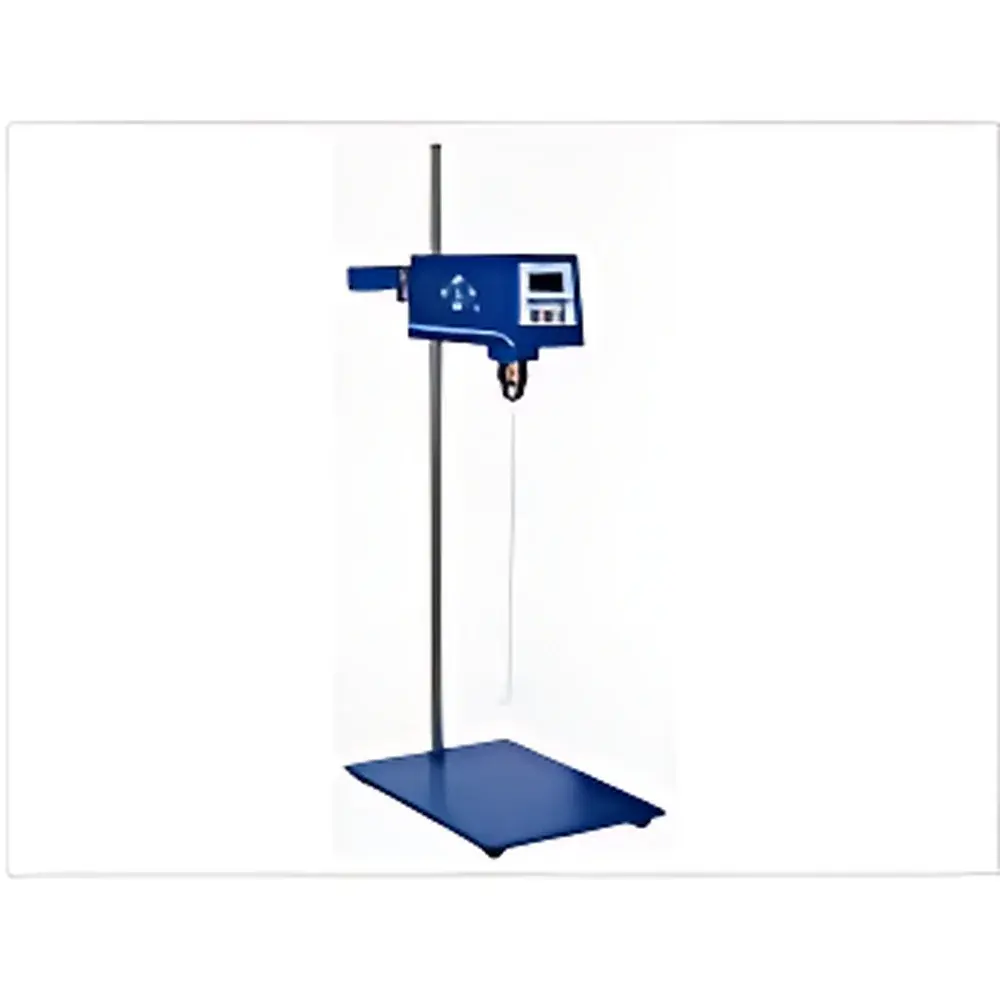

SiLe HD2010W Constant-Speed Electric Stirrer
| Brand | SiLe |
|---|---|
| Origin | Shanghai, China |
| Model | HD2010W |
| Stirring Capacity | 10 L |
| Speed Range | 30–1300 rpm |
| Motor Power | 100 W |
| Torque | 300 mN·m |
| Viscosity Range | 0–10,000 mPa·s |
| Clamp Jaw Capacity | ≤ Φ10 mm |
| Support Rod | Φ14 × 160 mm |
| Dimensions (W×D×H) | 320 × 220 × 770 mm |
| Weight | 10 kg |
| Speed Adjustment Resolution | ±10 rpm per step |
| Input Voltage | AC 100–230 V |
| Control Type | Digital, Closed-Loop Constant-Speed |
| Direction | Reversible |
Overview
The SiLe HD2010W Constant-Speed Electric Stirrer is an engineered laboratory mixing solution designed for reproducible, low-to-medium viscosity applications requiring stable rotational output under variable load conditions. Unlike open-loop variable-speed stirrers, the HD2010W employs a digital closed-loop control architecture that maintains consistent motor torque and rotational speed across its full 30–1300 rpm range — even when encountering sudden changes in medium viscosity or impeller drag. This constant-power behavior is particularly advantageous during prolonged homogenization, dissolution, or suspension preparation where thermal drift or mechanical loading could otherwise induce speed fluctuation. The device operates on universal AC input (100–230 V), eliminating the need for region-specific power adapters, and features a reversible drive system to support bidirectional mixing protocols — a capability critical for breaking up agglomerates or preventing vortex formation in sensitive samples.
Key Features
- Digital closed-loop speed regulation ensures ±10 rpm stability per adjustment step and minimal speed deviation (<±2% of setpoint) under dynamic load conditions
- 100 W brushless DC motor delivers 300 mN·m nominal torque, enabling reliable operation with standard PTFE-coated or stainless-steel impellers up to Φ10 mm shaft diameter
- Reversible rotation function supports both clockwise and counterclockwise stirring sequences via front-panel tactile switch — programmable for timed direction alternation in advanced protocols
- Robust aluminum-alloy support column (Φ14 × 160 mm) with integrated clamp mechanism accommodates vertical positioning of stir bars, overhead mixers, or temperature probes
- Compact footprint (320 × 220 mm base) and 770 mm total height optimize bench space while maintaining structural rigidity for 10 L vessel compatibility (e.g., beakers, jacketed reactors, or tall-form cylinders)
- Compliance-ready design includes CE marking, RoHS-conformant materials, and electrical isolation meeting IEC 61010-1 safety requirements for laboratory equipment
Sample Compatibility & Compliance
The HD2010W is validated for use with aqueous, organic, and mildly corrosive media within a viscosity range of 0–10,000 mPa·s — covering applications from buffer dilution (low-viscosity Newtonian fluids) to polymer solution blending (shear-thinning non-Newtonian systems). It is not intended for high-viscosity pastes (>20,000 mPa·s), abrasive slurries, or explosive atmospheres. The unit complies with ISO/IEC 17025-relevant operational traceability standards when used in conjunction with calibrated tachometers and documented SOPs. While it does not incorporate built-in temperature control, its mechanical architecture permits integration with external heating mantles or water-jacketed vessels — provided thermal expansion of the support rod and clamp assembly is accounted for in experimental setup.
Software & Data Management
The HD2010W operates as a standalone analog-digital hybrid instrument without embedded firmware or network connectivity. All operational parameters — including set speed, direction, and runtime — are manually configured via tactile interface; no software installation or driver dependency is required. For laboratories operating under GLP or GMP frameworks, users may implement external logging using third-party USB tachometers or optical RPM sensors paired with time-stamped acquisition software (e.g., LabVIEW or MATLAB Data Acquisition Toolbox). Audit trails can be maintained through procedural documentation referencing batch numbers, operator IDs, and environmental conditions — aligning with FDA 21 CFR Part 11 principles when electronic records are generated externally.
Applications
- Preparation of standard solutions and calibration standards in analytical chemistry workflows
- Homogenization of cell culture media and nutrient broths in microbiology labs
- Mixing of reagent-grade solvents prior to HPLC or GC sample injection
- Suspension stabilization during pharmaceutical excipient testing (e.g., USP Disintegration)
- Supporting ASTM D2196 viscosity measurement procedures using Brookfield-type spindles mounted on the chuck
- Integration into multi-step synthesis rigs where synchronized agitation timing is essential but precise speed ramping is not required
FAQ
Is the HD2010W suitable for continuous 24/7 operation?
Yes — the motor and control circuitry are rated for indefinite duty cycle at ≤80% of maximum speed (≤1040 rpm) under ambient temperatures of 15–30°C and relative humidity <75%.
Can the stirrer be mounted on a fume hood shelf or custom frame?
Yes — the base features four M4 threaded inserts (12 mm depth) compatible with standard lab mounting hardware; load distribution must remain vertically aligned to avoid lateral stress on the support column.
Does the unit meet electromagnetic compatibility (EMC) requirements for shared lab environments?
Yes — it conforms to EN 61326-1:2013 for laboratory-use EMC and exhibits minimal RF emission below 30 MHz, ensuring coexistence with sensitive analytical instruments such as balances and spectrophotometers.
What impeller types are recommended for optimal performance?
PTFE-coated paddle, propeller, or helical impellers with shaft diameters ≤10 mm and total mass ≤150 g are recommended; stainless steel variants require passivation verification for acidic or halide-containing media.
Is calibration certification available from the manufacturer?
SiLe provides factory calibration reports upon request (traceable to NIM, China); third-party ISO/IEC 17025 calibration services are supported via authorized metrology partners in North America and EU regions.



