
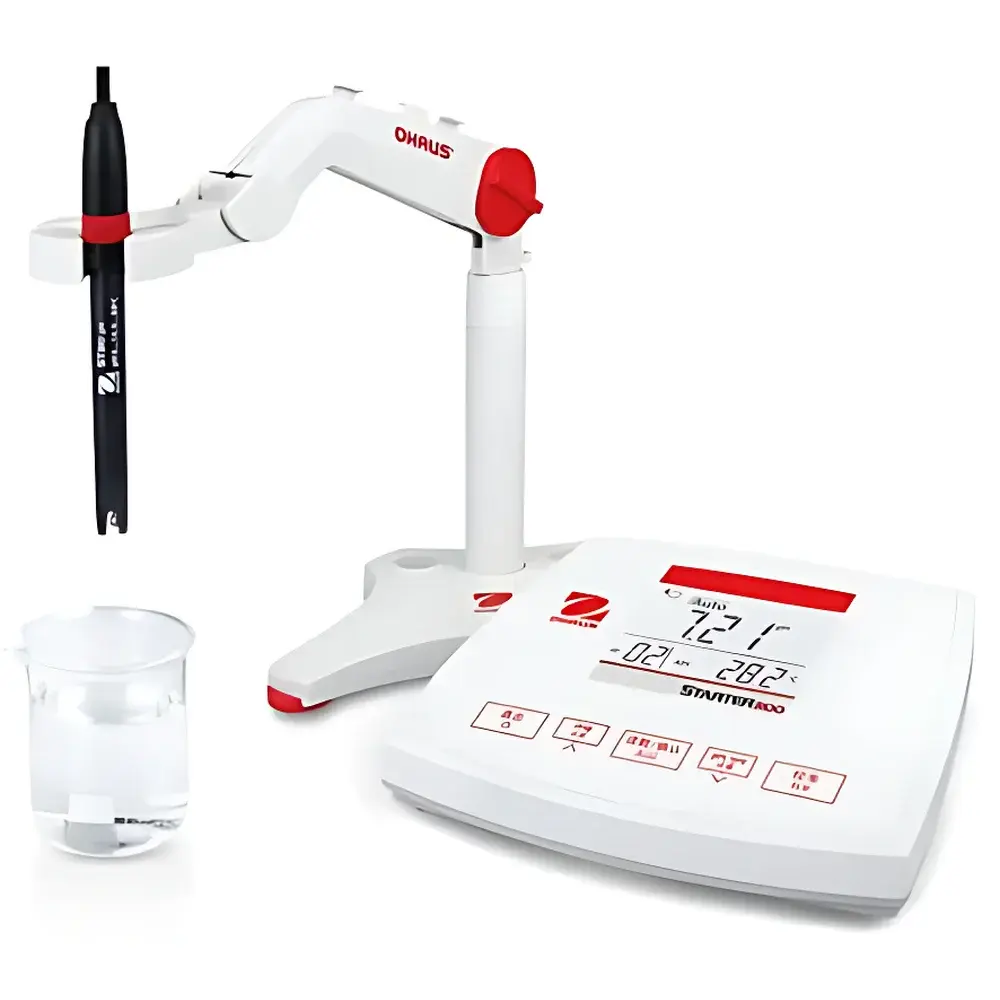
Ohaus STARTER 3100 Benchtop pH Meter
| Brand | Ohaus |
|---|---|
| Origin | USA |
| Model | STARTER 3100 |
| Instrument Type | Benchtop |
| Parameter Types | Multi-parameter |
| Measurement Range | -2.00 to 16.00 pH |
| Resolution | 0.01 pH |
| Accuracy | ±0.01 pH |
| Calibration Buffer Recognition | Auto-identifying international buffer sets (e.g., pH 4.01, 7.00, 10.01) |
| Temperature Compensation | Automatic and manual |
| Memory Capacity | 99 data sets |
| Display | Backlit LCD |
| Power Supply | 110–240 V AC / 50 Hz, DC 12 V adapter |
| Interface | RS232 serial output |
| Compliance | GLP/GMP-compliant data logging with timestamp and electrode ID tracking |
Overview
The Ohaus STARTER 3100 Benchtop pH Meter is an engineered solution for routine and quality-critical pH measurement in academic laboratories, pharmaceutical QC labs, and industrial process support environments. Designed around a robust potentiometric measurement principle—based on the Nernst equation—the instrument measures the potential difference between a pH-sensitive glass electrode and a stable reference electrode, converting it into a precise pH reading with traceable accuracy. Its extended measurement range of −2.00 to 16.00 pH accommodates highly acidic or alkaline samples common in electroplating baths, caustic cleaning validation, and battery electrolyte analysis. The device meets fundamental metrological requirements for laboratory-grade instrumentation, delivering consistent 0.01 pH resolution and ±0.01 pH accuracy under standard operating conditions (25 °C, calibrated with certified NIST-traceable buffers). Its benchtop form factor ensures stability during extended measurements, while its modular architecture supports integration into regulated workflows requiring audit-ready documentation.
Key Features
- Auto-recognizing multi-buffer calibration: Supports international standard buffers (pH 4.01, 7.00, 10.01) with automatic slope and offset calculation; optional 2- or 3-point calibration routines.
- Flexible endpoint detection: Configurable auto-read stabilization threshold (±0.01 pH/10 s) or manual hold function for non-equilibrating samples.
- Dual temperature compensation: Integrated ATC input accepts Pt1000 or thermistor probes; manual TC entry also available for fixed-temperature applications.
- GLP/GMP-compliant data management: Each stored reading includes date/time stamp, electrode ID (if encoded), calibration status, and ambient temperature—enabling full traceability per FDA 21 CFR Part 11 principles.
- Ergonomic mechanical design: Rigid ABS housing with chemical-resistant surface finish; detachable independent electrode stand allows flexible bench layout and secure probe positioning during measurement or storage.
- Backlit high-contrast LCD: 3½-digit display with dedicated icons for mV mode, temperature, calibration status, and battery level—optimized for low-light lab environments.
Sample Compatibility & Compliance
The STARTER 3100 is compatible with standard BNC-input pH electrodes—including double-junction, refillable, and gel-filled configurations—ensuring broad applicability across aqueous, semi-aqueous, and low-ionic-strength samples. Its independent reference junction port minimizes liquid junction potential drift in viscous or protein-rich matrices (e.g., cell culture media, dairy products, or polymer solutions). The instrument complies with ISO 7888 (water quality—pH determination), ASTM D1293 (standard test method for pH of water), and USP (pH measurement in pharmaceutical preparations). All firmware and hardware design elements align with IEC 61010-1 safety standards for electrical equipment used in laboratory environments.
Software & Data Management
Data export is facilitated via RS232 serial interface, supporting direct connection to Ohaus-compatible thermal printers (e.g., PR 500 series) for hard-copy GLP records. While the STARTER 3100 does not include proprietary PC software, its ASCII-based output protocol is compatible with third-party laboratory information systems (LIMS) and spreadsheet tools via standard terminal emulation (e.g., Tera Term, PuTTY). Each memory entry retains full metadata: sample ID (user-defined), measurement value, temperature, calibration date, electrode serial number (when entered manually), and operator code—satisfying internal audit requirements for ISO/IEC 17025-accredited testing laboratories.
Applications
- Pharmaceutical manufacturing: Final product pH verification of injectables, ophthalmic solutions, and topical suspensions per USP monographs.
- Food & beverage QA: Monitoring acidification in fermented products (yogurt, kimchi), titratable acidity validation, and shelf-life stability studies.
- Environmental testing: Surface water, wastewater effluent, and soil leachate analysis compliant with EPA Method 9040C.
- Academic teaching labs: Foundational electrochemistry experiments involving buffer capacity, weak acid dissociation, and electrode response kinetics.
- Industrial process control: Electrolyte monitoring in plating baths, boiler feedwater treatment, and bioreactor pH feedback loops.
FAQ
Does the STARTER 3100 support electrode diagnostics or slope monitoring?
Yes—it displays real-time electrode slope (%) and offset (mV) post-calibration, allowing users to assess electrode health and detect aging or contamination before measurement errors occur.
Can the instrument store calibration data separately from sample readings?
No—calibration parameters are embedded within each measurement record. However, the full calibration history (date, buffers used, slope, offset) is retained and printable via RS232.
Is the RS232 interface optically isolated?
No—the interface is galvanically coupled and requires proper grounding when connected to shared lab networks; use of shielded cables and serial-to-USB adapters with isolation is recommended in electrically noisy environments.
What is the operating temperature range for the instrument itself?
10 °C to 40 °C at ≤80% relative humidity (non-condensing), as specified in the Ohaus Declaration of Conformity.
Does the STARTER 3100 meet FDA 21 CFR Part 11 requirements out-of-the-box?
It provides foundational features (audit trail-capable memory, time-stamped records, user-accessible calibration logs) but requires procedural controls (e.g., defined roles, password management, backup protocols) to achieve full Part 11 compliance in regulated settings.




