
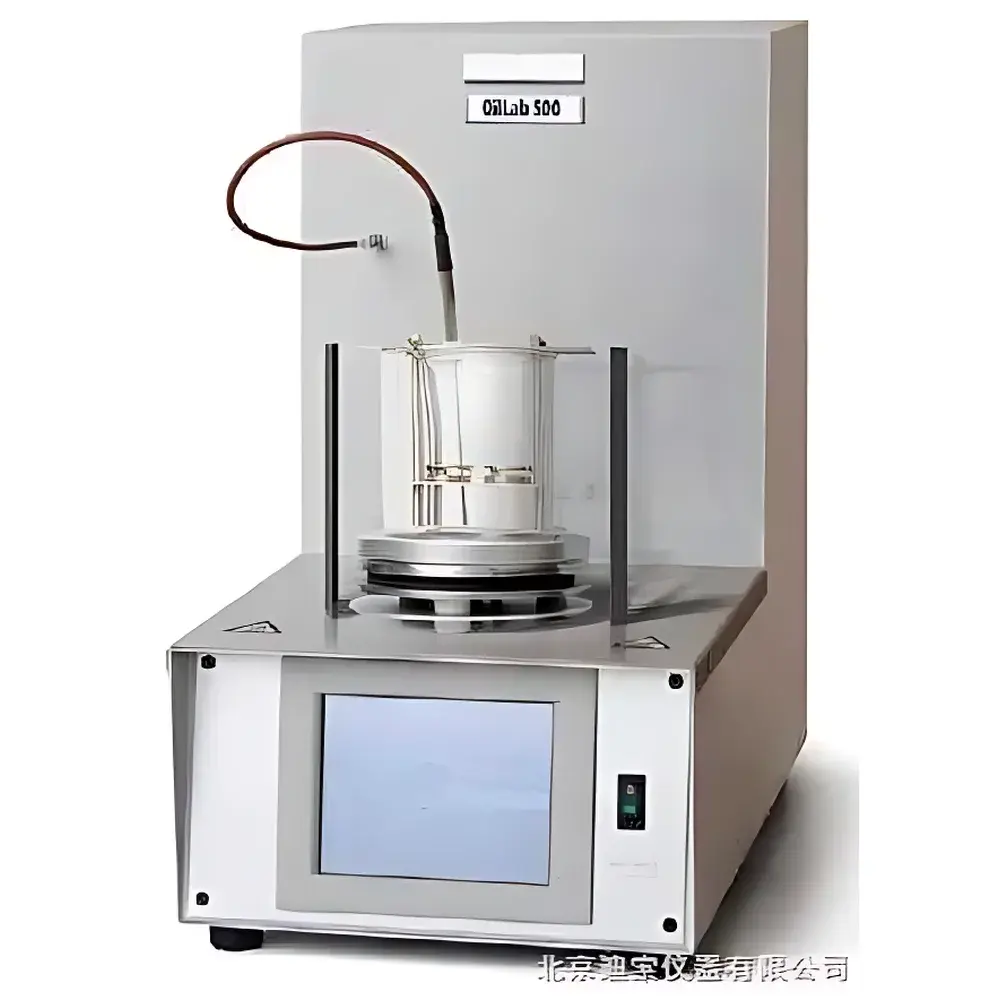
OilLab 500 Automatic Ring-and-Ball Softening Point Analyzer
| Origin | Switzerland |
|---|---|
| Manufacturer Type | Authorized Distributor |
| Origin Category | Imported Instrument |
| Model | 500 |
| Price | Upon Request |
| Standards Compliance | ASTM D36, ASTM E28, EN 1427, IP 58, ISO 4625, DIN 52011, NF T 66-008, AASHTO T53, JIS K2207 |
| Temperature Range | 0–250 °C |
| Temperature Resolution | 0.06 °C |
| Temperature Accuracy | ±0.1 °C |
Overview
The OilLab 500 Automatic Ring-and-Ball Softening Point Analyzer is an engineered solution for precise, repeatable determination of the softening point of bituminous materials and thermoplastic substances according to internationally recognized ring-and-ball methodology. Based on the principle of thermal deformation under standardized load and controlled heating rate, the instrument measures the temperature at which a standardized steel ball, resting on a specimen disc suspended in a heated bath, causes the material to soften sufficiently to allow the ball to descend a defined distance (typically 25.4 mm). This gravimetric–thermal transition measurement is fundamental to quality assurance in asphalt production, road construction specification compliance, and polymer-modified binder characterization.
Key Features
- Dual independent detection channels with high-precision laser emitters and photodiode-based receivers—enabling simultaneous, non-contact monitoring of ball descent for both test positions without mechanical interference or drift.
- Embedded real-time control system with integrated touchscreen interface and onboard data logging—eliminating dependency on external PCs while supporting audit-ready operation.
- Temperature-controlled oil bath with PID-regulated heating and PT100-class sensor feedback (optional factory-installed), ensuring stable ramp rates per ASTM D36 (5.0 ± 0.5 °C/min) and EN 1427 (1.0 ± 0.1 °C/min for low-melting materials).
- Compliance-certified architecture: CE-marked per Directive 2014/30/EU (EMC) and 2014/35/EU (LVD); designed to meet mechanical safety and electromagnetic compatibility requirements for laboratory environments.
- Modular hardware design facilitates field serviceability—bath assembly, detection modules, and sample holders are mechanically decoupled and individually replaceable without recalibration.
Sample Compatibility & Compliance
The OilLab 500 accommodates a broad spectrum of petroleum-derived and synthetic thermoplastic materials, including paving-grade and roofing-grade asphalts, cutback and emulsified binders, coal tar pitches, rosin esters, microcrystalline waxes, polyolefin-based adhesives, and polyester resins. Each test configuration adheres strictly to dimensional and procedural constraints defined in ASTM D36 (standard method for bitumen), ASTM E28 (general softening point reference), EN 1427 (European standard for bitumen), and supplementary specifications such as AASHTO T53 (U.S. highway agency protocol) and JIS K2207 (Japanese Industrial Standard for asphalt testing). All critical parameters—including ball diameter (9.53 mm), ring dimensions (15.9 mm ID × 12.7 mm height), and specimen thickness (≥3.2 mm)—are mechanically enforced by precision-machined fixtures to ensure inter-laboratory reproducibility.
Software & Data Management
The embedded firmware provides three operational modes: Analysis (fully automated run sequence with real-time curve visualization), Calibration (multi-point temperature verification using NIST-traceable reference standards), and Diagnostics (system self-test of optical alignment, heater response, and sensor linearity). Raw temperature/time datasets are stored internally with timestamp, operator ID, and method identifier. Export is supported via USB 2.0 to CSV or PDF report formats compliant with GLP documentation requirements. Audit trail functionality records all parameter changes, calibration events, and user logins—satisfying FDA 21 CFR Part 11 readiness when deployed in regulated QC laboratories.
Applications
- Quality control of virgin and recycled asphalt binders in refinery and paving material manufacturing facilities.
- Performance grading (PG) verification of polymer-modified asphalts per AASHTO M320 and ASTM D6373.
- Thermal stability assessment of hot-melt adhesives used in packaging and automotive assembly lines.
- R&D evaluation of bio-based bituminous alternatives, including lignin- and tannin-modified binders.
- Regulatory submission support for EN 13108-series compliance documentation in EU infrastructure projects.
FAQ
Does the OilLab 500 require external PC connectivity for routine operation?
No—full test execution, data acquisition, and reporting are handled autonomously by the integrated embedded system. External PC connection is optional and limited to advanced data export or firmware updates.
Can the instrument be validated against NIST-traceable temperature standards?
Yes—the calibration menu supports multi-point verification using certified reference thermometers (e.g., Fluke 724 or equivalent), with deviation logs automatically archived.
What maintenance intervals are recommended for optical alignment?
The dual-laser detection system is factory-aligned and sealed; no user-accessible adjustment is required. Annual verification using the diagnostic mode is advised as part of preventive maintenance protocols.
Is the bath fluid specified, and can alternative media be used?
Glycerin (for tests up to 200 °C) or silicone oil (up to 250 °C) are recommended. Substitution requires validation of thermal homogeneity and viscosity profile per ASTM D36 Annex A1.
How is compliance with ISO/IEC 17025 documented?
The instrument’s type-test certification, traceable calibration certificate (with uncertainty budget), and built-in audit trail collectively support laboratory accreditation evidence packages for softening point testing scope.





