
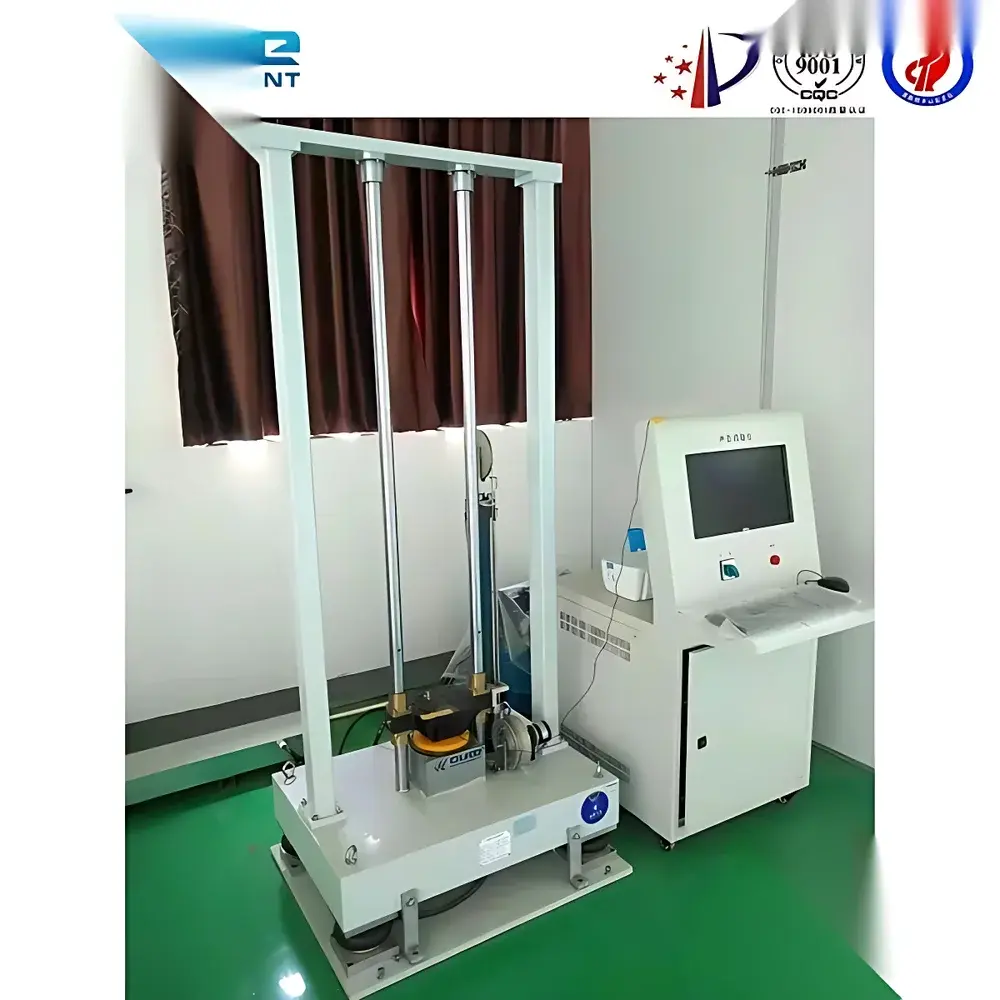
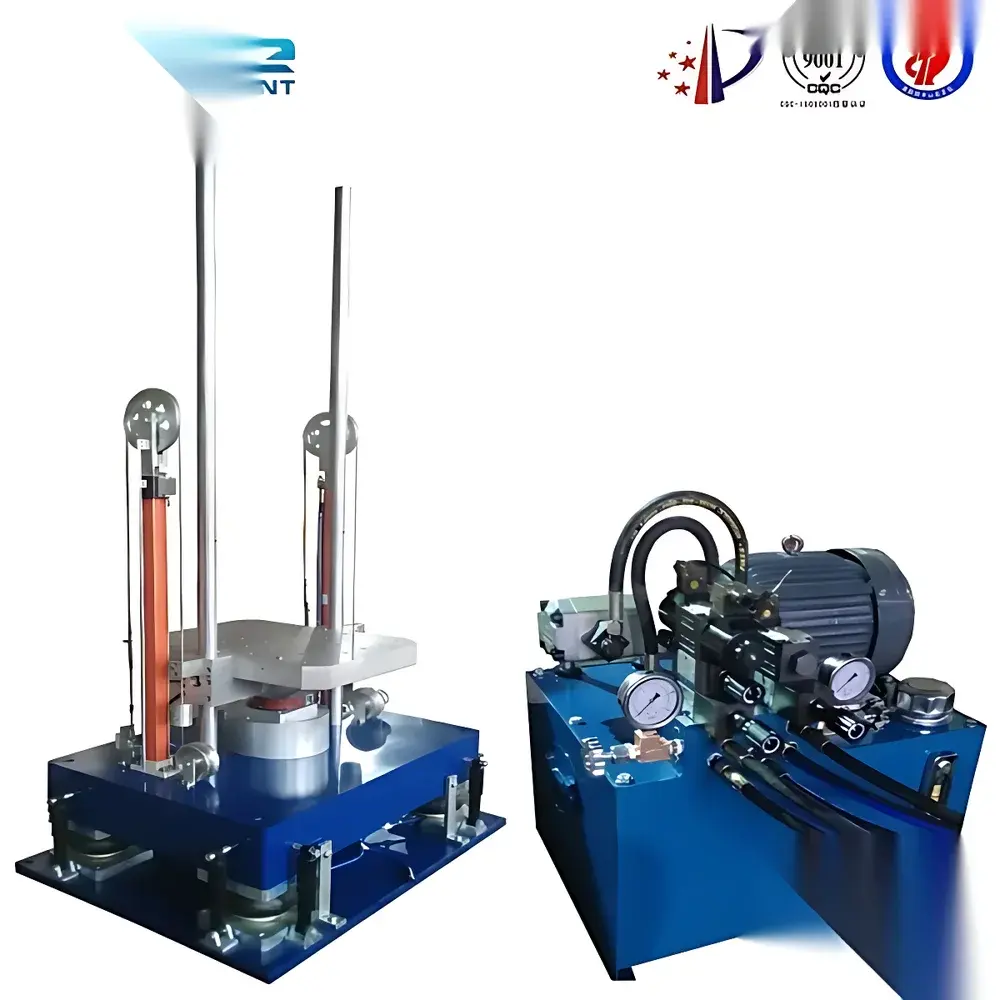
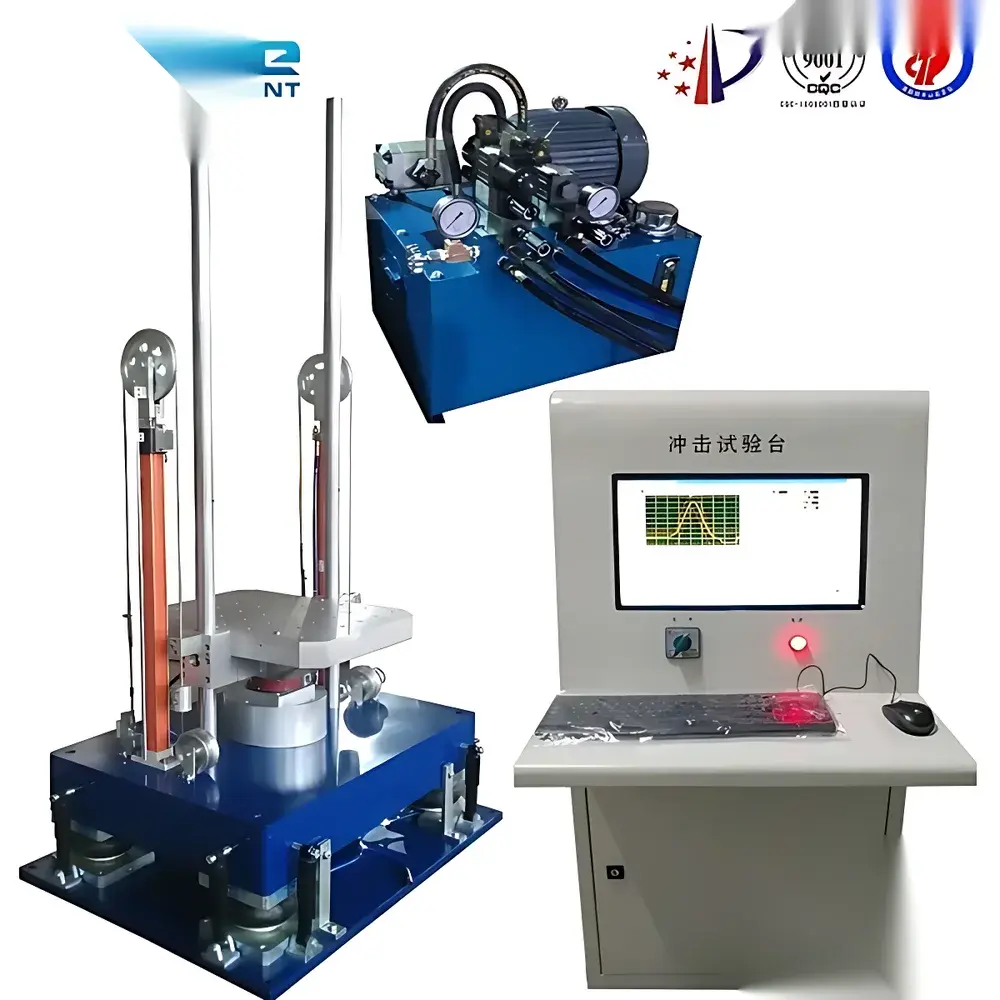
OKPZ Series Electromechanical Impact Testing System
| Brand | Other Brands |
|---|---|
| Max Load Capacity | 50–800 kg |
| Peak Acceleration Range | 30–1000 m/s² (model-dependent) |
| Pulse Duration | 20–230 ms |
| Impact Repetition Rate | 10–60 impacts/min |
| Tabletop Dimensions | 500×700 mm to 1000×1000 mm |
| Drop Height Range | 0–80 mm (model-dependent) |
| Continuous Operation Time | 8 h |
| Power Supply | 220 VAC ±10% / 380 VAC ±10%, 50 Hz |
| Operating Temperature | –40 °C to +50 °C |
| Relative Humidity | <85% RH (at 25 °C) |
| Compliance | GB/T 2423.5–1995, GB/T 2423.6–1995, IEC 60068-2-27, IEC 60068-2-29, JJG 497–2000 |
| Control System | PC-based digital control and data acquisition |
| Safety Features | Interlocked door protection, over-travel limiter, zero-signal verification circuit |
| Enclosure | Reinforced steel frame with wooden crate packaging |
Overview
The OKPZ Series Electromechanical Impact Testing System is a precision-engineered platform designed for controlled mechanical shock simulation in laboratory and industrial quality assurance environments. Unlike pneumatic or hydraulic impact testers, this system employs a servo-controlled electromechanical actuation mechanism to generate repeatable half-sine, trapezoidal, or sawtooth shock pulses—enabling strict adherence to standardized test profiles defined in IEC 60068-2-27 (Shock) and IEC 60068-2-29 (Bump). The system is calibrated to deliver traceable acceleration amplitudes across a broad dynamic range (30–1000 m/s²), with pulse durations programmably adjustable between 20 ms and 230 ms—critical for evaluating the structural integrity, solder joint reliability, and mounting robustness of electronic assemblies, automotive ECUs, aerospace avionics housings, and medical device enclosures. Its modular architecture supports five standard configurations (OKPZ-50 through OKPZ-800), differentiated by maximum payload capacity, tabletop area, and vertical stroke capability—ensuring scalability from small PCB-level qualification to full-system shock validation.
Key Features
- Electromechanical actuation with closed-loop position and acceleration feedback, eliminating compressed air dependency and enabling high repeatability (<±1.5% amplitude deviation over 100 consecutive shocks)
- Programmable pulse waveform generation (half-sine, trapezoidal, sawtooth) via embedded motion controller synchronized with host PC software
- Interlocked safety enclosure with dual-channel door interlock, mechanical overtravel stops, and real-time zero-reference signal monitoring to prevent uncommanded motion
- Thermally stabilized linear guide rails and preloaded ball screws ensure long-term mechanical stability under continuous 8-hour operation cycles
- Dual-voltage power input (220 VAC or 380 VAC, ±10%, 50 Hz) with integrated EMI filtering and surge suppression compliant with IEC 61000-4-5
- Modular tabletop design accommodating fixtures up to 1000 × 1000 mm, with T-slot patterns (M6/M8) for universal test article mounting
Sample Compatibility & Compliance
The OKPZ series accommodates rigid and semi-rigid samples weighing 50 kg to 800 kg—including printed circuit board assemblies (PCBAs), battery modules, instrument panels, and sealed sensor housings—without requiring custom adapters. All models are supplied with factory calibration certificates traceable to national metrology institutes (NIM, China NIM; or equivalent ISO/IEC 17025-accredited labs). The system meets mandatory requirements for environmental stress screening (ESS) per MIL-STD-810H Method 516.8 (Shock), as well as regulatory conformance testing for CE marking (EMC Directive 2014/30/EU, Low Voltage Directive 2014/35/EU). It supports audit-ready documentation workflows aligned with GLP and GMP frameworks, including electronic signature-capable test reports and raw acceleration/time waveform export in IEEE Std 1159-compliant CSV format.
Software & Data Management
Control and analysis are performed using OKPZ-TestSuite v3.2—a Windows-based application developed in accordance with FDA 21 CFR Part 11 principles. The software provides role-based user access (Administrator, Operator, Reviewer), automated audit trail logging of all parameter changes and test executions, and configurable pass/fail criteria based on peak acceleration, velocity change (Δv), and pulse duration tolerances. Real-time oscilloscope-style visualization displays live acceleration waveforms with adjustable sampling rates (up to 50 kHz), while post-test analysis tools include FFT spectral decomposition, shock response spectrum (SRS) generation per MIL-STD-704F Annex D, and statistical summary reports (mean, SD, Cp/Cpk). All data files are stored in encrypted SQLite databases with optional network backup to NAS or cloud storage via SMB protocol.
Applications
- Qualification testing of automotive infotainment units per ISO 16750-3 (Mechanical loads)
- Reliability assessment of lithium-ion battery packs subjected to transport-induced shock per UN 38.3 Section 38.3.4
- Verification of vibration-isolation mounts used in satellite payload integration
- Failure mode analysis of MEMS accelerometers under transient overload conditions
- Conformance testing of industrial IoT gateways to IEC 60068-2-27 Ed. 4.0 (2021)
- Production-line shock screening of consumer electronics prior to final packaging
FAQ
What standards does the OKPZ system support out-of-the-box?
The system includes pre-loaded test templates for GB/T 2423.5–1995, GB/T 2423.6–1995, IEC 60068-2-27, IEC 60068-2-29, and JJG 497–2000. Custom profile import (via CSV or XML) is supported for proprietary or customer-specific shock specifications.
Is third-party calibration certification available?
Yes—factory calibration is performed using NIST-traceable piezoelectric accelerometers and charge amplifiers. Optional ISO/IEC 17025-certified calibration reports (with uncertainty budgets) can be ordered at time of purchase or during annual maintenance.
Can the system operate unattended for extended periods?
With proper thermal management and ambient conditions maintained within specification (–40 °C to +50 °C, <85% RH), the OKPZ series supports fully automated batch testing for up to 8 hours without intervention. A watchdog timer automatically halts operation upon detection of abnormal current draw, temperature rise, or encoder fault.
What maintenance is required during the first year of ownership?
No scheduled maintenance is required within the first 12 months. Lubrication of lead screws and inspection of belt tension are recommended annually thereafter, using only OEM-specified grease (OKPZ-LUB-01) and torque procedures documented in the Maintenance Manual (Rev. 4.1).



