
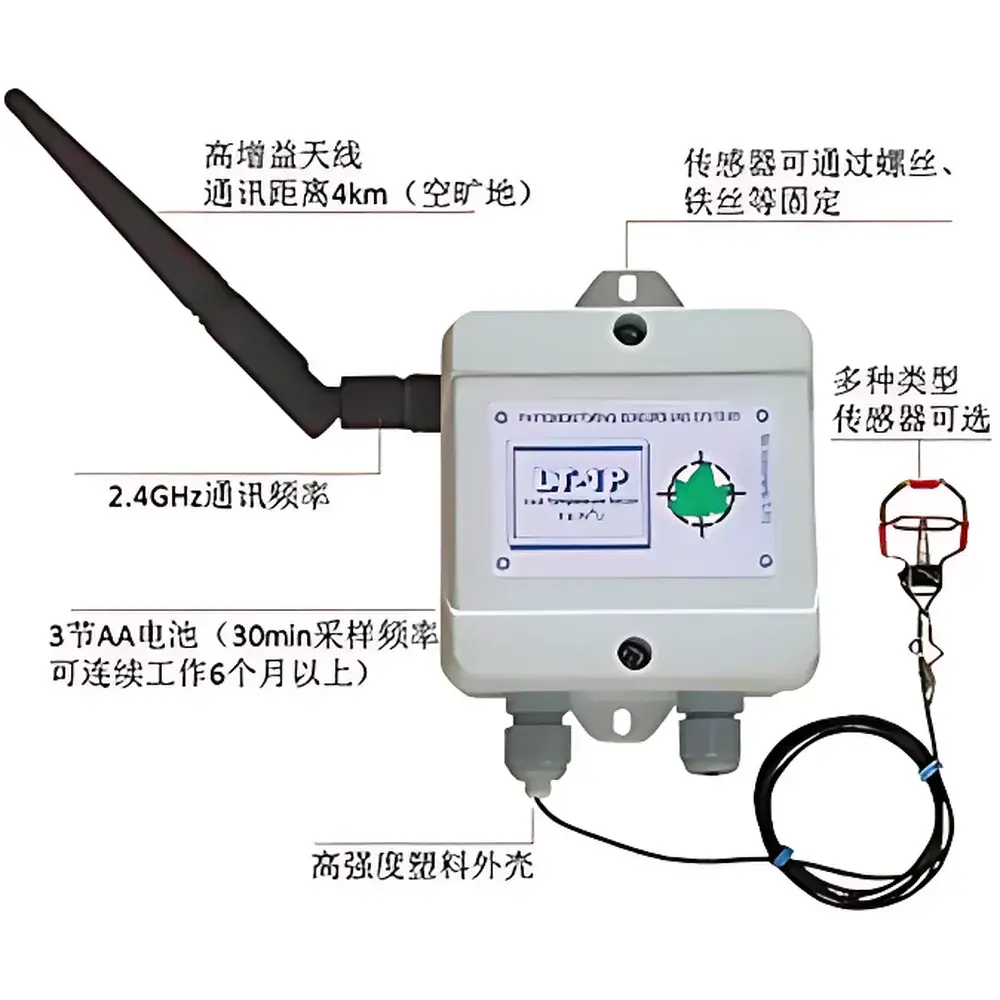
OLAN PM-11z Wireless Plant Physiology and Ecological Monitoring System
| Origin | Israel |
|---|---|
| Manufacturer | OLAN Ltd. |
| Type | Wireless sensor network-based plant physiology & microclimate monitoring system |
| Model | PM-11z |
| Sensor Capacity | 15 direct + scalable via Router repeaters (15 per repeater) |
| Sampling Intervals | 1–1440 min (configurable) |
| Onboard Storage | SD card (host), 4096 data points per sensor |
| Power | Sensors—3×AA batteries (≥6 months) |
| Compliance | Designed for ISO 17025-aligned field research, GLP-compliant data logging architecture |
Overview
The OLAN PM-11z Wireless Plant Physiology and Ecological Monitoring System is a modular, field-deployable sensor network engineered for long-term, non-invasive measurement of plant physiological responses and concurrent microclimatic variables. Operating on a robust 2.4 GHz ISM-band wireless mesh architecture, the system implements a hierarchical topology: sensors transmit time-synchronized measurements to a central PM-11z host unit, which aggregates, timestamps, and stores data locally on removable SD media. Where terrain, canopy density, or spatial scale limits direct radio line-of-sight, optional Router wireless repeaters extend both node count and geographic coverage without compromising timestamp integrity or measurement synchronization. Unlike wired or single-point loggers, the PM-11z supports distributed, multi-parameter observation across heterogeneous plots—enabling correlation analysis between stomatal conductance proxies (e.g., leaf temperature differentials), stem water potential indicators (stem diameter variation), carbon assimilation drivers (PPFD, PAR), and edaphic constraints (soil moisture, EC, temperature). Its design adheres to principles of ecological metrology: low-power operation ensures minimal disturbance to natural diurnal cycles; calibrated analog-to-digital conversion preserves signal fidelity; and deterministic sampling intervals support Fourier-based phenological trend detection.
Key Features
- Scalable wireless topology: 15 sensors directly connected to PM-11z host; each Router repeater adds up to 15 additional nodes—supporting deployments spanning hectares with sub-100 m node spacing.
- Long-duration autonomous operation: Sensor nodes powered by standard AA batteries (typical service life ≥6 months at 10-min sampling); host and repeaters compatible with 12 VDC solar power (15 W panel + 7 Ah battery recommended).
- Precision-calibrated sensor suite: Includes traceable leaf temperature (±0.1 °C), stem diameter change (0.002 mm resolution), fruit expansion (0.02 mm resolution), PPFD (400–700 nm, ±5% accuracy), and volumetric soil moisture (0–100% vol, TDR-based).
- Deterministic data management: All sensors store 4096 timestamped records internally; configurable upload intervals (1–1440 min) ensure temporal alignment across heterogeneous parameters.
- Field-hardened mechanical design: IP67-rated enclosures for sensors; UV-stabilized housings; 3-m mast-compatible mounting hardware for meteorological integration (DWS-Z station, solar panel).
Sample Compatibility & Compliance
The PM-11z accommodates diverse botanical morphologies—from herbaceous monocots (via SA-20z height sensors) to woody perennials (DE-1z trunk growth monitors)—without requiring destructive installation. Stem sensors (SD-5z/SD-6z) employ non-compressive, spring-loaded clamping mechanisms; leaf temperature probes (LT-1z/LT-LRz) use contact or non-contact configurations validated against ASTM E1933-19 reference methods. System firmware enforces audit-trail metadata: each data packet includes sensor ID, UTC timestamp, battery voltage, and CRC-16 checksum. Data files comply with FAIR principles (Findable, Accessible, Interoperable, Reusable) and are structured in CSV/JSON formats compatible with R, Python (Pandas), and MATLAB workflows. While not FDA 21 CFR Part 11-certified as a standalone device, its logging architecture supports GLP/GMP-aligned validation protocols when deployed under documented SOPs—including calibration certificate traceability to NIST-traceable references.
Software & Data Management
The included PC application (Windows/macOS) provides full configuration control: users define sampling intervals per sensor channel, set automatic upload schedules to the host, initiate manual data pulls via USB-connected receiver module, and export time-series datasets with embedded metadata headers. The software does not require cloud dependency—data remains on local storage unless explicitly exported. Exported files include columnar headers specifying parameter name, unit (e.g., “PPFD_μmol_m2_s”, “StemDiameter_mm”), sensor serial number, and acquisition timestamp (ISO 8601 format). Batch processing tools enable interpolation of missing intervals (linear or spline), outlier flagging based on user-defined sigma thresholds, and automated generation of diurnal cycle plots. Raw binary logs from the SD card are also accessible for third-party analysis using provided documentation of the OLAN binary frame structure.
Applications
- Irrigation scheduling optimization via real-time coupling of soil moisture depletion rates (SMS-5z) with stem shrinkage dynamics (SD-5z/SD-6z) and canopy temperature differentials (LT-LRz).
- Phenological stage modeling using integrated fruit expansion trajectories (FI-Sz/FI-Mz) alongside thermal time accumulation (ATH-2z/ATH-3z) and photosynthetic photon flux density (PRI-1z).
- Climate resilience assessment across genotypes: comparative analysis of stomatal response lags (leaf vs. air temperature differentials) under controlled drought stress protocols.
- Ecosystem-scale evapotranspiration estimation by combining sap flow proxies, net radiation (TIR-4z), and vapor pressure deficit derived from ATH-series humidity/temperature pairs.
- Long-term ecological monitoring networks: deployment across elevation gradients to quantify altitudinal shifts in phenophase timing using SA-20z height growth and PRI-1z light capture efficiency.
FAQ
What is the maximum operational range between a sensor and the PM-11z host in open-field conditions?
Typical line-of-sight range is 300–500 m; foliage attenuation reduces this to ~100–150 m in dense canopy. Router repeaters restore full link budget—each repeater extends effective range by an additional 300 m.
Can sensor calibration certificates be provided with NIST traceability?
Yes—OLAN supplies factory calibration reports for all optical (PRI-1z, TIR-4z), thermal (LT-series, ATH-series), and dimensional (SD-, FI-, DE-series) sensors, referencing NIST-traceable standards per ISO/IEC 17025 requirements.
Is the system compatible with third-party data platforms such as EnviroDIY or FRAMES?
Raw CSV exports are fully interoperable; JSON schema documentation enables custom API ingestion. No proprietary protocol lock-in exists—the system operates as a local edge logger, not a cloud-dependent appliance.
How is time synchronization maintained across distributed nodes?
The PM-11z host broadcasts periodic time-sync packets; all sensors adjust internal RTCs within ±100 ms drift per month, verified during firmware updates and data download sessions.
Does the software support automated alerting (e.g., SMS/email) for threshold breaches?
No—alerting is intentionally omitted to preserve offline operability and data sovereignty. Users implement external notification logic via exported CSV feeds in their preferred scripting environment (e.g., Python cron jobs, Node-RED).



